


2026 Statehouse Snapshot: Week 10
Kansas Action for Children | March 20, 2026
Want to receive this weekly recap as soon as it's released? Sign up for our emails here.
It Was a Good Week in the Kansas Legislature
Maybe it was the nice spring breeze, but we left this week of the legislative session with hope and progress on good policies that will make Kansas a better state to be a kid.
The Senate passed several measures improving child care, housing protections, and school meals. In the House, we’re continuing to see harmful bills amended in response to dozens of advocates’ concerns. We also saw the Governor hold a public signing on Senate Sub. for Sub. for HB 2299, the cell phone restriction in K-12 schools.
This progress was not by accident, but is a direct result of lawmakers working with each other (and advocates!) to prioritize kids over politics. This week was a stark reminder of what’s possible when people set aside party labels to focus on what’s best for kids. Any one of these policies could have been blocked by a lack of willingness to listen to another perspective. But many lawmakers have chosen to listen to the research and stories advocates have brought to their attention.
As we enter the last week of the legislative session, we hope this sentiment will continue when lawmakers finish their work in the coming days. Kansas kids are counting on it. If this week is any indication, there is every reason to believe there is more room for bipartisanship, as long as lawmakers are willing to work across the aisle.
Tenant-Friendly Policies Find a Home in Kansas
One of the more encouraging things that has emerged this session has been the tone shift around housing and homelessness. In 2023, a strong coalition was created to oppose the proposal to criminalize homelessness across the state. And just last year, lawmakers greatly diminished a program that addressed our state’s shortage of affordable housing.
 This year, however, housing advocates have worked closely with lawmakers on legislation that will improve outcomes for cost-burdened Kansans. Sub. for HB 2357, which would allow Kansas renters to expunge their eviction records three years after the eviction occurs, passed out of the Senate yesterday on a vote of 33-7. During the debate, lawmakers spoke about the affordability crisis and acknowledged that evictions are a leading cause of homelessness. Overall, there seemed to be broad understanding that low-income renters need some help getting back on their feet.

In that same vein, bills that would increase burdens for housing insecure Kansans aren’t seeing the same broad support they may have in past years. SB 391, which would prohibit local governments from passing several renter-friendly housing protections, was on the House floor this week. While it ultimately passed, it didn’t receive the number of votes needed to override a veto from the Governor.
The same themes we saw during the HB 2357 debate were present in this debate and seem to be resonating with many lawmakers. We’re hopeful to see this coalition continue to grow so we can address the housing affordability crisis that so many Kansas families are struggling to navigate.
Progress toward Addressing Childhood Food Insecurity
 Lawmakers across the political spectrum have shown great interest in ensuring kids don’t go hungry. This year in particular, we have seen several proposals considered to expand meals to more kids. We were excited to watch as two of those proposals received broad support on the Senate floor this week.
Sub. for HB 2731 was amended to include a provision that would get $120 in SUN Bucks EBT benefits to an additional 60,000 eligible kids this summer. The amendment easily skated through with little discussion, as lawmakers overwhelmingly seemed to agree with the idea of getting food benefits to more Kansas kids. The bill passed 37-3.
Similarly, Senate Sub. for HB 2402 (which now includes the contents of SB 438) passed out of the Senate this week with a near-unanimous vote. This bill would require eligible boards of education to consider participation in the Community Eligibility Provision, which would allow those schools to take additional federal money to provide free meals to all students regardless of their family’s income. As with HB 2731, the Senate voted to pass this out with very little discussion.
In past years, bills expanding access to food have struggled to even get a committee hearing. This year, however, lawmakers are working alongside food security advocates to keep these bills alive and moving toward the finish line. We’re excited about the opportunity to get more kids fed, and we commend all those who are working to make it happen.
Where Will the House Take SB 363?
 The House Committee on Welfare Reform just barely passed out SB 363, the major public assistance bill, to the full House chamber this week after significantly revising the bill through an amendment.
Of the items they changed, several were in response to advocates voicing concerns about what the bill would mean in practice. Previously, the bill would have implemented quarterly redeterminations for some Medicaid enrollees. Now, the bill moves that to bi-annually and specifically only applies to very low-income parents and caretakers. The Committee also removed household composition from the list of prohibited self-attestation (self-reporting) items, as well as removed a few data matching requirements.
While these amendments addressed several advocates’ concerns, we still cannot support this bill due to the harm it inflicts on qualifying parents and caregivers, who cannot make more than $850 a month for a family of three.
The bill was set to be taken up by the House yesterday before the chamber abruptly adjourned. We wait to see if the House will eventually debate this, if it shows up in conference committee next week, or if it dies at the end of session.
Child Care Legislation Gains Momentum
The Senate considered and passed out two bills this week that are a step in the right direction to bettering the child care system in Kansas.
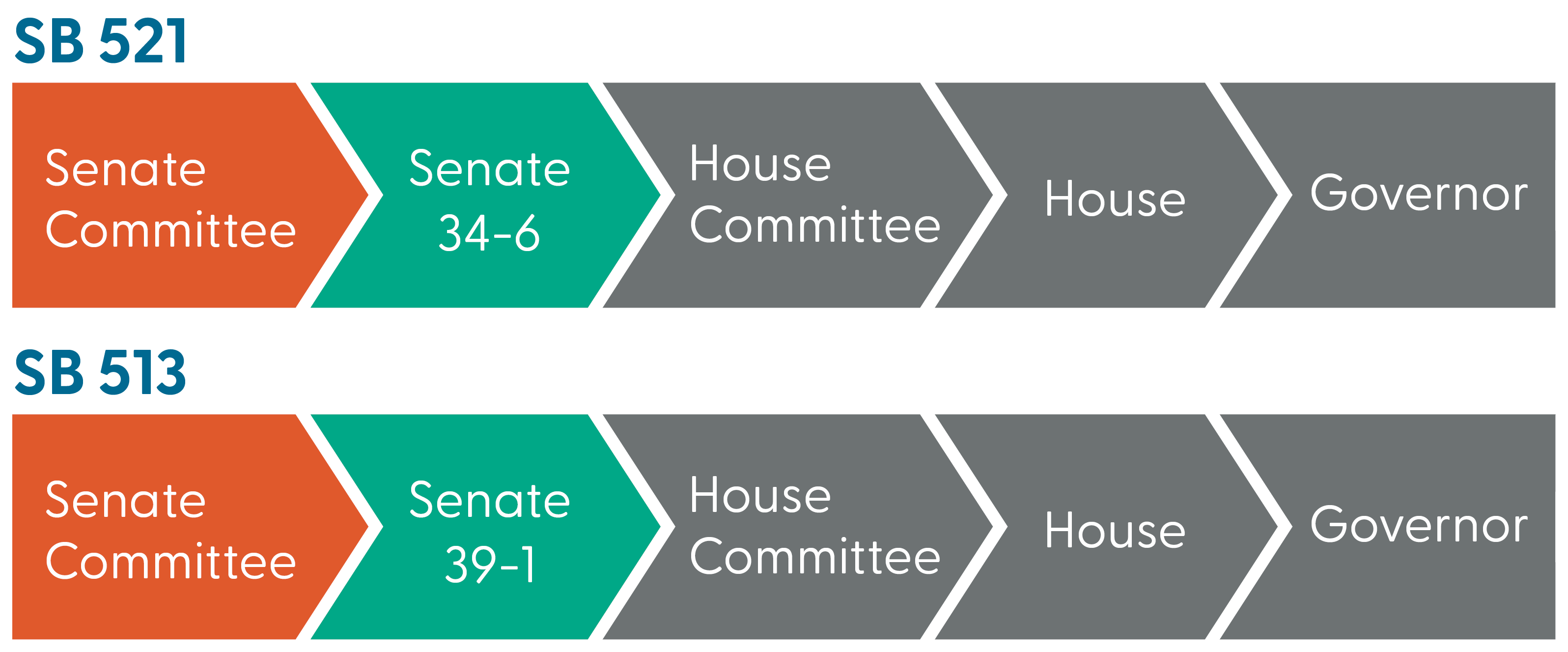 SB 521 modernizes and expands the employer child care tax credit to make it simpler, more generous, and far more useful. The bill passed the Senate this week on a vote of 34-6 after an amendment that restored the refundability of the credit and allowed for certain child care-related contributions to a third party, such as a child care resource and referral organization.
SB 521 now joins SB 513 as the only two child care bills that have advanced this far in the legislative process. SB 513 would improve the Child Care Assistance Program by implementing a streamlined child care subsidy management and payment system. The goal of this modernization is to support direct child care subsidy payments to eligible child care providers. The Senate approved this bill nearly unanimously at a vote of 39-1.
Neither bill has been voted on by the House, making the most likely path forward for them to be bundled with other legislation in a conference committee report next week. As lawmakers continue their work next week, we hope they’ll move these measures forward without bogging them down with divisive policies.
Legislature Racing to the End with Outstanding Property Tax Relief
This week started with a flurry of activity from both the House Committee on Taxation and the Senate Committee on Assessment and Taxation, and it was beginning to look as though the Legislature may finally move on major property tax legislation.

But instead of anything they created this year, the House took up their old idea from 2025. SCR 1603, if approved by voters, would provide for the Legislature to implement a rolling average for residential property valuation for tax purposes. When the House considered it, the measure was amended to allow a future Legislature to freeze or limit property taxes for seniors. As amended, the proposal would likely result in shifting tax burdens from qualifying seniors onto working families.
The House passed SCR 1603 out of the chamber with just the votes needed (84, since it proposes a constitutional amendment). The Senate has already opted to not agree with the revised proposal, setting up a conference committee with just five working days until the end of the regular 2026 session.
The path forward for SCR 1603 remains uncertain since it barely received the necessary votes in the House in its current form. It’s unclear if a conference committee agreement could garner the two-thirds needed in both chambers so it can be placed on the ballot for voters to consider in November.
As we await the next steps on the resolution, Senate Sub. for HB 2745 – which would cap local property tax revenue growth – sits in the Senate Committee on Assessment and Taxation. The full Senate was originally set to consider this bill earlier last week, but it was referred back to committee after SCR 1616 failed in the House. Now, the Committee has reworked this legislation up to the point that it is ready to be moved out of committee, but stopped short of advancing it.
To put it simply, we still have nothing on property taxes as the end of session rapidly approaches. But with all the pieces floating around the Statehouse, a package is likely coming together. We hope the Legislature finishes their work with smart solutions, not short-sighted measures that deliver little tax relief while destabilizing the state budget.
Budget Negotiations Underway

A conference committee finally began meeting this week to sort out the differences between the House and Senate bills and agree a final budget proposal. The conference committee, which includes the Chair, Vice Chair, and Ranking Minority of House Appropriations and Senate Ways and Means, uses this Conference Comparison document to guide their work. Every item on which the House and Senate do not agree is listed. A separate document, called Conference Shorthand, lists budget items that have already been agreed upon and will appear in the bill.
The budget conference committee meets several times to work through their differences. At each meeting, they work line by line through the Conference Comparison document, stating whether they will take the House position or the Senate position. An item is considered complete once the position has been confirmed in two consecutive meetings (i.e., the House agreed to take the Senate position, and the Senate agreed with that position in its next offer). This process continues until all items have been agreed on.
As you may remember, the conference committee is entering negotiations having made a promise before session to cut $200 million from the budget in FY 2027. In reality, however, the current House spending plan is $91.1 million above the FY 2026 budget while the Senate’s is $45.8 million above.
The Legislature is facing the reality that it’s not easy to arbitrarily cut an already slimmed-down state budget. Factors like inflation, an increasing number of Kansans in need of long-term care, rising health care costs, and a need to maintain competitive wages for service providers require significant budgetary additions to simply maintain current services. We will continue to watch how these conflicting factors play out over the next week as the budget is finalized.
What to Expect in Week 11

As we approach the final week of the regular 2026 session, we are noticing the long list of bills the Legislature must get to. Because the House adjourned earlier than expected on Thursday, several items that were set to be taken up are likely to see immediate conference committee action instead.
During the last week of the regular session, the Legislature typically dedicates nearly all of their time settling their differences on bills through conference committees. As a reminder, conference committees are the final process for many bills if the “other chamber” made changes to a bill sent from the "originating” chamber. If there are differences from when the originating chamber passed the bill, they’ll need to confirm they agree with the other chamber’s revisions. The originating chamber may agree (“concur”) and send the bill off to the Governor or disagree (“non-concur") and set up a conference committee to negotiate.
Three members from each chamber then negotiate their differences before the measure goes back to both chambers for an up or down vote. The bottom line is that this is really a process where anything can happen and bills once thought dead are suddenly revived and stuck into the bill at hand. Conference committees are also typically scheduled without much public notice, so it’s difficult for advocates or the public to insert their voices and perspectives.
With time running out and still a lot of work left to accomplish, we’ll be looking to lawmakers to keep the last few days of session transparent and informed by the facts.
Share

