


2026 Statehouse Snapshot: Week 11
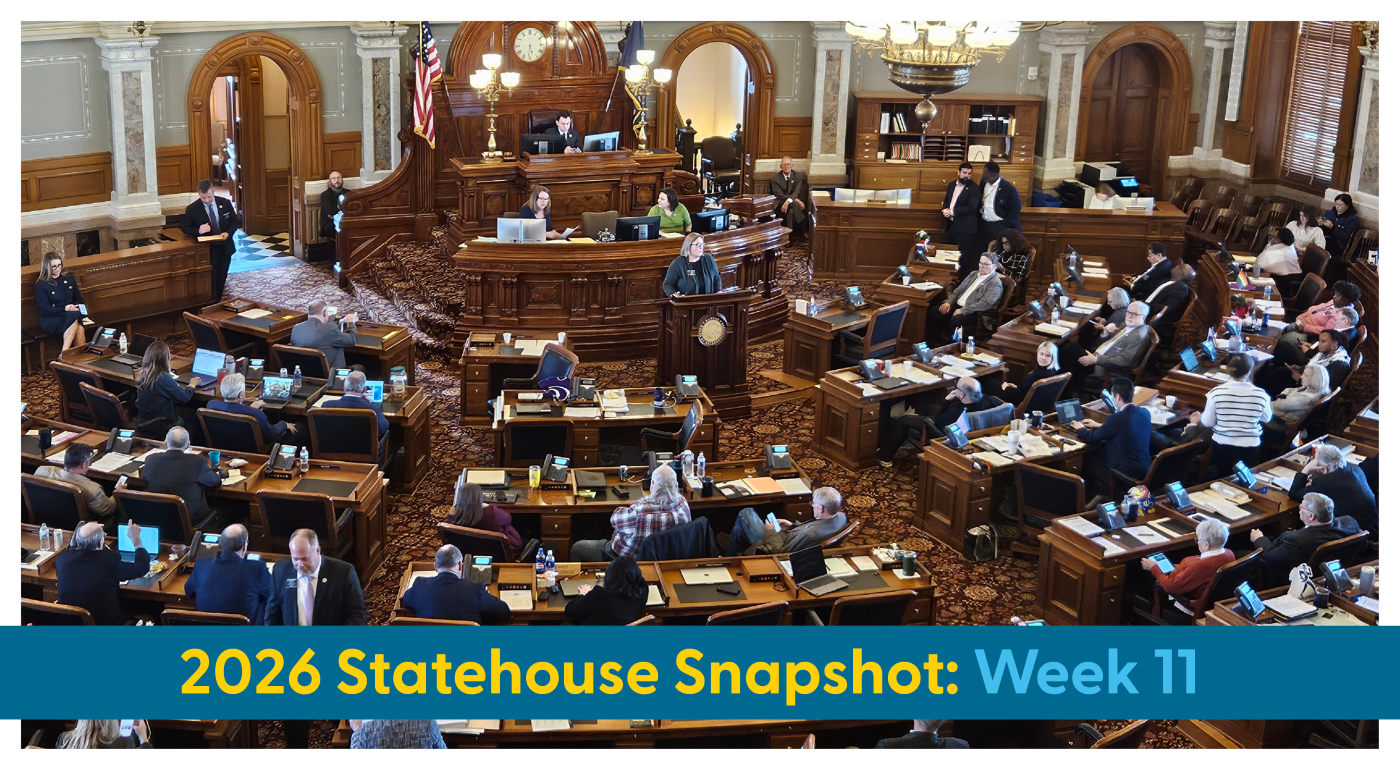
Photo: Representative Wikle speaks in opposition to HB 2731 (previously SB 363).
Kansas Action for Children | March 27, 2026
Want to receive this weekly recap as soon as it's released? Sign up for our emails here.
Late Night End to 2026 Session
Just before midnight last night, the Legislature finished its work for the regular portion of the 2026 session.
While several bills we oppose passed this week, advocates made inroads with several lawmakers who will be key to keeping these bills from becoming law. And, as lawmakers negotiated bills through the conference committee process, we saw some additional harmful provisions removed from the final deals.
As you’ll see throughout the rest of this week’s summary, many bills are several votes shy of the threshold needed to override potential vetoes by the Governor.
This week served as a reminder of what’s possible when advocates, lawmakers, and the public are willing to engage in conversations about how Kansas kids and families can thrive. In vote after vote, we are seeing progress in getting this message across and hope that these lawmakers will hold firm when they come back for the Veto Session on April 9.
Thank you for staying engaged with us this session. We’ll send our next Statehouse Snapshot just before lawmakers return for Veto Session. If there are any opportunities for you to contact your lawmaker in anticipation of what the Legislature has in store for Veto Session, we’ll make those available.
HB 2731 (previously SB 363) Passes, but Doubts Remain
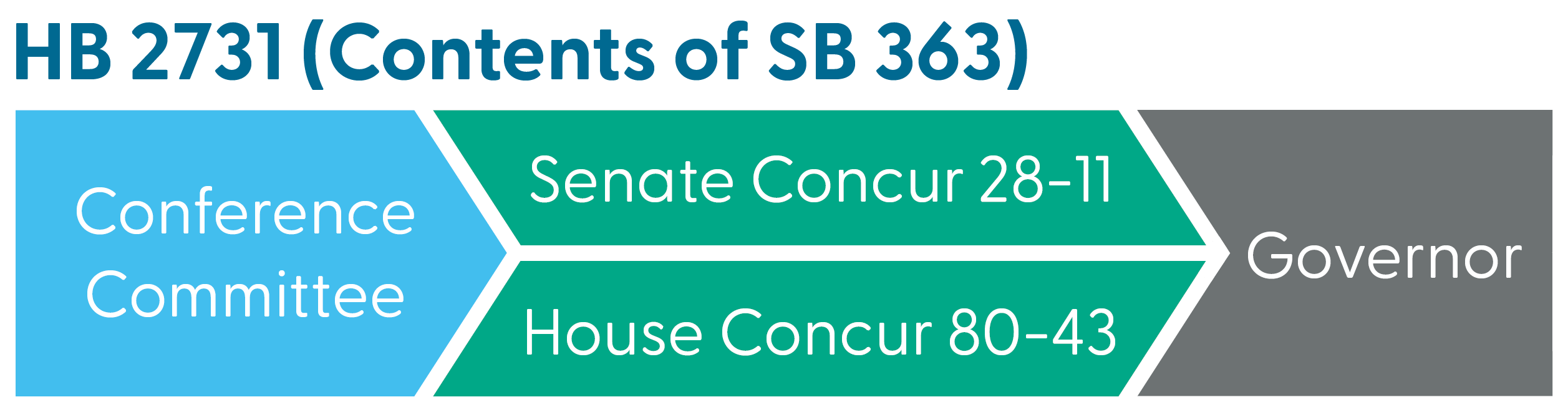
We started conference committee week uncertain what would happen to SB 363 after the House abruptly adjourned last week and didn’t take it up in the House. If you remember, this bill adds more paperwork requirements for public assistance in addition to codifying parts of the “One Big, Beautiful Bill” passed by Congress last summer.
This week, a conference committee was quickly convened to move this legislation along. During negotiations, the conference committee placed a majority of the contents of SB 363 into Sub. for HB 2731, removed the provision allowing for more frequent eligibility checks for some Medicaid enrollees, added household composition back into the bill to disallow it as a form of self-attestation, and added a previous provision that would direct the Kansas Department for Health and Environment to pursue a continuous eligibility waiver for the Intellectual / Developmentally Disabled (I/DD) waiver population.
The final version of the bill passed today in the Senate 28-11 and the House 80-43. With the House’s failure to reach the supermajority level of votes needed to override a Governor’s veto, we’re hopeful advocates can keep this from being cemented into law.
As it left conference committee, we were relieved the worst part of the bill (more frequent Medicaid redeterminations) was left out, but still remain concerned about how the remaining parts of the bill will play out in reality and burden vulnerable Kansans’ access to public assistance programs.
About 1 in 5 Kansas kids are food insecure and don’t know where their next meal is coming from, and more than 51,000 Kansas kids went uninsured in 2024. This bill does nothing to make these data points go in the right direction.
If the goal of SB 363 (now HB 2731) is to ensure tax dollars are used effectively so eligible Kansans can access SNAP, Medicaid, TANF, and Child Care Assistance, then this bill falls far short of that aspiration. In fact, this bill is the exact opposite of government efficiency. It does nothing to ensure the neediest in the state keep critical benefits and will overwhelm agencies and add millions in extra costs to the state. And, most importantly, eligible families, children, and people with disabilities will face a higher level of scrutiny to keep their benefits.
There are better ways that lawmakers could approach streamlining government systems, and this bill isn’t the answer. In the next few weeks, we’ll be working to ensure a potential Governor’s veto is sustained when lawmakers return on April 9.
Progress on Keeping Kids Fed, but More to Do Next Year
When it comes to childhood food security, it’s hard to know how to feel about the way this session has gone. Lawmakers have gone back and forth on food policies, adding provisions into bills to help more eligible kids enroll in SUN Bucks and legislating competing proposals on the Community Eligibility Provision (CEP) that gets more kids fed at school.
Ultimately, it has been a wash on protecting access to food. We fought against HB 2731 (formerly SB 363), which sought to codify some of the worst SNAP provisions of H.R. 1 (the “Big, Beautiful Bill”) into state law, but the bill ended up passing favorably through both chambers. Thousands of children have already lost their SNAP food assistance since H.R. 1 passed, and thousands more could still be at risk.

On the other hand, both chambers passed Senate Sub. for HB 2402, which requires school districts to consider opting into the Community Eligibility Provision. This could greatly increase childhood food security by providing tens of thousands more Kansas students with free school meals, all via federal funding.
We also advocated to automatically extend Summer EBT benefits to 60,000 more eligible Kansas kids this summer, and we watched joyfully as the Senate voted 37-3 in favor of it. Unfortunately, our success on this provision was short-lived when, without much discussion, a conference committee left this out of the bill when it added the remaining provisions of HB 2731 into HB 2004.
A bright spot this year was that the “fraud, waste, and abuse” narrative that was often present last session has lost some of its gravity. Lawmakers this year still expressed concern about fraudulent actors, but also seemed to understand the impacts that endless red tape has on struggling Kansans.
Perhaps next year we’ll make even more progress and begin to strike a better balance between safeguarding program integrity and ensuring Kansans have access to the resources they so badly need and deserve.
Legislature Adopts Housing Protection
Safe and affordable housing has been a positive topic of conversation this year. In past years, advocates have commonly needed to defend against further erosion to housing protections. This year, SB 391 was the only harmful housing bill we were closely following, and it has failed to get the votes needed in the House to override a potential Governor’s veto.
Instead, it has been refreshing to spend so much of our time this year focusing on positive possibilities. A strong coalition of advocates came together over the past few years to address the housing affordability crisis at the statewide level, and we are seeing their actions begin to pay off. A flurry of bills were introduced this session that aimed to seek a better balance between renters and their landlords. While most of these bills didn’t make it very far through the process, we were pleased to see the increased interest and bipartisan support, and even more pleased to see a great bill get sent to the Governor’s desk today.

We anxiously waited all week for a conference committee to be announced for Sub. for HB 2357 so that the House and Senate could hammer out their differences, and that finally happened on the final day of the regular 2026 session. Both chambers agreed to retain all the best parts of the bill, including the requirement for courts to consider mediation during eviction proceedings and the ability for renters to expunge their eviction record three years after the eviction occurred.
During the conference committee, members proposed bundling another good renter protection bill (SB 415) with Sub. for HB 2357. While the proposal was rejected, members from both chambers committed to pursue the policy next session. This was a great way to wrap up housing discussions for this session and we look forward to working with stakeholders during the interim to build the momentum toward passing more great legislation in 2027.
Stalled Health Policies from Previous Years Cross the Legislative Finish Line
For several years, Kansas Action for Children has been advocating for several health items that have been previously caught up in external politics. But this year, we’re finally able to celebrate their legislative success.

After nearly five years of work, the Children’s Health Insurance Program (CHIP) eligibility fix (SB 271) was passed with a unanimous vote in both chambers this week. We’re grateful to the lawmakers and partners who weighed in and kept this issue moving over these past several years to ensure Kansas families are no longer impacted by a year-specific reference in state law. Now that a permanent fix is set to become law, Kansas kids falling within a certain household income are guaranteed CHIP coverage, just like children in other states.
We also saw longtime work by public health partners to finally get expedited partner therapy across the finish line when both chambers passed Sub. for HB 2250. The final version of this bill also included updating state law to account for future approved methods of delivering epinephrine to children in schools by school nurses.
We look forward to the Governor signing both pieces of legislation soon.
Property Tax Proposals Pass in Final Hours
After a slow start to the week, the Conference Committee on Senate and House Taxation started negotiations over SCR 1603 late this week. Initially, as passed by the Senate last year, this constitutional amendment would have rolled the assessed valuation of any real property back to 2022 levels and capped future growth at no more than 3%. The House amended the legislation by changing the hard cap to a rolling average of valuations, removing the 2022 rollback, and limiting the changes to residential and commercial property.
To put it simply, the two chambers were nowhere close to an agreement going into negotiations. Several meetings later, the Tax Conference Committee finally reached an agreement that heavily favors the Senate position but is much less restrictive.
Instead of a 3% cap with a 2022 lookback, the final legislation provides for a 9% cap with a 2024 lookback, completely removing any mention of a rolling average for agricultural, residential, and commercial properties. Notably, the final resolution also gives future legislatures latitude to define certain terms and to lower the 9% cap.

Despite the Tax Conference Committee heavily compromising their positions, the House rejected the measure. While we agree Kansans need property tax relief, this measure, if eventually approved by voters, would have cost the state more than $150 million per year in lost revenue. Unfortunately, due to considerable tax cuts in recent years for economic development and income tax changes, the state just cannot afford this type of across-the-board tax cutting. Instead, with what is within the state’s ability, the Legislature should target tax relief to the Kansans who need it most.
The House "reconsidered" their vote of failure on SCR 1603 immediately to save the bill from total demise, so we'll likely see something come out of this measure in Veto Session.
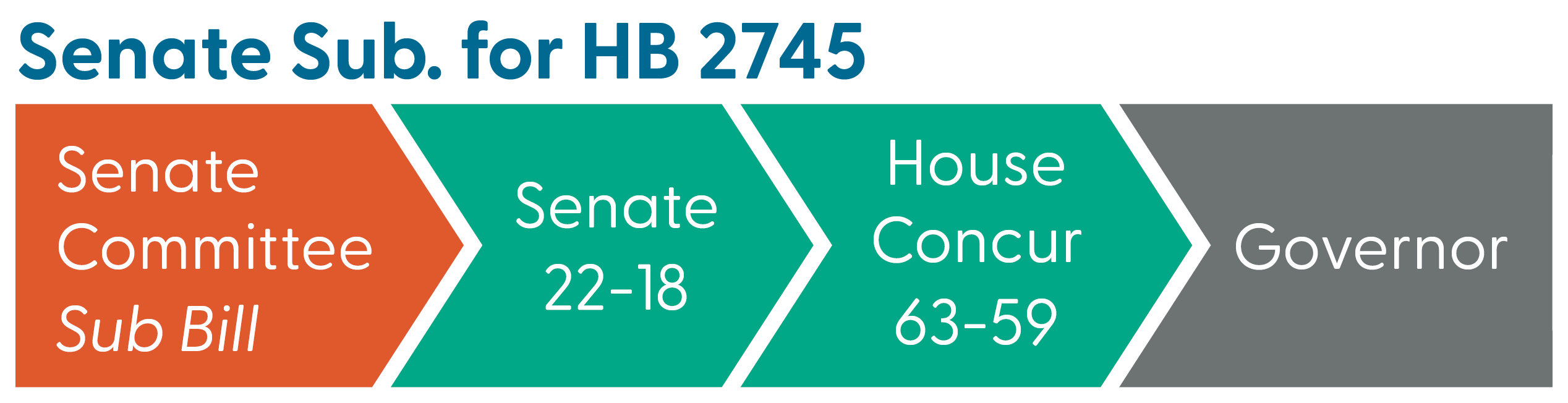
Beyond a constitutional amendment proposal, the Legislature also hashed out their differences on HB 2745, which allows voters to protest their property tax increases if certain conditions are met. When originally proposed by the House, we were supportive of this legislation because it could slow the increase in property tax bills by imposing a reasonable limit on growth in property tax revenue at the local level. But substantial changes made by the Senate make this levy limit much more restrictive and leave us concerned about the impact to schools and the services provided by cities and counties.
After barely passing in the Senate on Friday evening, the House narrowly approved the bill. Neither chamber came close to a veto-proof majority vote, leaving the future of this legislation in doubt.
The Legislature will have a final chance to address property taxes or other options when they return to Topeka on April 9.
Budget Passes Despite Wide Discontent with Spending Plan
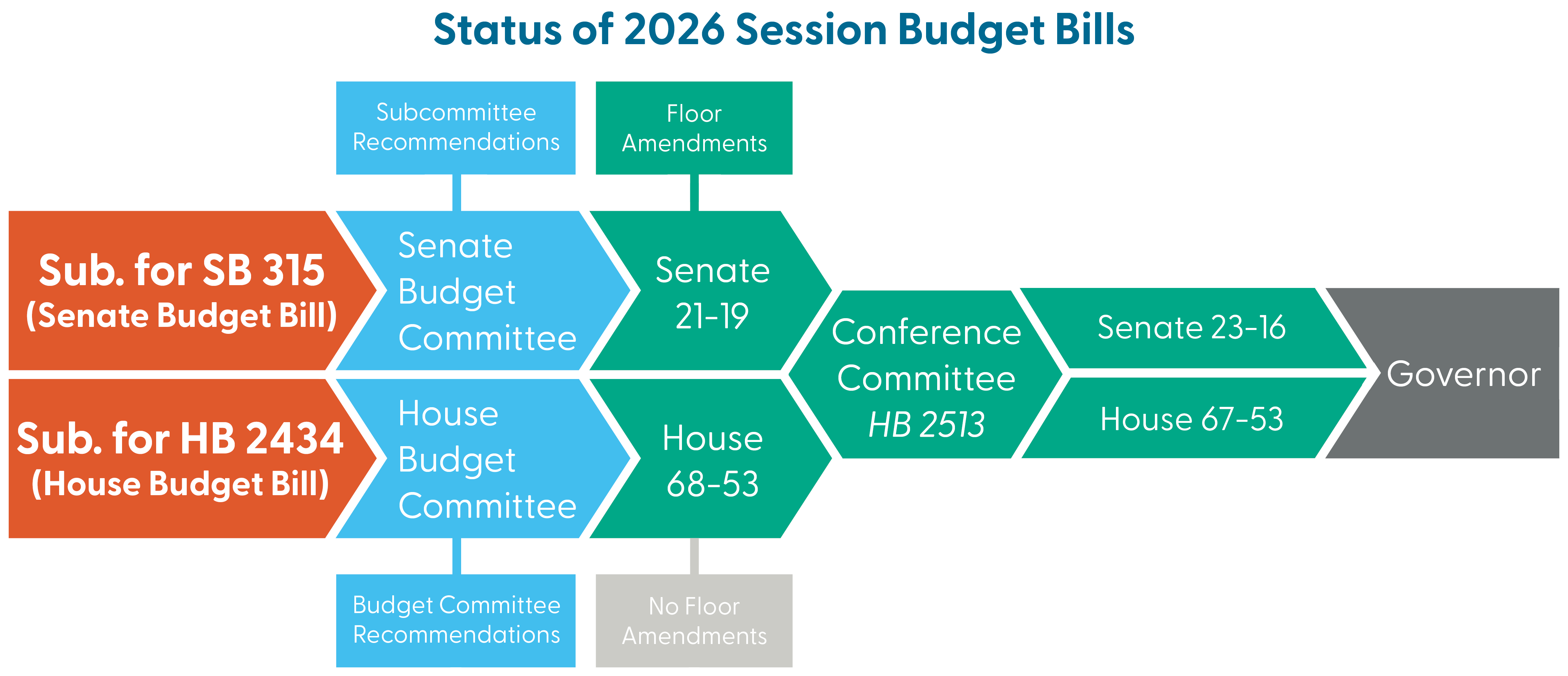
The House and Senate passed the final budget this week, and, though it was an up or down vote, that did not stop legislators from airing their grievances.
One set of lawmakers voiced frustration that the budget continues a trend of spending more than the state brings in. They pointed out that the FY 2027 budget is an increase of $28.7 million state general funds over last year’s approved budget and expenditures exceeding state revenue by $475.3 million. Furthermore, while a healthy State General Fund ending balance and Budget Stabilization Fund allow the state to continue spending at the current rate, these backstops will not be available for long unless spending is curbed in future years.
Another set of lawmakers voiced concern that the budget doesn’t do enough for Kansans, including not fully funding important services like K-12 special education and not appropriately raising employee state salaries. The final budget includes an additional $6.0 million for special education and a 1% pay increase for state employees, neither of which, many legislators argued, comes close to meeting the needs of the state.
Caught in the middle of these two perspectives are the legislators forced to reconcile a need to cut spending with the reality that programs and services are becoming more expensive and seeing increased demand. It costs more each year to simply sustain employee salaries, health insurance for children, and K-12 education at a stable level, much less increase the reach of programs. At the same time, tax cuts passed in the past several sessions have greatly decreased revenue coming into the state, forcing the need to spend less.
This year’s budget bill includes increased state spending for important services, including the Children’s Health Insurance Program, SNAP, and several HCBS waivers. It also includes funding to get the new Office of Early Childhood up and running. On the other side of the coin, the Mental Health Intervention Team took a funding hit, state agencies will be required to cut operational costs by 1.5% for the second year in a row, and several requests from agencies went unfunded.
Even in times of plenty, the state budget is complex and full of difficult decisions, which just further reflects the priorities of the Legislature. It’s unfortunate this year’s spending plan doesn’t do more for vulnerable Kansans, but we’re heartened by the lawmakers on both sides of the aisle who stood up for those individuals through their committee work, their comments, and their votes. As lawmakers close out this year’s work on the state budget, we hope they’ll keep in mind the flexibility needed in future years to fund the programs that help the neediest Kansans.
All Eyes on the Governor

The Legislature is set to return April 9 for Veto Session, at which time lawmakers will finish any outstanding business and attempt to override the Governor’s final vetoes. As a reminder, the Governor has 10 calendar days from the time a bill is sent to her to sign, veto, or let a bill become law without her signature.
Here are some of the bills we’re watching that could receive a veto:
-
Sub. for HB 2731 (previously SB 363), the public assistance bill that would add paperwork hurdles for enrollees and codify parts of the “Big, Beautiful Bill,” passed the House 80-43 and the Senate 28-11.
-
SB 391, the bill banning local governments from implementing several renter-friendly housing policies, passed the House 76-48 and the Senate 29-11.
- Line items in HB 2513, the state budget plan. The budget package received a Senate vote of 23-16 and a House vote of 67-53.
Bills we’re hoping to see a quick signature from the Governor:
-
SB 271, which includes a fix to the Children’s Health Insurance Program (CHIP) that we have been advocating about for years. It passed unanimously by both chambers.
-
Sub. for HB 2250, which includes language to modernize the ways school nurses can administer epinephrine and allows for expedited partner therapy to treat sexually transmitted diseases.
-
SB 232, the Born to Invest Act that would enable the State Treasurer’s Office to communicate with new parents about wealth-building accounts.
-
Sub. for HB 2357, which would allow for expungement of eviction records if certain conditions are met.
- Senate Sub. for HB 2402, which requires certain school districts to consider opting into the Community Eligibility Provision that helps thousands more Kansas kids access free school meals.
KAC will be taking a break from the Statehouse Snapshot next Friday, but we’ll still be hard at work preparing for what’s in store starting April 9! We’ll give you a quick Veto Session preview before then.
Share

