


2026 Statehouse Snapshot: Week 8
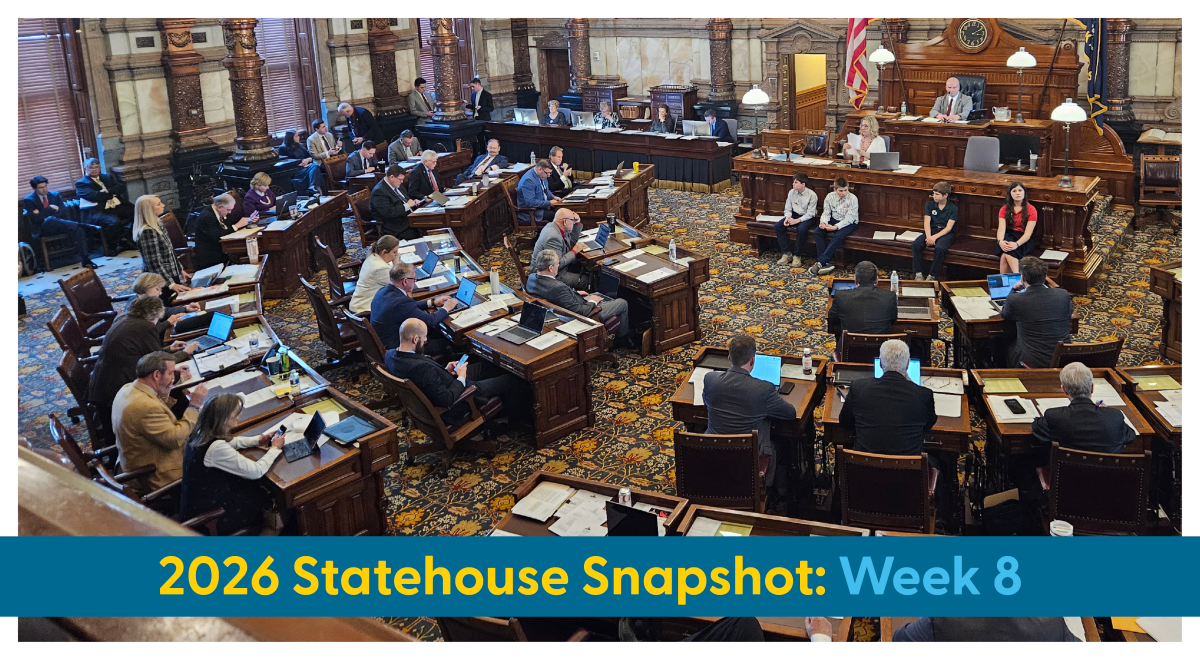
Photo: The Senate debated SB 363 on the floor on Thursday.
Kansas Action for Children | March 6, 2026
Want to receive this weekly recap as soon as it's released? Sign up for our emails here.
Senate Charges Ahead with Public Assistance Changes
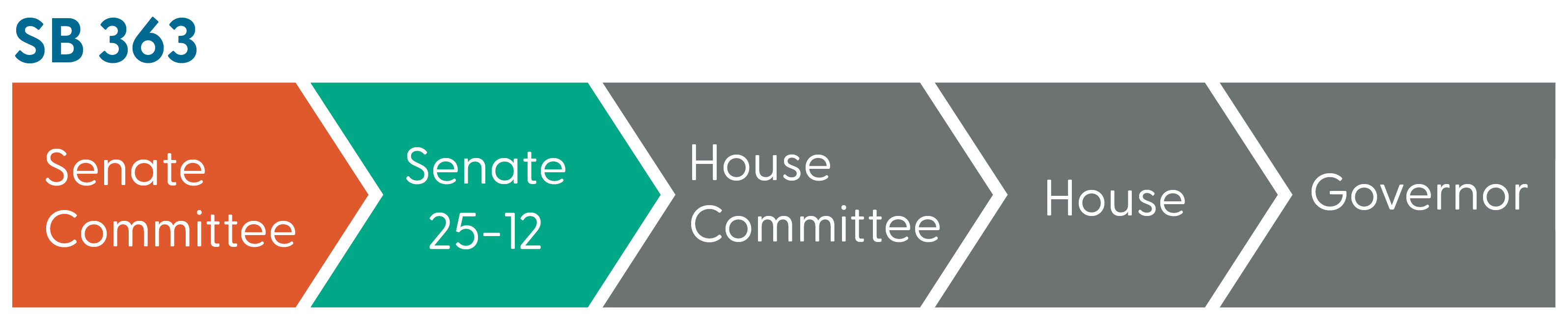 The Senate passed SB 363, which would add multiple new hurdles to people eligible for public assistance programs like Medicaid and SNAP, at a vote of 25-12. Debate was lengthy, with one Senator even claiming that the bill is “designed to strengthen public assistance programs by ensuring that the truly needy receive the resources they need and simply codifies (federal) HR 1.”
But, as advocates have been telling Senators for weeks, the bill goes far beyond aligning with new federal law. Together, many provisions will make it much harder for our most vulnerable Kansans to keep their Medicaid and SNAP – not strengthen and simplify their access to the benefits they are eligible for.
Supporters also conflated national headlines about fraud, waste, and abuse onto Kansans receiving public assistance, arguing that SB 363 “takes several common-sense steps to restore accountability” to stop “draining finite resources from Kansans who actually need the help.”
Yet, opponents of the bill raised the struggles vulnerable Kansans eligible for public assistance already face navigating daily life, and how many provisions of this bill – particularly the added requirement to recheck Medicaid enrollees’ eligibility every three months – will make it even harder for them to keep coverage. While the Senate amended the bill to remove children from the quarterly requirement, an amendment to entirely remove this particularly harmful provision failed by only a few votes.
In response to what KAC and others have raised concerns about, a recurring point made by supportive Senators was that children are not impacted by this bill. While we are relieved that the 225,000 children on Medicaid are no longer caught up in the quarterly redeterminations section, they, as are every Kansan enrolled in public assistance programs, are still impacted by other parts of the bill. This includes official proof required for every aspect of an applicant’s eligibility and the bill’s requirement of legislative approval for any program waivers.
Several populations on Medicaid are still subject to the new quarterly redetermination checks, including low-income parents and caregivers making around $12,000 or less yearly (the amount varies depending on household size) and those in other Medicaid categories who are not explicitly exempted in the bill (like those struggling with mental health conditions who are enrolled in Medicaid).
And while we also support a piece of the bill that provides for continuous eligibility for the IDD waiver population, all populations are still caught up in other burdensome requirements of the bill.
While SB 363 supporters have framed this bill as necessary to protect public assistance for the “most needy,” the reality is that it will result in the most vulnerable Kansans losing help that helps them access health care or have enough to eat. Kansans are already struggling to navigate complex program requirements. Rather than listening to the people who know these systems best, the Senate has given into a narrative that vilifies the people most in need.
As the measure moves to the House for its work, we hope lawmakers will listen closely to the many advocates who have been raising the alarm on this bill rather than the bill’s singular supporter from the Senate hearing.
Kansas Shows an Appetite for School Meals

A positive development we’ve seen this session is a focus on expanding access to free school meals. On the House side, amendments to the budget were offered in committee and on the floor to eliminate the co-pay for the 34,000 students across the state who receive reduced-price school meals. While neither attempt received enough votes to pass, both efforts found some bipartisan support.
Additionally, committees in both chambers have held hearings for bills (HB 2637 and SB 438) that would require schools to consider opting into the Community Eligibility Provision, which would allow qualifying schools to use federal funds to provide free meals to every student, regardless of their family’s income.
The evolution of SB 387 is a perfect representation of the growing interest in the expansion of free school meals. This bill was highly concerning when it was first introduced, as its two main components would have created roadblocks preventing schools from opting into CEP and, to some degree, stripped at-risk funding from schools. But before the bill made it out of the Senate Committee on Government Efficiency, it was positively amended to eliminate the reduced-price meals co-pay.
Still a bad bill otherwise and one we’re unable to support at this time, it barely passed out of the Senate with a 22-18 vote and was then sent to the House Education Committee.
During the committee hearing earlier this week, there were strong indications that the provision preventing schools from participating in CEP will be removed when the committee works the bill next week. We’re also expecting amendments to the component that harmed at-risk funding.
We will see what actions the Committee may take, but if the reduced-price co-pay provision remains and the other two are eliminated or at least heavily amended, what started as an extremely harmful bill may turn into a bill that expands access to school meals without harming schools otherwise.
Cell Phone Bill Passes Senate with Bipartisan Support
As the Senate’s last item of business this week, the chamber took up its version of the cell phone restriction bill, Senate Sub. for Sub. for HB 2299. It passed with significant bipartisan support, ending with a vote of 32-4.
The Senate’s passage of the cell phone ban bill marks an important step toward creating safer, more focused learning environments for Kansas kids. After significant discussion and compromise, the measure is well‑positioned for effective implementation should it become law. The bill now heads to the House, where lawmakers will decide whether to accept the Senate version or convene a conference committee to refine it further.
CHIP Fix Progress
The House Health Committee heard and then quickly worked SB 271, which fixes a long-standing error in state law regarding eligibility for the Children’s Health Insurance Program (CHIP). The bill’s next stop is the House floor. As this is a policy KAC has been working on for nearly five years, we hope Representatives will move it forward without any issue.
The House Health Committee also held hearings on two other bills we’re supportive of. SB 328 address epinephrine delivery systems in schools, updating the law to apply to new delivery systems and future ones approved by the FDA. SB 448 allows expedited partner therapy to treat sexually transmitted diseases, which can be particularly harmful for pregnant women and newborns. Both bills are great for kids and will hopefully continue to move forward with strong support in both chambers. The next step is for the Committee to work the bills and pass out to the full House chamber.
House Tax Hears Vaping Tax Bill
The House Committee on Taxation held a hearing on HB 2783, which would increase the tax on e-cigarettes and credit the new revenue to the Children’s Initiatives Fund (CIF). KAC gave verbal testimony in support of the legislation.
Despite the need for finding an additional funding stream for the CIF and e-cigarettes being a close match to how the CIF is already funded, the Committee seemed to have little appetite for the bill.
Several lawmakers voiced concern about what the tax would mean for owners of vape shops, who could see a hit to their business if consumers had to pay higher prices.
While it doesn’t seem likely that the bill will go any further this session, we're grateful the hearing put a spotlight on the need for additional revenue to support the CIF and on a licensing issue that exists among sellers of vape products. According to testimony by opponents of HB 2783, there are dozens of businesses in Montgomery County alone that are selling disposable vape products but have not received a consumable materials license.
The consumable materials license, which is required for vape shops, is how the Kansas Department of Revenue keeps track of who should remit the tax on e-cigarettes. For vape shops, there is really no way around this licensing. But for companies that sell the closed-system products as a part of their business (like gas stations) there is apparently a large gap in compliance.
Lawmakers seemed more open to generating more revenue by addressing this issue, but with little time remaining in this session, that will be an opportunity for next year.
Senate Budget Proposal Squeaks By
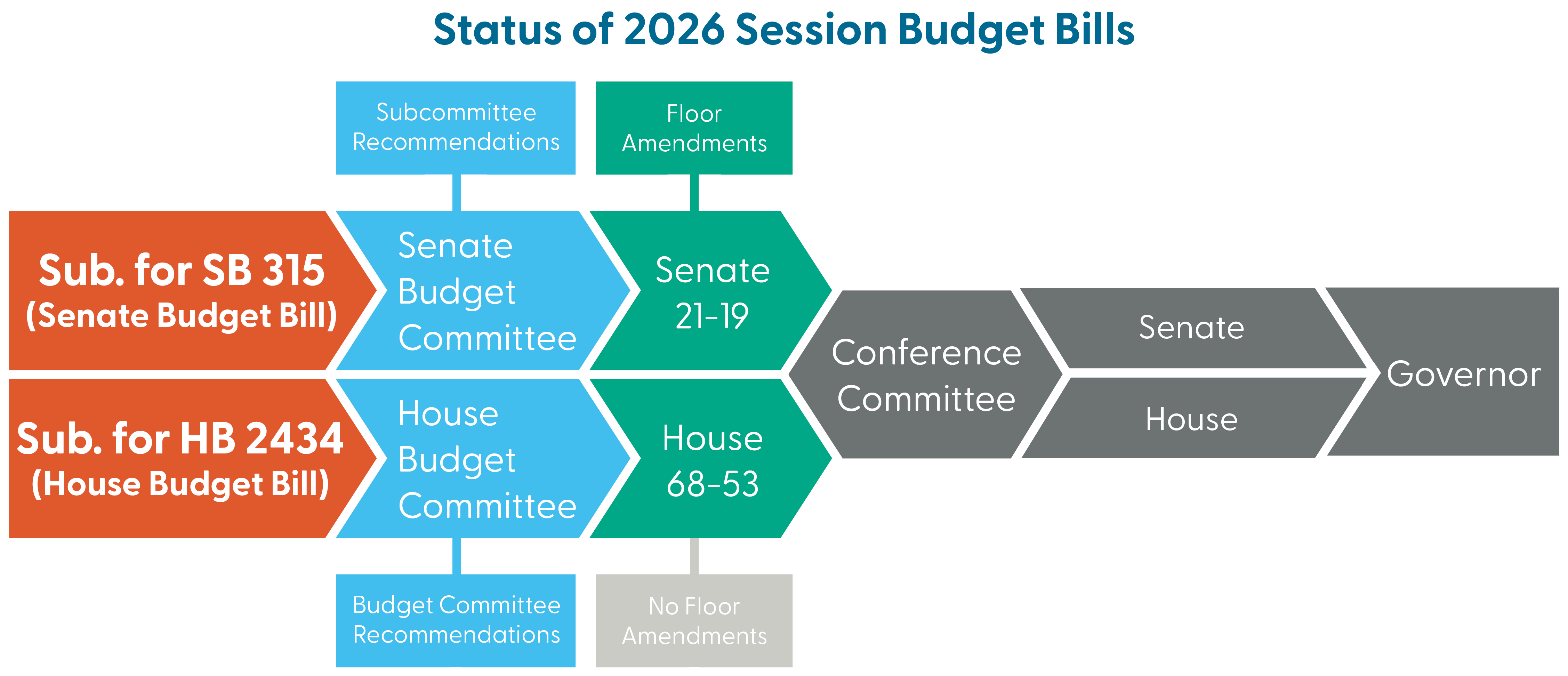
The budget bill was passed by the Senate (21-19) following six hours of debate with 13 approved amendments. One of the more concerning amendments was the deletion of the $16.0 million Mental Health Intervention Team (MHIT) Pilot Program, a program that supports mental health services in K-12 schools across the state. Funding for MHIT is still included in the House bill, however, so the funding could still be added back to the final budget plan when the two chambers negotiate their differences in conference committee.
Beyond the 13 amendments that made it into the Senate’s budget bill, another 12 failed to be added. Among these failed amendments were increasing funding for K-12 Special Education and funding the Community Support Waiver (a new Home and Community Based waiver designed to serve the IDD community and decrease the number of individuals on the waiting list for IDD waiver services). Like the MHIT program, funding for the Community Support Waiver is included in the House bill and will be discussed in conference negotiations.
As we pivot toward six key budget leaders working toward a final budget bill, one item funded we’re glad to see in both the current House and Senate bills is overall agreement on funding for the new Office of Early Childhood. Although the chambers disagree on funding the position of the Early Childhood Ombudsman, the agency is otherwise fully funded in both bills. This will ensure the new agency gets off to the right start once the agency begins full operation on July 1, 2026!
Now that both chambers have passed their initial budget proposals, we have a better idea of how the overall budget might compare to that of the previous year. You may remember that the Legislators entered session with promises to cut $200 million from the budget in FY 2027. Despite this goal, the current House spending plan is $91.1 million above the FY 2026 budget while the Senate is $45.8 million above.
This will be something to watch as the Legislature continues to have hearings that would further reduce revenue and the Legislature passes bills that will cost the state more money over the next several years.
What to Expect in Week 9

With only three weeks of session left, committees and chambers will be working quickly to finish up work on policies from public assistance to property taxes. Specifically, committees only have seven days left to hold hearings and pass out bills to the full chamber. Here’s what KAC plans to weigh in on next week:
-
SB 521, streamlining and enhancing the employer provided child care tax credit, will have a hearing in the Senate Committee on Assessment and Taxation on Monday. We’ll provide testimony in support.
-
SB 513, directing DCF to create a system to provide child care subsidy payments directly to child care providers, has a hearing in the Senate Committee on Ways and Means on Tuesday. We’ll submit testimony in support.
-
SB 363, adding administrative burdens to eligible Kansans enrolled in public assistance programs, is likely to have a hearing in the House Committee on Welfare Reform on Tuesday. We’ll testify in opposition.
-
HB 2790, requiring state agencies to proactively inform new parents about early wealth building accounts like 529 or 530A accounts, will have a hearing in the House Committee on Federal and State Affairs on Tuesday. We’ll provide testimony in support.
-
HB 2504, prohibiting local governments from implementing several renter-friendly housing protections, has a hearing in the Senate Committee on Commerce on Wednesday. We’ll testify in opposition.
-
Property Taxes. The Senate Committee on Assessment and Taxation will tackle several new property tax proposals Monday through Wednesday. We’ll provide opponent testify on SCR 1621, SB 488, and SB 489.
- HB 2357, which would allow for expungement of evictions in certain circumstances, has a hearing in the Senate Committee on Commerce on Friday.
Bills are likely to hit chamber floors quickly after being approved by committees this coming week, so be ready to contact your lawmaker on any priorities you might have identified.
Share

