


A Holistic View of Child Poverty in Kansas
Nathan Kessler | October 23, 2025
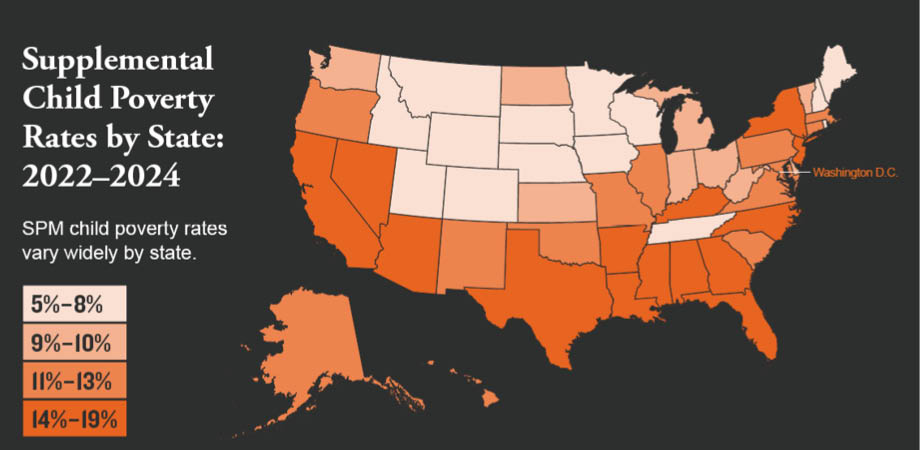
The Annie E. Casey Foundation recently released a reported analyzing childhood poverty across the United States as measured by the Supplemental Poverty Measure (SPM). The report offers comparisons across states and robust discussion of trends in the SPM and the factors that impact it.
To understand this report, it’s crucial to understand how the SPM differs from the official poverty measure.
Established in the 1960s by economist Mollie Orshansky, the official poverty measure (OPM) is used to determine eligibility for most anti-poverty programs, such as the Supplemental Nutrition Assistance Program (SNAP).
The OPM is calculated by comparing a family’s pretax income to a poverty threshold, which is determined by multiplying the cost of a minimum food diet by three. Adjustments are made for inflation and the size of the family, and families are considered below the poverty line if their income falls below that threshold for their family size in a given year.
While the OPM is based only on a family’s minimum food budget, the SPM is much more holistic in how it measures poverty. Factors — location, housing costs, medical care, and child care, and the value of public assistance benefits — are all considered when measuring the SPM. For this reason, this measure is considered to be more useful for policy analysis.
According to the Annie E. Casey Foundation’s new report, Kansas finds itself in the top 20 states with an SPM rate of about 9%. This means that after accounting for cost of living and the value of public assistance, 9% of Kansas children are considered in poverty. However, for comparison, the official poverty measure for children in Kansas is approximately 13%. This tells us that public assistance programs are having a significant impact when it comes to keeping children out of poverty.
That point is made clear in the report, which estimates that without public policy programs like SNAP, the Earned Income Tax Credit (EITC), and others, an additional 72,000 Kansas children would be living in poverty and our SPM rate would stand at 20%.
While Kansas is in a better place than many states, there is room for improvement, and the state has been moving in the wrong direction in recent years. For the three-year period from 2019-2021, an estimated 39,000 Kansas children were in poverty according to the SPM, a rate of 6%. In the most recent period, 2022-2024, those numbers increased to 62,000, which is 9% of Kansas kids.
This trend is entirely reversible through policies that prioritize children in low-income families. The most impactful policy that Kansas lawmakers could implement is a state child tax credit (CTC). Nationally, the federal CTC is credited with keeping more than 1.5 million children out of poverty, as these funds are often spent on food, clothes, and other necessities.
Legislation introduced during the 2025 legislative session would provide an extra $600 per child to families earning less than $25,000, with that amount decreasing as income rises. Policies like this put more money in the pockets of people who need it most so children in these families have more than they otherwise would.
The SPM is just another demonstration of how investing in our children today is essential for a brighter tomorrow.
< Back to the news listShare

