


State of the State Economy: Month of February 2026
Nathan Kessler | March 23, 2026
Any way you look at it, February was a tough month for the economy. Growth is slowing, prices are rising, and state revenues are missing the mark. And recent national events are unlikely to improve the near-term outlook.
February’s data reveals job losses, high housing costs, and a large shortfall in state revenues relative to expectations. New conflicts in the Middle East add to concerns about an economy already showing signs of struggling. The effects of the conflict may not be reflected in the February data, but the conflict itself looms over this report and leaves us wondering what comes next.
State Revenues
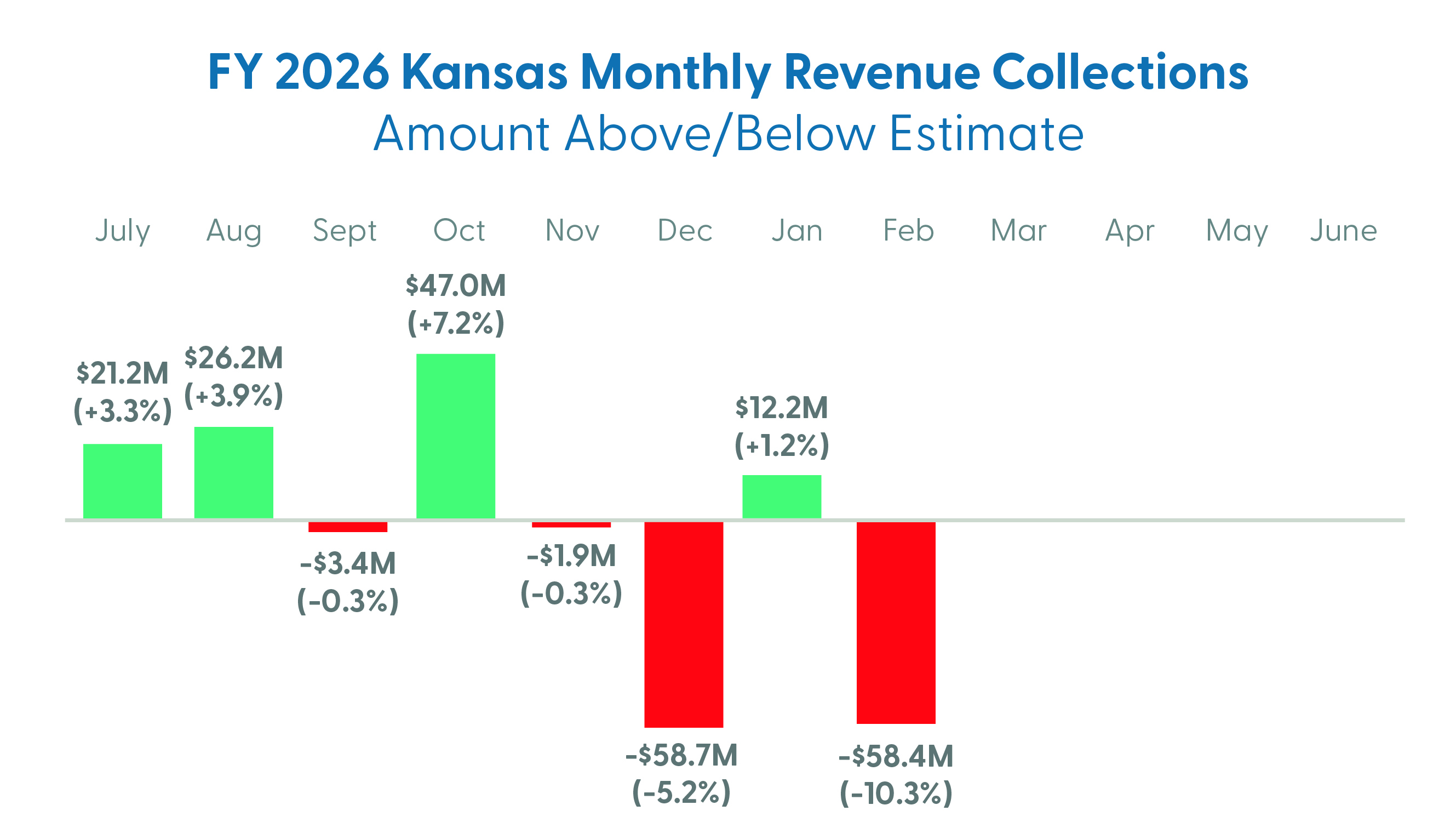
Kansas tax revenues were $506.3 million in February, missing the estimate of $564.7 million by more than 10%. Total receipts also fell short of last year’s collections by $41.9 million. This large shortfall in February puts cumulative receipts for the fiscal year $106.8 million below expectations.
The driving force behind the revenue shortcomings are individual and corporate income taxes, which fell short of estimates by 17.7% and 102.3%, respectively, in February. This could partially be the result of larger and more state tax refunds than expected, especially regarding individual income taxes.
This was a possibility cited by the Consensus Revenue Estimating (CRE) Group when they released their November report. With one more month until the filing deadline, the next two revenue reports should give us a clearer idea of how this year’s revenues are going to compare with FY 2025.
Jobs Report
Kansas labor reports for January and February will come out in the first half of April, so for insight into the jobs market in February, we turn to the national report from the U.S. Bureau of Labor Statistics (BLS).
In February 2026, the United States lost 92,000 jobs, while the unemployment rate rose slightly from 4.3% to 4.4%. The largest losses were in health care, which shed 28,000 jobs, and information and transportation and warehousing, which each declined by 11,000 jobs. Health care losses occurred in offices of physicians and mainly reflect strikes in the industry. Even when not accounting for job losses due to strikes, employment declined by 64,000 jobs last month after a stronger-than-expected report in January.
Taking a step back, there are some large cracks forming in the labor market. Revisions to the month of December show a loss of 17,000 jobs that month, while the benchmark revisions to 2025 indicate national job growth was anemic last year. Relatedly, the first revision to fourth quarter Gross Domestic Product (GDP) revealed that the economy grew half as fast as originally reported at an annual rate of just 0.7% in the last three months of 2025.
This kind of sluggish growth, in combination with other economic conditions, raises serious concerns about the health of the U.S. economy.
Regional Inflation
Among those other economic conditions is inflation, especially in the Midwest. In February, prices rose 2.8% compared to last year, which was significantly faster than 2.4% for the nation overall. Housing continues to be a significant driver of higher inflation in the Midwest, rising 4.6% in February versus 3.3% for the United States.
Within housing, shelter was up 3.9% while household energy rose 11.7%. Both of these measures were much lower for the country more broadly. This rapid increase in housing costs, in conjunction with other increases, is straining household budgets at a time of slowing economic growth – a worrying trend that brings to mind the specter of stagflation.
Adding to that concern is the recent oil price shock brought on by the ongoing war with Iran, which began after the reporting period for the February inflation report. The much higher oil prices will begin to have a significant impact on inflation in March, meaning families across the state are going to be paying higher prices to run their cars and power their homes.
The higher prices from an oil shock don’t end there, however, as oil and its derivatives are major inputs throughout the supply chain. Higher fuel costs mean higher transportation costs, which result in higher prices at the grocery store.
The events of today evoke the oil crises of the 1970s. And while the country is unlikely to experience any genuine shortages, the impact on household budgets and the broader economy could be enormous.
The Big Picture
For the last few months, the data has shown an economy in a holding pattern, unsure of which way to go. But February’s data is decidedly tilted toward contraction. Amid flat job growth, the unemployment rate is creeping steadily higher. Price increases, especially in the Midwest, continue to erode purchasing power. And war in the Middle East has resulted in the largest ever oil shock.
Many consumers are hanging by a thread and the downstream effects of this shock could be too much to bear. A sharp pullback in consumption would further weaken the labor market, which would further reduce consumption. This is the recessionary spiral that could take shape if oil remains near $100 per barrel for a period of weeks to months.
The big picture here is that the economy is at a pivotal moment. The combination of high prices, slow growth, and geopolitical instability amounts to a perfect storm for an economy that was already vulnerable. The hope is that future data releases prove this analysis to be overly pessimistic. The reality is that the downside risks far outweigh the upside potential in this moment.
< Back to the news listShare

