


State of the State Economy: Month of March 2026
Nathan Kessler | April 23, 2026
After awaiting the benchmarked Kansas jobs data, the Kansas Department of Labor released those revisions, as well as the January and February labor reports.
Additionally, we received the March revenue report and the newest round of Consensus Revenue Estimating (CRE) Group projections for FY 2026 and 2027. We also received the first inflation report since the conflict in the Middle East erupted and sent oil prices soaring. Putting this all together, this may be one of the most comprehensive insights into the state economy since before the record-breaking government shutdown last year.
State Revenues
Kansas collected $577.1 million in taxes in March, falling short of the expected $646.0 million by 10.7%. This is the second month in a row that state revenues missed estimates by more than 10%. On a cumulative basis, state collections are 2.5% shy of the expected $7.07 billion at this point in FY 2026.
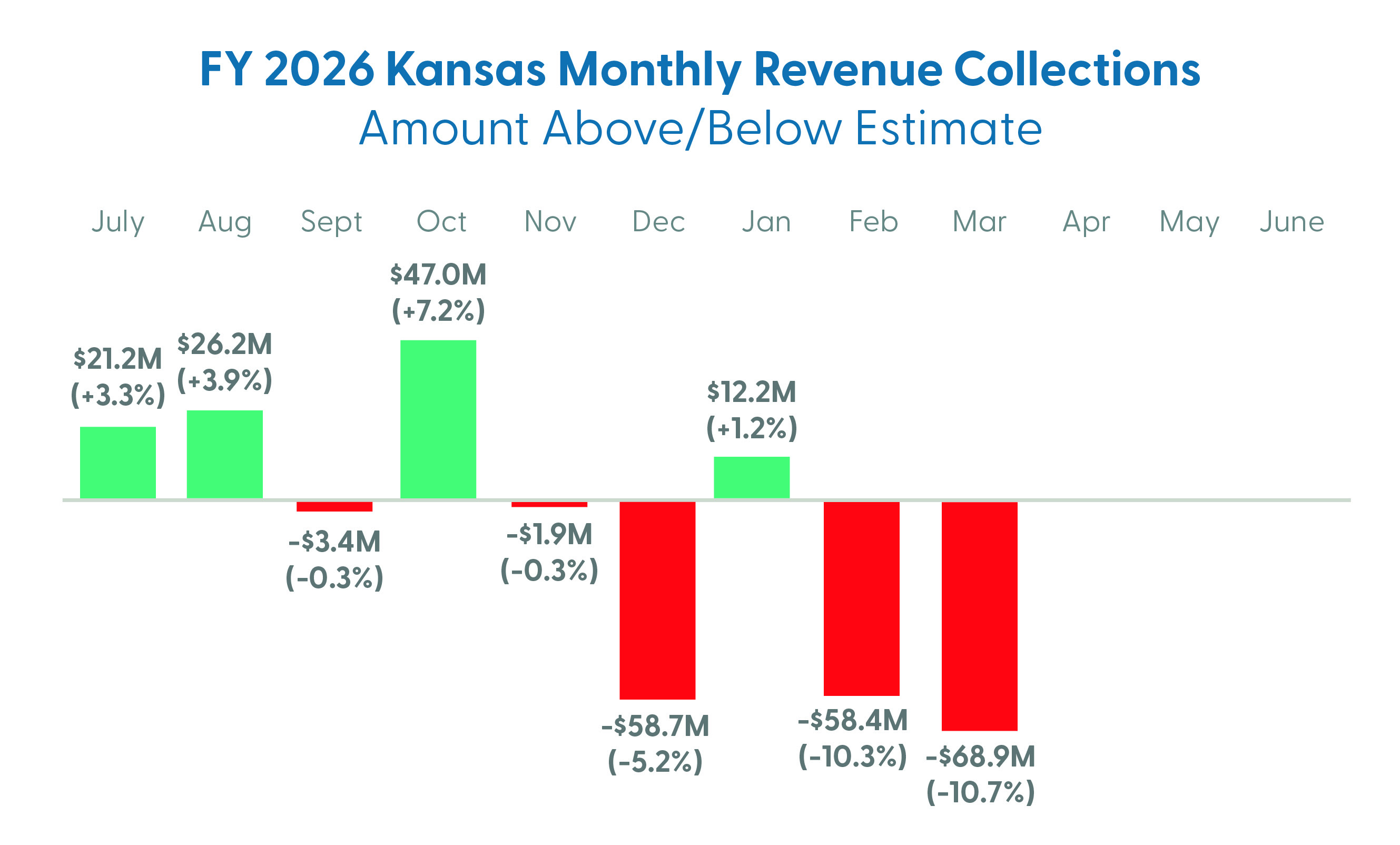
This was the last revenue report that we received before the CRE Group met again in April to reassess their outlook for this fiscal year and FY 2027. With total receipts at just 68.3% of the previously expected $10.1 billion in FY 2026 revenues — and with only three months left to go — the CRE Group revised its revenue projection downward by $153 million to $9.95 billion. Its FY 2027 projection also received a downward revision of $34.5 million to an expected $10.2 billion.
After multiple rounds of large tax cuts in recent years, including one that puts the state on a path to a flat corporate and individual income tax rate if certain conditions are met, the state is in the unenviable position of raising too little revenue to cover expenses. As the budget shortfalls get larger and the Budget Stabilization Fund dwindles, state lawmakers will need to raise revenue or be forced to make deep, unpopular cuts to much-needed programs.
Jobs Report
In April, we received the Kansas Labor Reports for January and February, and the numbers indicate a relatively stagnant job market. Total nonfarm jobs in Kansas declined by 3,800 from January to February and are higher by just 1,100 compared to February 2025. The largest gain in February was in leisure and hospitality, which rose by 800 jobs, while the largest decline was in trade, transportation, and utilities with a loss of 1,800 jobs.
Overall, the headline number tells us that job growth is essentially flat, but it does not tell the whole story. Unemployment rates across the state show that workers in Southeast Kansas are experiencing a much more challenging labor market than Kansans in other parts of the state.
Bourbon County has the highest unemployment rate in the state at 6.1% compared to 3.9% for Kansas overall. Woodson and Wilson Counties, also in Southeast Kansas, each have an unemployment rate of 6.0%, while many other Southeast Kansas counties are at or above 5.0%. Outside of Southeast Kansas, only Geary, Leavenworth, and Wyandotte Counties have unemployment rates of at least 5.0%.
This is a concerning trend for families in the Southeast part of the state. With little job growth statewide and high unemployment rates in their region, many Southeast Kansas households may find themselves having to make difficult decisions as they navigate a tough labor market amid persistently higher prices.
Regional Inflation
The inflation report for March is the first since the war with Iran began on February 28, and the data responded as expected. Overall prices in the Midwest rose 0.9% in March, an increase of 3.4% compared to last year, as fuel prices surged in the wake of the war and closure of the Strait of Hormuz.
The price of gas increased 15.4%, which was below the nationwide increase of 18.9% but still a serious concern for Kansans already stretched thin by higher food and shelter costs. Excluding food and energy costs, inflation in the Midwest remains elevated compared to the nation. Core inflation was up 2.9% over the year in the region compared with 2.6% for the United States.
Housing continues to be the primary driver of higher inflation in the Midwest, with shelter costs rising by 3.9% since March last year compared to 3.0% for the nation. While the trend in core inflation has been favorable for consumers, concerns over the cost of living persist and the spike in fuel prices will certainly add to those. Worse still, Kansans will be contending with price hikes from the war for months.
Higher prices for fuel and fertilizer are likely to persist for at least a few months, even if the war were to end today. That’s a major problem for farmers across Kansas and the United States who rely on those inputs. A Kansas State University economist suggests that the higher fuel prices alone could add $10,000 to a Kansas farmer’s costs. These higher costs erode profit margins for farmers and will translate into higher prices at the grocery store when the crops are harvested in the fall.
This should serve as a stark reminder that the economy is deeply connected across countries and products.
The Big Picture
Given the wealth of data released this month, there are a few stories we could highlight, but the one that stands out most is that of Southeast Kansas. The region is experiencing substantially higher unemployment than much of the state as gas prices soar amid already-high prices for food and housing.
As a major agricultural hub in Kansas, the Southeast region may be hit particularly hard by war-fueled inflation as higher input costs eat into profits for farmers and ranchers. Perhaps crop yields will be smaller because less acreage was sown as farmers cut back on fuel, fertilizer, and hired hands. That means there will be less work – and less need for workers – at processing facilities in the fall, especially since those facilities will be forced to pay higher prices.
After leaving those facilities and making its way to the shelves of your local grocery store months from now, products will pass through fewer workers — but that product will still cost more. For those people in Southeast Kansas – and others like them across the state – struggling to find work, that price increase matters. And it all started with a war thousands of miles away.
This scenario is the best possible reminder that real people feel cascading impacts – not just at the individual level, but on the geopolitical stage, too. So much so that a war in March affects the price of corn in October. The world is deeply connected through the economy, and it is important that leaders recognize how their actions today could decide whether families are able to meet their household’s needs months down the line.
< Back to the news listShare

