


State of the State Economy: Month of October 2025
Nathan Kessler | November 20, 2025
Now that the federal government shutdown has concluded, we are expecting to see some economic data releases soon. For now, we’re still missing the jobs data because the U.S. Bureau of Labor Statistics (BLS) operations were impacted by the shutdown. But that doesn’t mean we’re completely in the dark about how the state economy is performing as it relates to state revenues and private-sector employment reports.
State Revenues
State revenues in October 2025 were $695.6 million, beating estimates for the month by 7.2% and higher than in October 2024 by 4.1%. However, higher-than-expected revenues remain driven by robust individual income tax collections as lackluster corporate income results continue to fall below expectations.
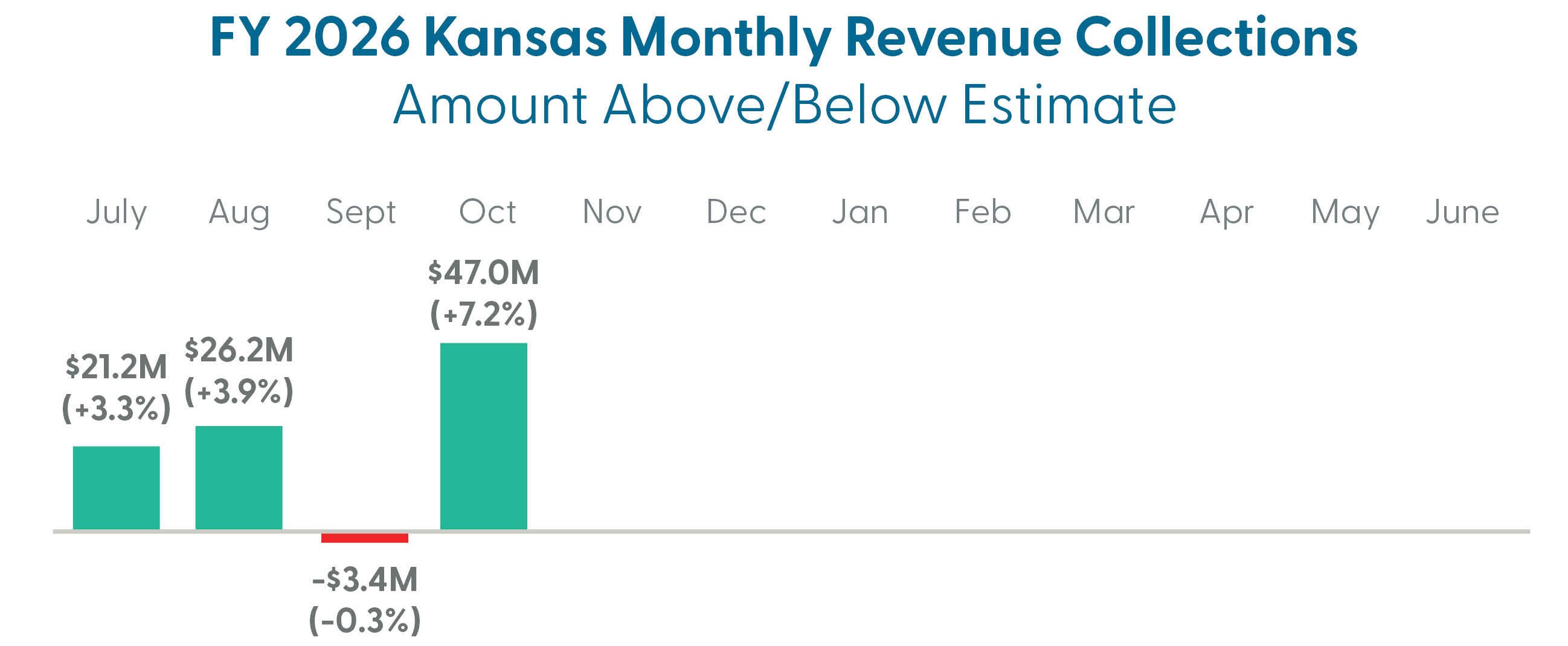
While individual income taxes make up a larger portion of collections than corporate income, it is notable that corporate income tax collections have fallen well below estimates in each month of FY 2026. To date, corporate income tax collections have fallen $77.7 million below expectations, while individual collections have exceeded expectations by $142.4 million.
Compared to this time last year, corporate income tax receipts are lower by $68.3 million, while individual collections are higher by $139.9 million. While higher wages – and likely extra withholdings – have contributed to the higher individual receipts, inflated prices have seemingly not led to higher corporate receipts.
Corporations are subject to different rules in how they are taxed, and it’s possible their revenues are taking a hit because of tariffs. We will continue to monitor State General Fund receipts to see if the pace of corporate collections picks up later in the year.
Regional Inflation
Inflation data for October has yet to be released after the end of the 43-day government shutdown. If inflation data for October is released (which is far from certain at this point), we will be sure to highlight it in our next economic update.
However, affordability has been in the news lately as everyday folks struggle to afford the basics. Recently, President Trump even exempted many food products from his administration’s tariffs – seemingly acknowledging that those tariffs were being passed onto consumers in the form of higher prices.
While this should alleviate some stress on families’ pocketbooks, the remaining tariffs will continue to keep prices on other items elevated, leaving household budgets stretched thin heading into the holiday season.
Layoffs Surge in October
While the national and state employment reports are delayed by the federal government shutdown, there is some private-sector data that we can look to for some insight into the U.S. labor market.
The big story for October was the report from Challenger, Gray, and Christmas, an outplacement and career transition firm known for its “Challenger Report,” which tracks job cuts from month to month. The October report was notable for the surge in announced layoffs from U.S.-based companies.
Employers announced 153,074 job cuts in October, which was an increase of 175% from the same time last year and a change of 183% in September, when just 54,000 job cuts were announced. Year-to-date, approximately 1.1 million job cuts have been announced, according to the report – an increase of 65% from the same period in 2024.
The most common reasons for the job cuts cited by employers include impacts from the Department of Government Efficiency (DOGE), cost-cutting, artificial intelligence, and economic conditions. A notable quote from the report paints a worrisome picture, “This is the highest total for October in over 20 years, and the highest total for a single month in the fourth quarter since 2008. Like in 2003, a disruptive technology is changing the landscape.”
Looking at the size of these numbers, it’s important to remember that there are real people behind the data. Most of the more than 150,000 announced job cuts will be layoffs or early separations of some sort, and many of those individuals may struggle to find employment that meets their needs. However many of these job cuts ultimately take place, there will likely be many more Americans looking for work soon in a job market that is clearly losing steam.
The Big Picture
The government shutdown resulted in a gap in important data for the month of October, but a combination of reporting and private-sector data offers us a glimpse into the state of the national economy, if not Kansas specifically.
Generally speaking, people continue to feel uneasy about their own economic circumstances. This is reflected in the University of Michigan’s Consumer Sentiment Survey, which shows sentiment – especially among those with little to no stock holdings – hovering near all-time lows.
High prices, job losses, and the government shutdown took their toll on Americans in October. With the government reopened and data collection restarted, the hope is that we will have a clearer picture going forward. It seems like we could all use a dose of certainty.
< Back to the news listShare

