


2026 Statehouse Snapshot: Veto Session
Kansas Action for Children | April 10, 2026
Want to receive this weekly recap as soon as it's released? Sign up for our emails here.
Dreary End to Session, but Rays of Sunshine Provide Hope
The skies were gray as the Legislature met for Veto Session, a fitting backdrop for a heavy few days of lawmakers overriding most of the Governor’s vetoes. The Legislature pushed through changes to public assistance rules, limiting local governments’ ability to address housing issues in their communities, and more.
But while the rain may have dampened the Statehouse Dome this week, it hasn't dampened the need for thoughtful conversation about how the state can best serve kids and families. While not everything ended as we had hoped this year, we’re celebrating wins pertaining to kids’ health, housing protections, school meals, and more. This session proves that lawmakers can work across the aisle when putting kids first.
We’ll have a fuller update soon about how the 2026 session went and what future opportunities there may be to continue the work started this year. We hope you’ll keep engaging with our work the rest of this year as we track federal issues and prepare for the next legislative cycle.
Now, read on to learn how the final votes were cast in the last few days of the legislative session.
Bills Signed by the Governor
SB 271 (CHIP Fix)
After nearly five years of advocacy efforts, the Governor signed into law SB 271, which permanently fixes an 18-year error with Children’s Health Insurance Program (CHIP) eligibility in state law. For the thousands of Kansas kids who will benefit from permanent certainty on their ongoing eligibility for the CHIP program, we are thankful for all the lawmakers and advocates who supported this issue over the years and pushed it across the finish line in 2026. In future years, we hope we can build on this momentum in other ways to increase kids’ access to health coverage.
Sub. for HB 2357 (Eviction Expungement)
The Governor signed Sub. for HB 2357 into law, which will allow for expungement of eviction records three years after the original eviction occurs. The bill also requires courts to consider mediation when an eviction is filed, which will help to avoid many evictions from occurring in the first place. This bill is the result of years of bipartisan coalition work, and it is exciting to see something so impactful be signed into law. Not only will this allow those who are evicted in the future to expunge their records if certain requirements are met, but Kansans with evictions in their past will be able to expunge those old records as well, even if that eviction occurred decades ago. We look forward to continuing to work with stakeholders to implement this new law to ensure it reaches as many Kansas renters as possible.
Sub. for HB 2250 (Expedited Partner Therapy and School Nurses Epinephrine Authority)
A health bill bundle in Sub. for HB 2250 made important changes to allow medical professionals and others greater flexibility to get medications to certain populations to proactively prevent disease spread and respond to emergency situations. First, Kansas becomes the 49th state to finally approve expedited partner therapy (EPT) medications to proactively prevent the spread of sexually transmitted infections (STIs), which can cause particular harm to pregnant women and newborns. Public health advocates have pushed for this change for many years, and it’s exciting to celebrate this particular package.
Additionally, this legislation future-proofs the epinephrine medication delivery methods that school nurses can deploy and utilize in schools for allergy emergencies, as well as allows expired naloxone to be used by several groups to respond to drug overdoses.
Veto Results
Sub. for HB 2731 – OVERRIDDEN
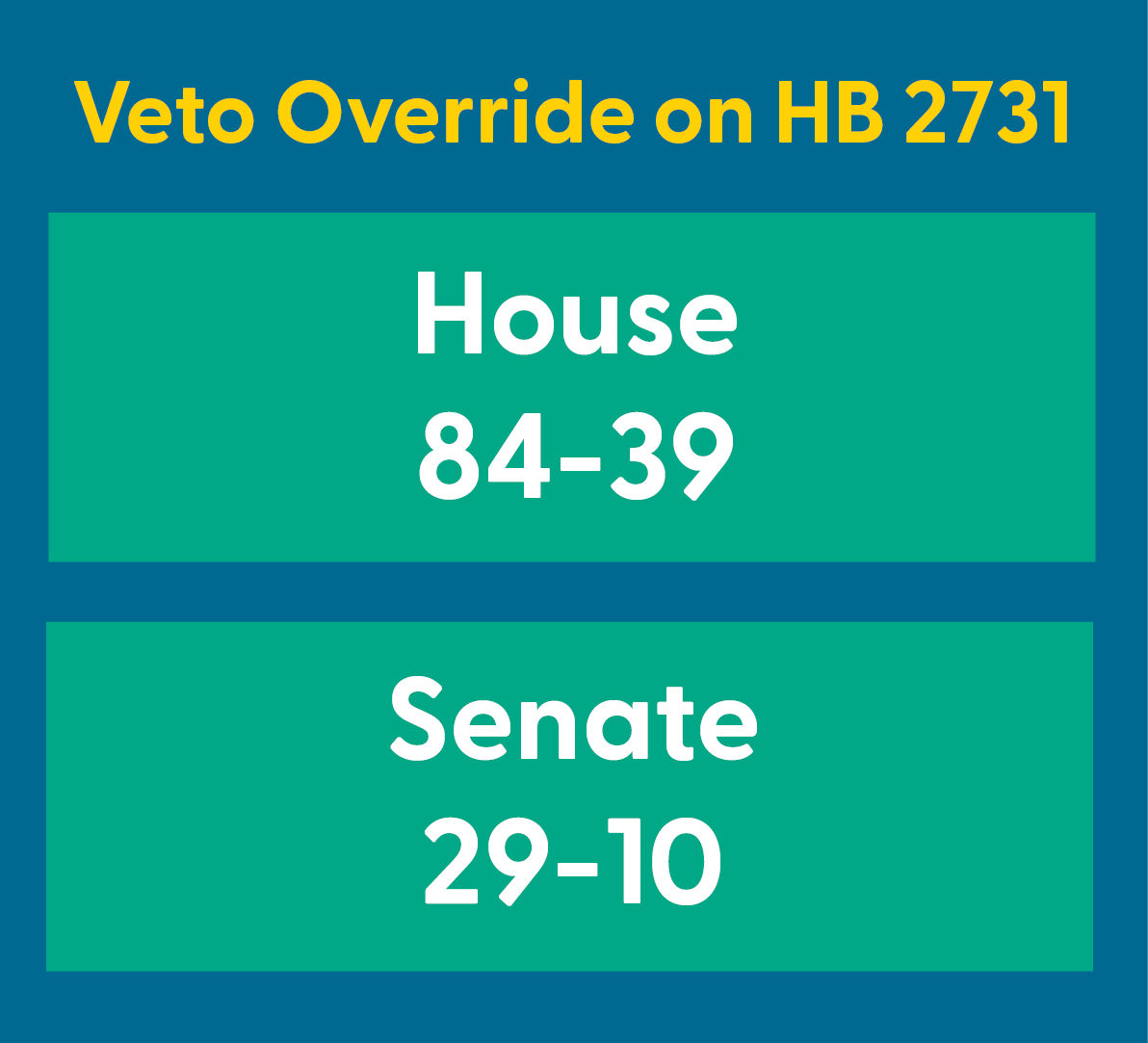
We are disappointed to share that the Legislature overrode the Governor’s veto on Sub. for HB 2731. This bill makes several changes to state public assistance programs and codifies parts of the “Big, Beautiful Bill” passed by Congress last summer. After more than an hour of arm twisting in the House, enough Representatives flipped to “yes,” passing 84-39 in the House. Not long after, the Senate later passed it 29-10, marking the final step in the process for it to become law.
The journey of this bill becoming law was not always a foregone conclusion. To get to this override, national and state pressure was applied to lawmakers for two days and in an hour-long vote to get enough “no” votes to flip to “yes.” While the pressure campaign ultimately worked, we are proud that advocates carved out the most harmful piece of this bill; more frequent Medicaid eligibility checks were removed entirely before it was sent to the Governor at the end of March.
In discussions around this legislation, one thing became clear: lawmakers have a lot to learn about how public assistance programs like Medicaid and SNAP are operated and how difficult they are for Kansans in need to navigate. We look forward to ongoing conversations to better under Kansans’ experiences with public assistance programs, and how we can improve them. Kansas kids and families deserve systems that work for them when times get tough, and we'll keep pushing until they do.
SB 391 – OVERRIDDEN
The Legislature also overrode the Governor’s veto on SB 391. This bill bans local governments from implementing several renter-friendly housing protections, like discriminating against a potential tenant for using housing vouchers.
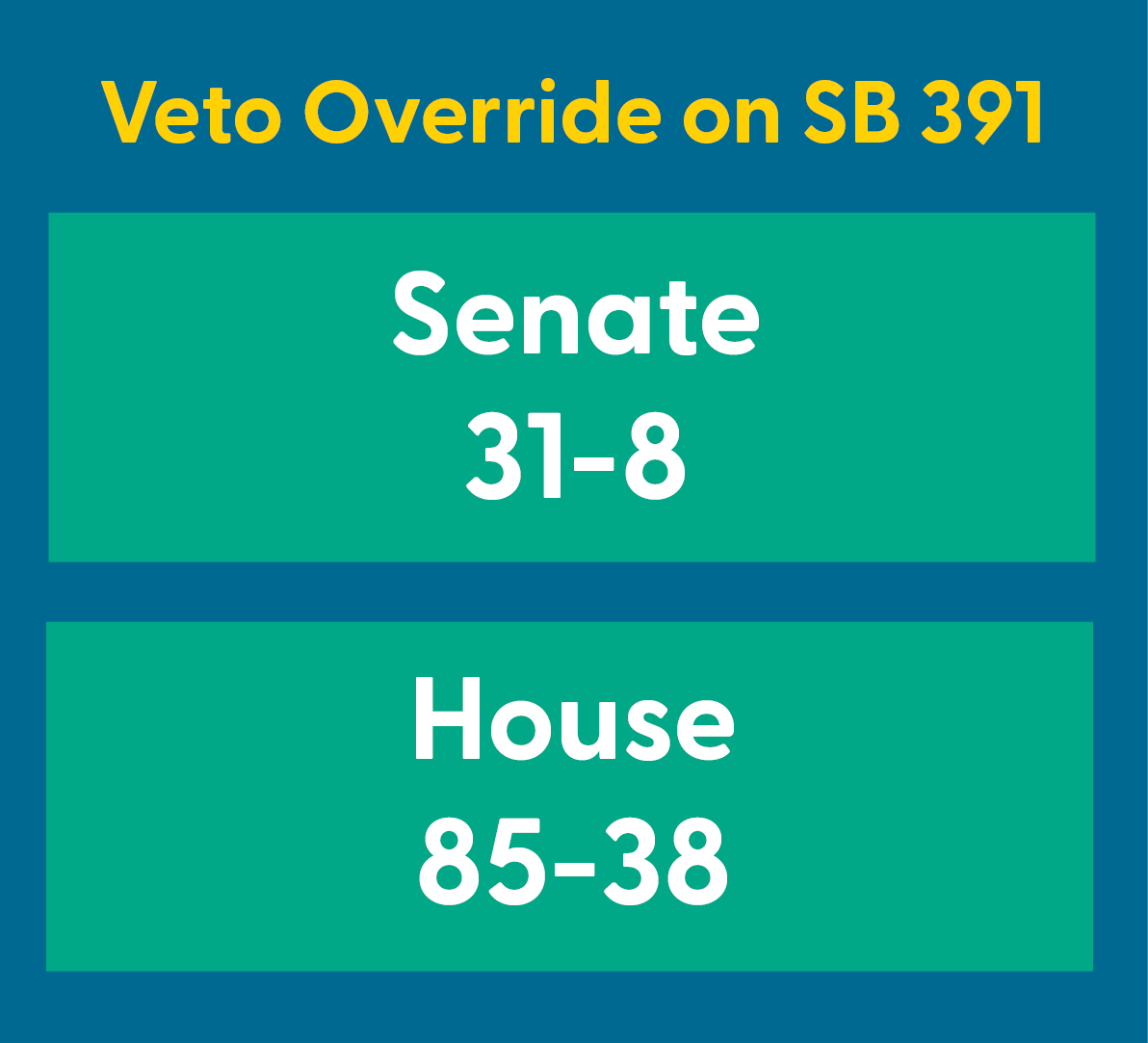
While the bill was sent to the Governor on a House vote of 76-48 – several votes shy of a veto-proof majority – the Governor’s veto was overridden with a vote of 85-38 in the House and 31-8 in the Senate. This vote is certainly not ideal, but we’ve been encouraged by other housing conversations this year. Going into next session, we hope lawmakers will be proactive in addressing the housing crisis in our state – not just pass bills that make it harder for community leaders to do what’s needed for their neighbors to access stable and affordable homes.
Senate Sub. for HB 2745 – SUSTAINED
After the Governor vetoed Senate Sub. for HB 2745, the Legislature declined to attempt an override on the bill, which would have allowed a protest petition to cap property taxes. This wasn’t surprising, given it barely passed either chamber in late March. Instead of moving forward with this proposal, lawmakers turned their attention to similar legislation that is a much less restrictive revenue cap but has a much lower threshold for voters to force a local government’s property tax revenues back to the prior year’s level.
Read below for more details on their “plan C” for property tax relief.
Race to the End for Property Tax Relief
After a session filled with chatter about major property tax legislation, the Kansas Legislature left Topeka with no constitutional amendment addressing rising property taxes, despite the House’s “hail Mary” attempt to revive SCR 1616 that was rejected in mid-March and the Senate's "hail Mary" attempt to amend HCR 5008 and get it through the House.
Instead, what eventually passed was a relatively permissive cap on growth in local property tax revenue that could ultimately be vetoed. The revenue limit, HB 2043, caps growth in local property taxes at the lesser of 3% or the Midwest CPI but excludes municipal bonds, new construction, and certain types of property. It also exempts school districts from the limit. If a local taxing authority attempts to exceed the limit, there is a protest petition mechanism that allows for just 10% of voters in the previous election for Secretary of State to force the local property tax revenues to hold steady from the prior year.
This plan would offer more stability in property tax increases, but it’s a far cry from comprehensive property tax reform. The biggest change in this bill is the protest petition, though it is unclear how often it will be triggered given the exemptions in the legislation.
It’s unknown at this time what the Governor’s thoughts are on this proposal, but with the Legislature adjourning “sine die,”, meaning that they are highly unlikely to come back to override any more vetoes, the Governor seems likely to end up with the final word on property tax relief this year.
In other tax news, the contents of one bill that we had been following closely (SB 521) made it into a final tax package bundled into SB 82. These provisions modernize and enhance the employer-provided child care tax credit that Kansas has had on the books in some form since 1992. Currently, the credit is confusing and heavily underutilized, and SB 82 aims to change that.
Under the new parameters, employers will be able to claim 75% of their eligible expenses up to $100,000; the credit is nonrefundable but can be carried forward for a period of three years. Businesses are eligible if they provide, pay for, or help employees locate child care or if they donate to organizations that help expand the availability of child care.
These positive changes will hopefully be enough to encourage employers to take advantage of the credit and help working parents find quality care for their children.
Budget Vetoes
This year’s budget bill, HB 2513, was sent to the Governor on March 30, 2026. On the last day of her 10-day time frame, she returned it to the Legislature with 31 line-item vetoes.
Unlike policy bills that must be vetoed in totality, appropriations bills can have specific lines vetoed, while leaving other lines intact. A line-item veto can range from a single line to an entire multi-page section. For example, one item we were watching as a potential veto was language that would require Kansas to follow the federal CDC guidelines for vaccine schedules. Once the Legislature receives notice of the Governor’s vetoes, they may attempt to override them either one at a time or in groups. Here are a few notable vetoes and their fate:
- Language that would require Kansas to follow federal CDC guidelines for vaccine schedules. Vetoed by the Governor; veto was sustained.
- Language directing that $1.5 million of the funding for the Mental Health Intervention Pilot Program will be spent on qualified private schools. Vetoed by the Governor; veto sustained.
- A 1.5% cut across all state agency operating budgets. Several groups were exempt from this cut (including the Legislature), but the State Schools for the Blind and Deaf were not. This language was vetoed by the Governor; veto overridden.
Now that veto session has come to an end, we have a full look at what’s in the final budget for FY 2027. Our recent blog includes a more detailed list of the items we have been watching and how they fared, but below are a few important items:
- $15 million to fund the increasing number of children benefiting from the Children’s Health Insurance Program (CHIP).
- $2.5 million to help avoid a waitlist for the Home and Community Based Services Technology Assisted, a waiver that serves medically fragile children and allows them to remain at home.
- $12.1 million to fund the increased state match for SNAP administration required by the federal government.
- $3 million for community-based primary care clinics. These are the front-line clinics serving uninsured children and families who are uninsured.
In any state budget, there are things to celebrate and others that disappoint. This budget is no exception. Within it, there are many examples of legislators choosing to fund programs that support children and families. There are also disappointing choices to fund pet projects or ideological endeavors. As we reflect on this year’s budget, we’re walking away grateful that many of the items we were tracking as being most directly linked to the well-being of children were eventually funded and remained a priority.
KAC Interns Reflect on Their 2026 Internship

This year, the second class of our internship program joined us for the legislative session to learn about policy and politics in action. Four students – three from the University of Kansas and one from Washburn University – worked diligently over the past three months to assist the KAC team in monitoring committees and chamber floor action, complete several projects to inform the rest of the team about legislative vote counts, and more.
We are so grateful they joined us this year and can’t wait to see where they go next! You can read about their experience here – as well as learn which intern will be sticking with us as Communications Specialist!
Share

