


Beyond the Headlines: What You Didn’t Hear about the 2026 Legislative Session

Kansas Action for Children | May 20, 2026
Every year, the Kansas legislative session produces a flood of news coverage: partisan standoffs, veto showdowns, and narratives around the policies in play. What rarely makes the front page is the behind-the-scenes work: the relationships built over months, the conversations held behind closed doors, and the strategic choices that determine whether good policy lives or dies.
This year, those strategies mattered more than ever to KAC’s mission to make Kansas a better place for kids and families.
The 2026 session was unlike any in recent memory. The year began with a failed redistricting plan that unsettled legislative dynamics, compressed timelines that left little time lawmakers to thoroughly vet bills, an election year environment that influenced narratives, and the cascading consequences of federal policy — the so-called "One Big Beautiful Bill" — arriving at the state level with real and immediate implications for Kansas families.
And yet, by the time the gavel fell for the last time this session, Kansas Action for Children had helped spearhead numerous meaningful victories on behalf of Kansas children and families.
Our five-year effort on the Children’s Health Insurance Program (CHIP) finally crossed the finish line. School meal programs won support across the aisle. Better pathways for renters will ensure more families can access safe homes. Changes to address the effects of student cell phones in K-12 schools passed with broad support, paving the way for students to enter distraction-free learning environments.
What made the difference this year was a deliberate shift in our approach. The KAC team worked proactively to co-create policy solutions designed from the start to earn bipartisan support and worked closely with partner organizations to spread the word about how certain policies would help Kansas families.
At the same time, KAC defended against harmful bills on behalf of the families and children who have no lobbyist of their own in the Statehouse. When these policies advanced, we worked alongside other advocates to organize and show up. And while some outcomes weren’t always favorable, the final version of damaging legislation looked considerably less harmful than it did when it was introduced. That’s because advocates made sure legislators understood what was truly at stake.
Showing Up for Kansas Kids

The KAC team was in the Statehouse from the first gavel on January 12 to the very last in the early morning hours of April 11. For those three months, our team tracked legislation that could move the needle on children’s well-being – or would create more barriers and hurdles for families needing help. From hearings to floor debates to final votes, our team was there to understand how the policy decisions made in 2026 would impact the future of our state.
When committees heard bills affecting Kansas kids and families, our team testified and helped shape policies as they moved through the legislative process. When bills were advancing, we sought out conversations with legislators across the aisle, because meaningful policy change requires working with influential policymakers. Those meetings built trust, provided clarity on complex policy, and, in some cases, changed the trajectory of legislation in ways that might have been buried in the news.
Throughout the legislative session, the KAC team worked alongside partner organizations to coordinate strategy, share information, and even meet with lawmakers with one another for maximum impact.
Policy Wins for Kids and Families
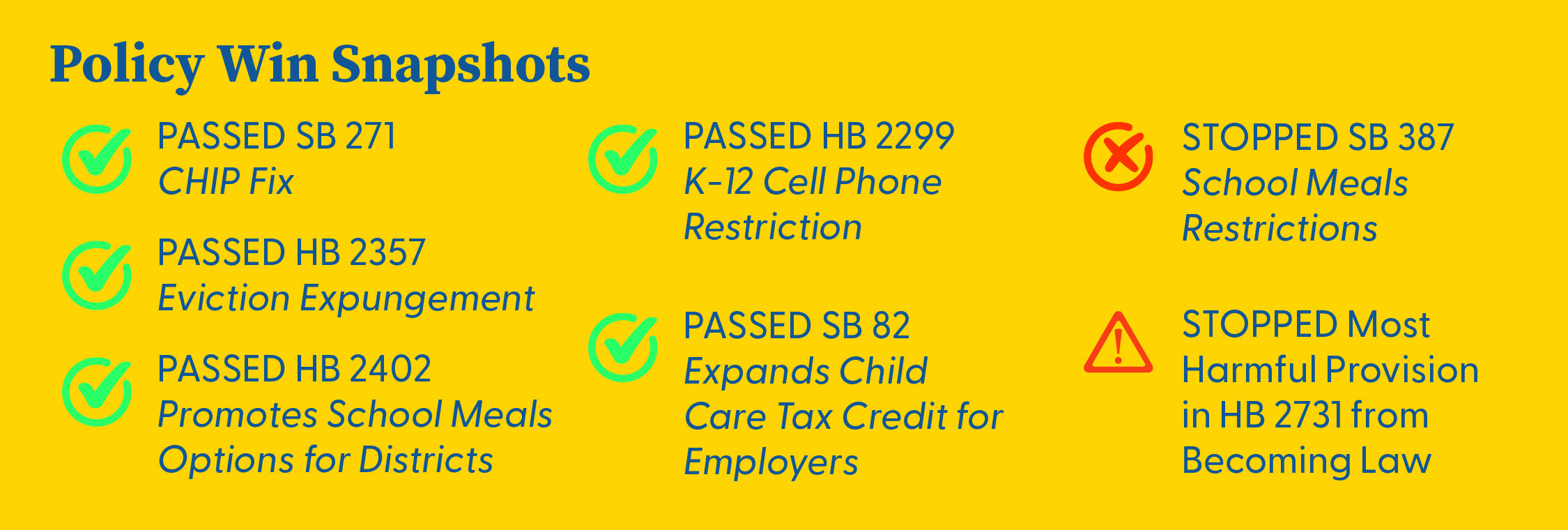
The 2026 legislative session was a year of genuine progress in many issue areas. That’s not to say there weren’t harmful bills pushed through this year, but Kansans should celebrate the bipartisan advances made for Kansas children and families.
Our long-advocated-for fix in the Children’s Health Insurance Program (CHIP) finally crossed the finish line after years of working with key lawmakers. With SB 271 now law, more Kansas kids are guaranteed to have access to the medical care they need regardless of their family's circumstances. We’re excited at what might be possible to expand on these efforts in the years to come.
Another long-fought-for policy becoming law was HB 2357, which establishes a pathway for expunging eviction records. An eviction on someone’s record — even one that was wrongful, resolved, or years in the past — can follow a family indefinitely, making it difficult to secure safe, affordable housing. Supporters of this legislation recognized that a single eviction record should not become a permanent barrier to finding the best home for their family.
Building on momentum we’ve seen over the past few sessions, the Legislature passed HB 2402, which promotes the federal Community Eligibility Provision (CEP). If an eligible school opts in, this program provides full federal funding to cover all of its students’ school meals. We know children who come to school hungry cannot focus, cannot retain information, and cannot perform to their potential, and this bill will encourage participation so more students have access to a nutritious meal during the school day.
With broad bipartisan support from the Governor and legislative leadership, lawmakers passed HB 2299, which establishes cell phone restrictions in K-12 schools. The evidence connecting smartphone use to declining student mental health and educational focus is growing. Kansas joined an increasing number of states making this commonsense change so that all students have a distraction-free learning environment, no matter the school they attend.
We also worked alongside partners to modernize and streamline the Kansas Child Care Tax Credit, which provides incentives for employers to provide or help pay for employees’ child care. This is an important step to ensuring the program has greater uptake and more working parents can find quality care for their kids.
Holding the Line
The wins are real — and so were the threats. Within the first week of session, legislation began to take shape that would cause serious harm to Kansas families struggling to make ends meet.
Bills targeting Medicaid recipients with additional eligibility hurdles, imposing new burdens on SNAP participants, enacting barriers to access free school meals, and prohibiting local governments from implementing several types of renter protections all emerged not long after the session began.
Despite sustained advocacy from advocates, several of these bills ultimately became law through the veto override process. But the mark advocates made on them should not be forgotten.
For instance, the final vote to override the Governor’s veto on HB 2731 was not the decisive margin it might have been. After more than an hour of political pressure — even pressure from the White House — just enough lawmakers voted to override and allow the bill adding more public assistance restrictions to become law.
The Legislature ultimately charged forward with SB 391, which preempts local governments from enacting renter protections, blocking communities from responding to their own housing challenges. The final passage of this bill makes the eviction expungement provisions in HB 2357 all the more important for families facing housing instability.
The session ended with at least one clear defensive victory for Kansas kids. KAC and several food security partners worked to oppose SB 387, which threatened to make the free school meals application process significantly more restrictive. As the bill advanced through the legislative process, lawmaker support eroded. When the session ended without a final vote on the measure, KAC and partners celebrated the outcome — a rejection of restricting no- or low-cost school meals for Kansas students.
A Stronger Advocacy Network
Statehouse advocacy is most effective when organizations with shared values work together strategically to respond to unique opportunities and challenges. This year, organizations and coalitions across Kansas did just that.
The 2026 session tested Kansas advocates in ways that we haven’t always seen. The compressed timeline and the cascading federal impacts demanded coordination. The result was a network of passionate, talented advocates who rose to that challenge.
Every relationship built this year, every lawmaker who came to trust an advocate’s analysis, every coalition that held together under pressure is an asset that carries forward into 2027.
The policy wins of this session did not happen by the KAC team facing the Kansas Legislature alone. Rather, they happened because a strong network showed up together on behalf of kids and families.
What’s Next
Advocates made incredible progress this year, despite the challenging political environment. But there’s more we can do to ensure all kids can access critical health care, sleep in a safe home every night, have enough to eat for every meal, and are set up for the greatest success from the start.
The unfinished work of 2026 will continue when lawmakers return next January:
- Meaningful property tax relief for families most in need
- Expanding access to free and reduced-price school meals
- Implementing more protections for renters
- Expanding children’s health coverage
- Directing more funding toward children’s programs
With all 125 members of the Kansas House of Representatives up for election this fall, we’ll be looking to see what opportunities there are to build momentum on the campaign promises laid out.
More lawmakers than ever before are ready to lead on these issues, and the KAC team will continue deepening relationships with lawmakers who showed a willingness to learn more about children’s priorities, coordinate with fellow advocates that made this year’s wins possible, and lay the policy groundwork for the issues that will make Kansas a better state for every kid.
The 2026 session made one thing clear: policies that build a Kansas where every child has enough to eat, can access health care, and has a stable place to call home can transcend political lines and ideologies.
With a new Legislature taking shape this fall, KAC is ready for what comes next. We’ll be spending every month left in 2026 ensuring that every lawmaker knows exactly what Kansas kids and families need from them in order to thrive.
Share

