


Education Funding Task Force: January and February Review

Emily Barnes | September 24, 2025
In 2024, the Legislature passed a bill mandating the creation of the Education Funding Task Force to review the Kansas School Equity and Enhancement Act (KSEEA) and provide guidance for creating the new public school funding formula when KSEEA expires on July 1, 2027
When lawmakers returned to the Statehouse in January 2025, the Education Funding Task Force began its work. You can find a more detailed explanation of the Task Force’s creation and its responsibilities by reading our first blog post in this series. In this entry, we cover what was presented during the January and February meetings and highlight important discussion points.
Review of Task Force Meeting on January 31, 2025

The early months of 2025 offered the Task Force a chance to understand its responsibilities, learn about the mechanisms in Kansas’ current funding formula, and begin to compare the formula to other states. When they met in January, legislative staff explained the relevant education statutes and expectations of the work, as well as the types of education funding available to schools.
As discussed in the meeting, there are three main buckets of funding schools rely on.
-
Statutorily required forms of aid, such as State Foundation Aid and Supplemental State Aid, Capital Outlay, KPERS (retirement) Contributions, and Other State Funds that can include mill levies, etc.
-
Funding that is not written into statute but is subject to legislative appropriations. These funds are used for programs like professional development, school food assistance, the Parents as Teachers program, and others.
- Funding that is not required by statute and commonly is included in the Legislature’s budget bill through one-year “proviso” language. This has included programs like School Safety and Security Grants and the Mental Health Intervention Team (MHIT) Program.
Public Materials Provided to Lawmakers During or About This Meeting
The documents presented to the Task Force members during the meeting can be found here.
Primary documents include:
- Education Funding Task Force Minutes – January 31, 2025
- Base Aid for Student Excellence (KLRD)
- Overview of Membership and Statutory Charge
- Kansas School Finance System Memo (KLRD)
- Members of the Task Force
Key Discussion Points from Task Force Members
At this stage, Task Force members focused on how Kansas’ school finance system functions. For instance, Task Force members asked to review the current school finance system Kansas uses and how special education state aid is determined and dispersed. They wanted to learn about the “inputs and outputs of the funding system,” or how the funding comes into the system and how student performance matches achievement goals.
Additionally, the group wondered about the impact on student outcomes from policies being tied to funding and whether they could work with districts to understand how the funding formula impacts their budgeting process.
The members also expressed wanting to understand the general financial health of Kansas school districts and the federal Census numbers for student enrollment and special education students. They stated their intent to review other states’ funding models and learn about the commonalities between states that perform well on standardized assessments.
They also stated an intent to learn about which school finance components interact well with school choice initiatives. Lastly, the Task Force asked for historical context or rationale behind the current weightings.
Review of Task Force Meeting on February 24, 2025
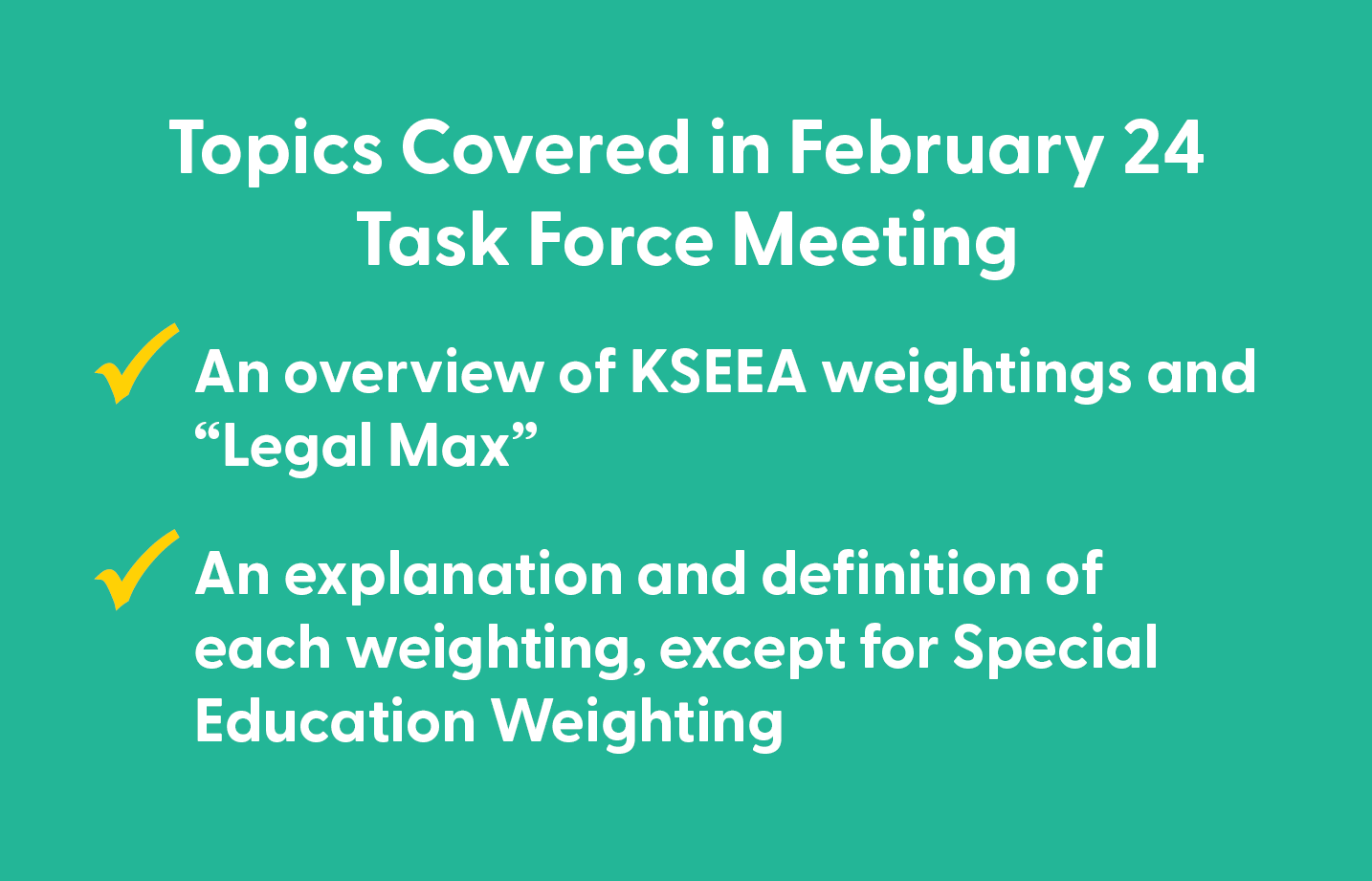
In February, the Task Force heard more in-depth information about the current finance formula Kansas uses for public schools. The discussion covered the different weightings used to calculate the funding that districts receive per pupil each year. The Special Education Weighting was not discussed at this time and was scheduled for review later in the year.
For reference, a weighting is a formulaic calculation that accounts for the additional costs school districts incur when providing services to certain student populations. Weightings are added to school districts’ full-time enrollment (FTE), which creates a weighted FTE used to calculate the districts’ Total Foundation Aid entitlement – or the amount of financial aid allocated to each unique district to serve its students’ needs.
Kansas uses 11 weightings to accommodate the different district or student characteristics. Five of the weightings are based upon district characteristics like enrollment levels and the cost of living. Six of the weightings reflect the needs a specific student may have for academic instruction, and they address the costs districts incur when providing programs like career and technical education, transportation, and other student supports.
The weightings include:
1. School District Characteristics
-
-
Ancillary School Facilities: A weighting granted to districts that have opened new school facilities and are experiencing enrollment growth. The weighting is funded by local property taxes and is calculated by dividing the tax amounts raised by the BASE aid.
-
Cost of Living: This weighting is available only to districts whose average appraised value of a single-family residence is 115% or more of the state’s average appraised value of single-family residences. Similar to the Ancillary Weighting, it is funded by additional local property taxes and is calculated by dividing the tax amounts raised by the BASE aid.
-
High Enrollment: All schools fall into a classification of either High Enrollment (more than 1,622 student FTEs) or Low Enrollment (fewer than 1,622 student FTEs). Each of these weightings utilizes its own percentage value for calculation in the finance formula.
-
Low Enrollment: There are three classifications of Low Enrollment — 1) Less than 100 FTEs, 2) more than 100 FTEs but less than 300 FTEs, and 3) at least 300 FTEs but less than 1,622 FTEs.
- New School Facilities: This is being phased out, and currently no schools receive it.
-
Ancillary School Facilities: A weighting granted to districts that have opened new school facilities and are experiencing enrollment growth. The weighting is funded by local property taxes and is calculated by dividing the tax amounts raised by the BASE aid.
2. Student Needs
-
-
At Risk: This weighting is calculated by multiplying the number of student FTEs who qualify for free lunch through the National School Lunch program by 0.484 to determine a district’s weighting.
- (Note: At Risk funding is generated based upon the number of student FTEs receiving free lunch, but it is expended for student services based upon a list of qualifiers that indicate a risk of low grade level performance. Qualifying for free lunch is not one of the indicators to actually receive At Risk services.)
- (Note: At Risk funding is generated based upon the number of student FTEs receiving free lunch, but it is expended for student services based upon a list of qualifiers that indicate a risk of low grade level performance. Qualifying for free lunch is not one of the indicators to actually receive At Risk services.)
-
Bilingual: Districts determine this weighting by taking the greater option of either the number of enrolled bilingual students in a district or the number of hours bilingual students receive support services. Head count determination is calculated by multiplying the number of students enrolled in the district’s bilingual education program by a weighting factor of 0.185. The contact hour determination is calculated by multiplying the FTE enrollment in the bilingual education program by 0.395.
-
Career and Technical Education: This weighting’s FTE enrollment is determined by taking the sum of CTE contact minutes and dividing by 60 to get the contact hours. This number is then divided by 6. FTE enrollment is multiplied by 0.5.
- (Note: CTE programs must be approved by the Kansas State Department of Education through the Pathways process to receive the weighting. Studies were completed when crafting KSEEA to determine if specific amounts of funding based upon program cost were helpful. It was determined that a universal weighting factor of 0.5 efficiently addressed the funding needs.)
- (Note: CTE programs must be approved by the Kansas State Department of Education through the Pathways process to receive the weighting. Studies were completed when crafting KSEEA to determine if specific amounts of funding based upon program cost were helpful. It was determined that a universal weighting factor of 0.5 efficiently addressed the funding needs.)
-
High Density At Risk: Based upon the percentage of students who qualify for free lunch, when at least 35% of a district’s or building’s student population qualifies, the district/building can be eligible for High Density At Risk. In districts/buildings with between 35% - 50% of its population qualifying for the At Risk weighting, they take the rate and subtract 35, multiply that by 7, then multiply that by the number of At Risk students. For districts/buildings with greater than 50% eligible for the At Risk weighting, they multiply the percentage number by 0.105.
-
Special Education Weighting: The weighting is determined by dividing a district’s Special education state Aid by the BASE for the current school year. This weighting was discussed in detail during the August 2025 meetings.
- Transportation: This weighting is determined based upon districts’ density of transported students and transportation distance, using a curve of best fit to adjust per capita transportation allowances. Districts must provide transportation to students living more than 2.5 miles from the school’s flagpole, but the transportation weighting is not a reimbursement of costs incurred and does not factor for gas prices or road closures. It also does not account for hazards within the 2.5-mile boundary that make conditions unwalkable for students.
-
At Risk: This weighting is calculated by multiplying the number of student FTEs who qualify for free lunch through the National School Lunch program by 0.484 to determine a district’s weighting.
During the overview, legislative staff provided Task Force members with financial breakdowns of each weighting for each public school district in Kansas. Multiple weightings were discussed in greater detail in subsequent months – we'll explain those details in later blogs.
Discussion also centered on the difference between full-time enrollment (FTE) and headcount. Headcount counts each enrolled student, regardless of the amount of time a student attends school. In an FTE count, each student counts for the portion of a six-hour day the student spends at school.
Since weightings do not operate independently of each other, the Task Force also pointed to how the weightings appear in the December 2024 “Legal Max” document, which calculates the Kansas State Department of Education general fund and supplemental general fund budgets for each district. The document is intended to inform a district about the Legal Maximum General Fund amount it is entitled to, and is updated multiple times throughout the year.
Public Materials Provided to Lawmakers During or About This Meeting
The documents presented to the Task Force members during the meeting can be found here. When visiting the page, you will also find a spreadsheet for each weighting by USD number and by percentage of weighting as compared to the Total Weighted FTE.
Primary documents include:
- Education Funding Task Force Meeting Minutes – February 24, 2025
- K-12 Education Glossary
- LegalMax-KSEEA Overview with Virtual Aid
- School Finance History 1992-2016
- School Finance Memo Updated
Key Discussion Points from Task Force Members
Members requested that legislative staff provide a review of other weightings in the current formula, information on special education funding and “suitable provision” of funds in the Kansas Constitution, and an update to the School Finance memo and Legal Max enrollment.
They also requested information about the At Risk weighting and services, stating they hoped to learn about the weighting’s creation and analyze its effectiveness since its inception in 1992. This includes the mechanisms and criteria for determining if a student is At Risk, student mobility once identified, and the correlations between poverty and at risk factors in a student’s path to academic achievement.
There was also discussion about simplifying the At Risk formula and separating the funding mechanism from the weighting factors for At Risk services. Some lawmakers on the Task Force voiced concern that funds are not being used for actual At Risk students. Data collection for At Risk students was a topic of discussion, specifically the use of digital tracking to collect data. Task force members also wondered about ways to report the identification of the primary risk factor a student displays when eligibility is determined.
Members asked for a breakdown of districts using the different formats of bilingual weighting (headcount versus contact hours). A district calculates bilingual funding based upon either the number of bilingual students (headcount) or the amount of time (contact hours) services are provided to students, whichever is greater. The Task Force hopes to better understand which districts use each calculation. They also discussed the possibility of simplifying the bilingual calculation for consistency across school districts.
Task Force members also want clarification about whether transportation for sporting events and field trips is included in the transportation formula, and their hope to better understand costs and reimbursement models for this area of funding. In addition, Task Force members asked for actual transportation expenses from school districts.
When discussing the Career and Technical Education (CTE) weighting, it was noted that cost studies were completed while crafting the KSEEA to determine specific amounts of funding for each CTE pathway. However, it was determined at that time that the added complexity was not worth the differences between individual funding amounts, so a universal weighting factor of 0.5 was put into place.
To close the conversation, the Task Force considered the Ancillary and Cost of Living weightings. Task Force members hoped to get verification about which districts levy the tax for Cost of Living, and they considered whether conversations with the four districts that qualify for the Ancillary School Facilities weighting could offer feedback to improve the process.
Foundational Learning
The Task Force’s meetings in January and February set the foundation for how future meetings would continue. With a baseline of knowledge of how the Kansas school finance system works and what requirements are in place to ensure every Kansas kid receives an equal education, the Task Force should feel knowledgeable in how to move forward for the next school finance formula set to be implemented in July 2027.
This blog series will continue by explaining the remaining meetings’ topics and discussions. We’ll continue next time by focusing on March’s meeting comparing some state’s finance models to Kansas.
< Back to the news listShare

