


Funding for At-Risk Services Meets Students' Unique Needs

Emily Barnes | December 12, 2025
In July 2025, the Education Funding Task Force discussed the At-Risk weighting and its impact on school funding. This weighting is intended to provide adequate support to students who are eligible to receive At-Risk programs and services with evidence-based education services in addition to the regular instruction they receive in the classroom.
The two-day July meeting covered a variety of topics in addition to the At-Risk weighting, including High Density At-Risk, a pilot program, and a legislative audit request.
July Task Force materials can be found here and the videos can be found here and here.
Public Materials Presented to the Task Force about or during This Meeting
- Agenda
- Approved List of State At-Risk Evidence-Based Programs, 2025
- At-Risk Education Fund
- At-Risk Subgroup Guidance Document
- Bilingual Audit Proposal
- Cash Balance 9.03
- State Foundation Aid Examples for At-Risk
- State Foundation Aid Examples for At-Risk+Success
- State Foundation Aid Examples for Density Models
- Early Childhood Research and Resources (Williams)
- Early Childhood Research and Resources (2) (Rooker)
- ECS Optimal School District Size
- Evaluating At-Risk Expenditures and Statutory Compliance, LPA, July 2023
- K-12 Education: Evaluating At-Risk Student Counts, Weights, and Expenditures, LPA, Dec. 2019
- Funding for Students from Low-Income Backgrounds
- High-Density At-Risk Student Weighting
- 50-State Comparison: High School Graduation Requirement
- Impacts of School and Class Size
- June 2025 Survey
- Kansas Pre-K Data 2023-2024 SY
- KDOT Crashes with School Zone Sign Indicated
- KLRD Information Request - Transportation
- KSDE Payment Dates for State and Federal Aid FY 2025
- KSDE USD Budget: Fund Summaries
- Overview of At-Risk Weighting Models
- Overview of High-Density At-Risk Weighting+Combined AR+HDAR Models
- 2025-2026 Preschool-Aged At-Risk Program Requirements
- Revisor Office, At-Risk Accountability Plans 2025
- Revisor Office, At-Risk Student Weighting
- KLRD Small Size, Isolated, or Sparsity Funding in Other States
- Supporting Information for the Density Weighting Models
- Universal Pre-Kindergarten-Programming, Funding, and Eligibility Criteria
- USD Maps Enrollment Free Lunches 2023-2024
- Yearly Totals State Students Approved for Free or Reduced Price Lunches
- Other supporting documents, including spreadsheets illustrating different weighting scenarios and studies discussing the long-term outcomes of early childhood education, can be found here.
High and Low Enrollment Weighting Follow Up Information
Before the Task Force dove into the At-Risk weighting topic, the group received more information about Low and High Enrollment weightings to display adjustments and the effect when the weightings are moved into BASE Aid.
Legislative staff presented the models that Task Force members requested in June that eliminate High Enrollment and adjust Low Enrollment accordingly. The models showed that although BASE Aid may increase by moving the weighting amounts into it, many districts would still see a decline in funding due to the reduction of their FTE enrollments in this scenario.
Discussion also noted the intricate connections between the weightings and other funding mechanisms in the formula. The state would likely see reductions in other weightings, like Special Education and Cost of Living, and the Local Option Budget as a result. Staff noted it might be possible to avoid these issues by proactively creating a model that avoids this dynamic or creating a different weighting to accommodate it. Task Force members were curious about how many students would be impacted by changes that resulted in declining amounts to their districts.
The group also discussed information about adjusting the Enrollment weightings to consider a model based upon density, which could mitigate some issues.
The Task Force learned about the Kansas State Department of Education’s (KSDE) budget workshops with school districts around the state, during which the agency gave districts the opportunity to give feedback about school funding. The short survey sought to understand the preferences of districts of varying sizes and settings about impactful weightings, changes to BASE Aid, special education reimbursement, and transportation. Most participating district responses came from rural districts.
Breakdown of Weightings – Historical Context and Overview
To better understand the Task Force’s discussion about the At-Risk weighting, it’s important to understand how it currently operates and how the funds provide services to the students who need them.
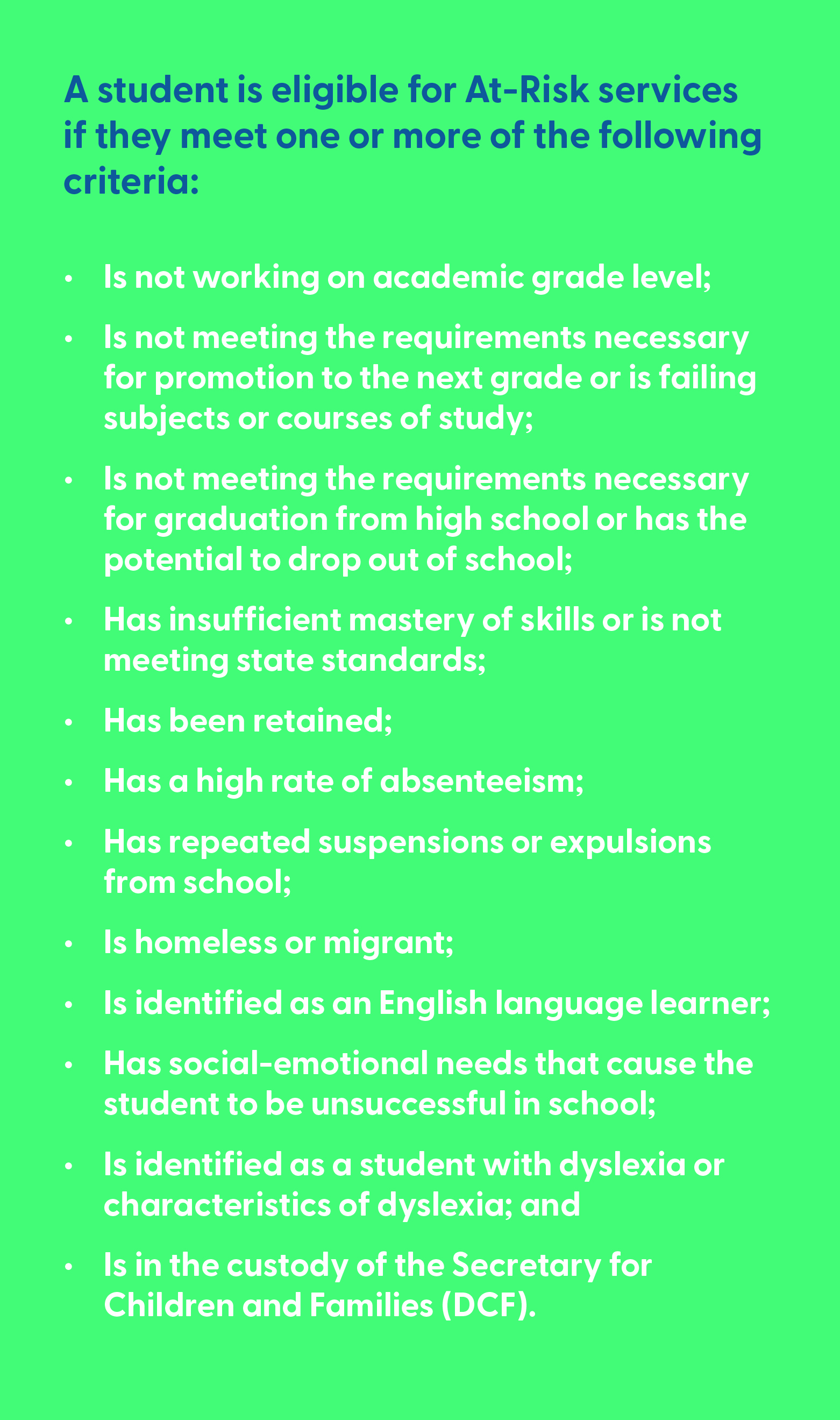
Established in 1992, the weighting has always been determined by a student’s eligibility for free meals under the National School Lunch Act. When providing At-Risk educational services, school districts must use their At-Risk Education Fund established in the Kansas School Equity and Enhancement Act (KSEEA) to pay for the services. This fund is intended to support students who are identified as being academically at risk according to a number of criteria. The services provide additional educational interventions and instruction beyond that of regular education services and must be approved by the Kansas State Board of Education.
The money deposited into the district’s At-Risk Fund is generated by the district’s At-Risk weighting, which is calculated by multiplying the number of students enrolled in the Free Lunch Program by the statutory weighting factor of 0.484.
“Free Lunch” Students x 0.484 = At-Risk Weighting
A family’s application for the Free Lunch Program is used as a proxy indicator to signal that a student may need At-Risk services. However, it does not guarantee that the student is eligible to receive At-Risk services. Although a school district may project their budget using this calculation, they will only receive funding for eligible students. Additionally, districts may only use the At-Risk funding they receive toward interventions and instruction on an approved list.
High Density At-Risk
The Task Force also heard details about the High Density At-Risk weighting, which applies when at least 35% of a district’s student enrollment are eligible for Free Lunch.
There are two calculations that a district may choose to utilize – a school district-level calculation or an attendance center (school building) calculation. These are based upon the total number of students enrolled who are eligible for free meals, but, depending upon the dynamic of the student population, the district will select the higher calculation. Tiered calculation tables are completed based upon whether 35% to 50% of students in the district are eligible for Free Lunch or more than 50% of students are eligible for Free Lunch. The building level High Density At-Risk weighting expires July 1, 2027.
At-Risk Accountability Pilot Program
The 2024 Legislature passed a requirement for school districts to create At-Risk Student Accountability Plans. To kick off the program, 10 districts were selected to participate for the 2024-2025 and 2025-2026 school years. Beginning in the 2026-2027 school year, all districts in the state will join. The purpose of the accountability plan is to demonstrate the use of evidence-based instruction, measure longitudinal academic improvement, and establish and strive to meet academic improvement goals.
School districts must use the plan to demonstrate they have ensured that At-Risk funds are used for interventions above and beyond regular education services. They are to continue using the plan until the school district meets the goal of having 75% of their students achieve proficiency in reading and math by scoring a Level 3 or 4 on the state assessment.
To participate, each district selects two cohorts of students, one of which is composed of 3rd grade students. Of these two cohorts, one must be students enrolled in Free Lunch. Each district will identify an academic improvement goal within which they implement two to four targeted supports selected from the list of approved At-Risk programs. KSDE has begun working with districts to identify cohorts and set goals.
School districts will implement these plans for four to five years and gather longitudinal evidence to determine whether the cohort meets or exceeds the goal. If they meet the goal, the district will repeat the process with a new student cohort.
However, if they do not meet the academic achievement goal, the district will be deemed as not meeting At-Risk improvement requirements, they will repeat the process with a different cohort, and they will continue to evaluate the original cohort for an additional year.
Beginning in the 2030-2031 school year, if after five years of this process a district fails to achieve the academic goal, they will not be entitled to the full amount of state aid that would have been allocated for At-Risk Student weighting and High Density At-Risk weighting.
Districts have begun to implement this pilot and are facing barriers already. Once selected, the cohort needs to stay together until 8th grade, but this can be difficult for smaller districts or districts with transient student populations. Often, students may leave the school or district, and it can be difficult to ensure the cohort remains stable. This can affect the collected data.
During discussion, Task Force members identified some challenges with interpreting growth trends. It was also noted that one of the approved screeners may help a district identify low and high risk for a student but are not designed to indicate proficiency, which might lead to a false sense of growth.
It was noted that the purpose of this pilot is to increase reporting and determine improvement in student skills. When considering the amount of money spent on At-Risk services, Task Force members asked which measures the state has that demonstrate what has helped student learning improve.
Other Points of Discussion
As the Task Force discussed the At-Risk weighting, they wondered about the cash balances that schools carry over at the end of a school year and the impact that providing At-Risk support to Pre-K students may pose on school finance overall.
Based upon the payment calendar for the school year, schools will often “carry over” unspent funds. Some members voiced concern about the growing amount of “unencumbered” or unused funds in districts’ balances. Schools receive payment in June, but do not receive another payment from the state until October. During the summer months and beginning of the following school year, schools still must take care of financial obligations. Task Force members stated their intention to better understand the ebb and flow of the funding and how it might be used to help districts maintain their budgeted funds without large ending balances.
The Task Force also discussed At-Risk Pre-K services in districts around the state. Members wondered about eligibility for Pre-K students and the statutory requirements to include them in the K-12 finance formula. An eligible student for At-Risk Pre-K services counts as 0.5 FTE, and their BASE Aid is calculated as such. Some voiced concern about how eligibility is determined for these students and the benefits of providing such services to preschool-aged children. However, considering that many states offer early childhood At-Risk programs, some wondered about the opportunity to dedicate more attention to this area to reduce learning risk.
Bilingual Legislative Division of Post Audit Request
The Task Force learned that a Legislative Division of Post Audit review had been requested for the Bilingual weighting. Questions included:
- How do school districts spend the funding they receive through the Bilingual weighting and do those expenditures comply with state law?
- What have the academic outcomes been of students who received English Speakers of Other Languages (ESOL) services in the last several years?
- How does the method Kansas uses to fund ESOL services compare to other methods?
The most recent audit was released in 2020, which looked at districts’ expenditures and whether they complied with the law, but it did not include a comparison to other states. The Task Force discussed whether an audit was necessary and how KSDE and the state are equipped to answer the questions.
Requests and Recommendations for Future Meetings
As the group discussed general ideas for the Task Force’s continued work, they pondered how to implement longitudinal data and growth models for At-Risk services. This could lead to improved transparency and data availability, as well as give insight into investments like tracking Pre-K growth.
They also noted the need for stakeholder engagement in this process and to consider what incentives may bolster efforts already in place. They want to continue exploring alternative funding formulas that can factor Kansas’ unique dynamics. Some stated their hope to determine how to use flexibility at the local level to allow for parent choice and recognize the parental roles in a child’s earliest years.
As the July meeting wrapped up, it was noted that August’s topic would focus on the Special Education weighting and a general topic would be covered in September. It was suggested to consider two different special education models to gain understanding of what is used in other states, such as focusing on student exceptionality and the service time provided in an IEP. We’ll cover this (and more) in our next summary of the Education Funding Task Force’s work.
< Back to the news listShare

