


How Does the State Budget Work?
Megan Leopold | Updated December 10, 2025
(Download this brief here.)
This primer provides a basic, high-level overview of how the budget is developed and implemented, as well as the revenue sources that support it.
Kansas’ budget is one of the most significant pieces of public policy the Governor and Legislature undertake each year. Lawmakers must weigh different priorities against each other while keeping the budget balanced, often making difficult choices to meet limited resources. The result is a roadmap for the upcoming year.
Budget decisions affect the long-term health and prosperity of our state and its residents in very real ways. Funding decisions dictate whether children have access to high-quality education and health care. They influence the safety of our roads and bridges and the state workforce. They determine if all children can have their basics needs met.
Fiscal Years
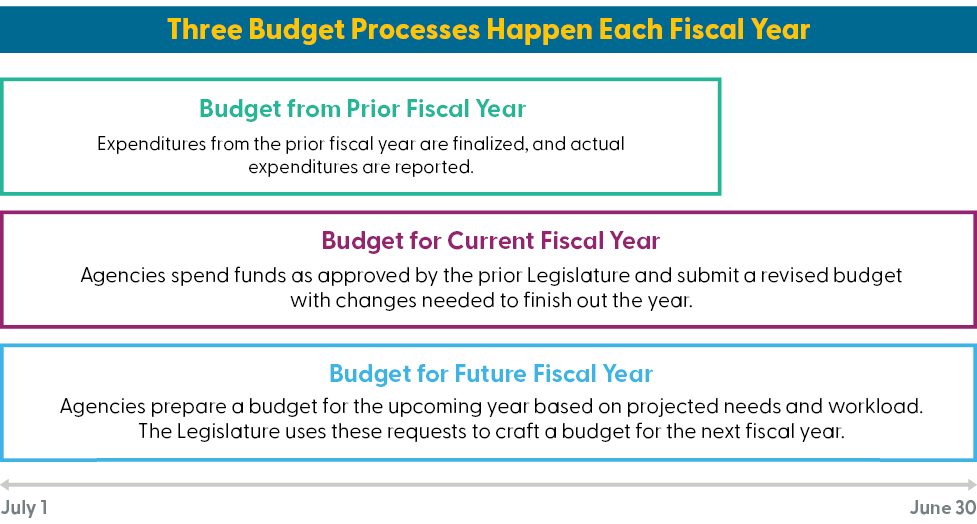
The Kansas state fiscal year (FY) runs from July 1 through June 30 and is named for the year in which the fiscal year ends. For instance, “FY 2027” refers to the fiscal year that started on July 1, 2026, and will end on June 30, 2027. Throughout the year, Division of the Budget staff work with each agency’s budget staff to manage three budgets at once – closing out the prior year’s, implementing the current year’s, and beginning work on the following year’s recommended budget.
Budget Basics
-
The Legislature is required to pass a budget, or appropriations bill, each fiscal year. This bill, sometimes referred to as the “mega bill,” appropriates funding for all three branches of government: executive, judicial, and legislative.
-
The appropriations bill includes a new budget for the future fiscal year and revisions to the current budget. For example, the budget negotiated during the 2026 session will be for FY 2027, which begins on July 1, 2026, and lasts for the following 12 months, ending on June 30, 2027. It will also include modifications to the FY 2026 budget that was passed by the previous Legislature.
-
The appropriations bill establishes the budget for each individual state agency, directing how much money is appropriated and how it can be spent.
- The budget must be balanced, as required by the Kansas Constitution. This means that expenditures cannot exceed revenues and reserves.
-
The budget must fund certain items. For instance, the Kansas Constitution requires the state to pay back debts and fund the state’s public education system. A collection of federal mandates and court orders impose other requirements.
-
State revenues are estimated twice a year. The Department of Revenue, Division of Budget, Kansas Legislative Research Department, and economists from the state universities, known collectively as the Consensus Revenue Estimating Group, meet twice a year to assess actual revenues and forecast revenues for the upcoming budget year.
-
State budgets can be led by either the Legislature or the Governor. Each legislative session starts with the introduction of a budget bill that is then revised throughout the session by the Legislature. Prior to the 2025 session, the Legislature used a budget bill submitted by the Governor to craft the final budget. In 2025, however, the Legislature introduced its own bill and used this as the initial draft of the budget.
-
The Governor can make recommendations to the Legislature through Governor’s Budget Amendments (GBAs). With a process led by the Legislature, any changes the Governor has for the budget must be submitted to the Legislature as a GBA and voted on.
- Some sessions include an Omnibus Budget Bill. Most policy bills are not funded at the time of their passage, so funding must be appropriated in a budget bill. To ensure agencies have the funding they need to comply with new policies, the Legislature may pass an omnibus bill. It’s often one of the last bills passed in session and adds funding to the already-passed budget.
Terms to Know
-
All Funds – The full amount, or the entirety of funds used to fund a budget or budgetary item.
-
Budget Stabilization Fund - In 2016, the Legislature created the Budget Stabilization Fund (BSF) to save money from good economic times and protect vital state operations in case economic downturns cause revenue shortages. This is often referred to as the “rainy day fund.”
-
Capital Improvements – Projects that include the construction of a new building or related activity like remodeling, repairing, or razing.
-
Encumbrances – Funds that are not spent but have been obligated for future payments in the form of a contract, purchase order, or other commitment.
-
Enhancements – Items included in the agency request that reflect an increase in current service levels or the creation of a new service or program.
-
Expenditure Limitation – A limitation placed on a special revenue fund that limits the amount an agency can spend in a fiscal year.
-
Full-Time Equivalent (FTE) Position – A state employee that counts against the position limit set by the Legislature. FTE positions can be full-time (1.0 FTE) or part-time (0.5 FTE).
-
Functions of Government – A classification of state agencies that groups together those with a similar purpose. The categories are: General Government, Human Services, Education, Public Safety, Agriculture and Natural Resources, and Transportation.
-
Lapse – Appropriations that are not spent and are returned to the fund from which they originated.
-
Line-item Veto – The Governor has the authority to veto an item of appropriation while approving the rest of the bill. The Legislature can override a veto with a two-thirds vote of each chamber.
-
Mega Appropriations Bill – The appropriations bill that includes supplemental appropriations and adjustments to the current FY budget as well as appropriations for the upcoming budget year.
-
Omnibus Appropriations Bill – An appropriations bill passed after the mega bill that primarily includes additional appropriations to finance policy bills passed during session.
- Reappropriation – Funds remaining at the end of the fiscal year that are carried over into the next fiscal year.
Annual Budget Process
Although the legislative session is only a few months long, the process of creating the state budget is a year-long effort. State agencies begin planning their budgets and enter into discussions with the Governor’s Office well before the Legislature is in session. Once session begins and agency budget requests are finalized, lawmakers receive input from agencies, the public, and legislative staff as they work to determine their funding priorities and how they will allocate funds.
The outline below calls out the major milestones of the budget process beginning with state agencies developing their requests and the Legislature passing the final appropriations bill.
|
Month |
Part of the Budget Process |
|
July to September |
Agencies amend strategic plans, update performance measures, and develop budget requests. |
|
September to November |
The Division of the Budget analyzes agency budget submissions and submits initial recommendations. Agencies then have an opportunity to appeal the recommendations. |
|
October or November |
The Consensus Revenue Estimating group meets to assess actual revenue to the State General Fund and estimate future revenue. |
|
November to December |
The Governor finalizes their recommendation and the Governor’s Budget Report is prepared. Concurrently, the Special Legislative Budget Committee convenes to hear summaries of agency requests and create an initial budget proposal. |
|
January |
House Appropriations and Senate Ways and Means committees hold a joint meeting to hear the Governor’s budget recommendations and updated revenue estimates. |
|
January to February |
House budget committees and Senate subcommittees hold agency budget hearings. Hearings typically include an overview of the agency budget by legislative staff, a presentation by the agency, and an opportunity for public testimony. |
|
February to March |
House Appropriations and Senate Ways and Means make final amendments to the bill and pass it to their respective chambers. Each chamber has the opportunity to recommend and vote on further budget amendments before the bill is passed. |
|
February to April |
The Governor may choose to issue budget amendments based on new information, such as revenue estimates, agency needs, changes in federal funding, or programmatic changes. |
|
March to April |
Conference committee members meet to rectify differences in the House and Senate budget bills. Final budget decisions are negotiated in conference committees and the bill is passed back to chambers where members vote but do not have the opportunity to amend. |
|
April |
The bill is passed to the Governor, who can line-item veto individual sections. The Legislature has an opportunity to override the Governor’s vetoes. |
The State Budget's Funding Sources
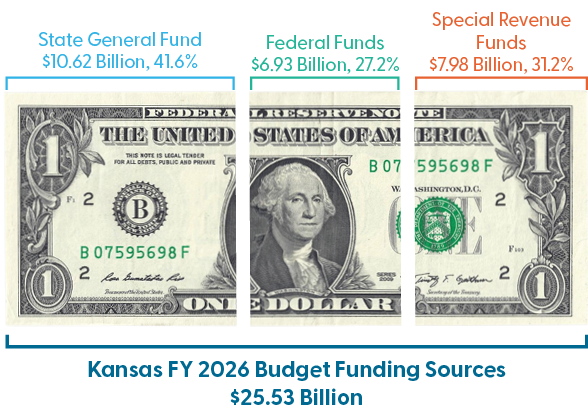 The state budget has three primary funding sources: State General Fund (SGF), federal funds, and special revenue funds. The SGF is generally the largest funding source for the state budget.
State General Fund
The SGF is the state’s largest unrestricted fund. It’s the primary funding source for state agency operations, as well as major public services like health care and education. The main revenue sources for the State General Fund include individual and corporate income taxes and sales and compensating use taxes.
Special Revenue Funds
These funds are typically funded by special fees, fines, or levies assessed by the state and are required to be spent in specific ways. There are several hundred state special revenue funds. Some examples include:
-
Agency fee funds. These funds collect revenue from licensing fees and are the primary funding source for several licensure boards, such as the Board of Pharmacy and Board of Nursing.
- The Children’s Initiatives Fund (CIF). The CIF is the only dedicated source of funding for early childhood programs in Kansas. It derives revenue from the state’s share of the Master Tobacco Settlement and is required to fund programs, projects, improvements, services, and other purposes directly or indirectly beneficial to the physical and mental health, welfare, safety, and overall well-being of children in Kansas.
Federal Funds
In most fiscal years, federal funds make up the second largest funding source for the state. All federal tax-supported funding directed to the state covers a large share of Kansas’ overall spending for support programs, health care, K-12 education, transportation, and other services. These funds typically come with restrictions on how they can be used and reporting requirements.
For programs that support the most vulnerable, federal dollars often make up a greater percentage of the funding than in the overall state budget. For example, in FY 2026, 65% of Kansas Medicaid assistance was federally funded. Other programs, such as Special Supplemental Nutrition Program for Women, Infants, and Children (WIC) and Temporary Assistance for Needy Families (TANF), are administered by the state but primarily federally funded.
Where Does the State's Money Come From?
 Kansas’ total FY 2024 budget, including federal funds, is $23.8 billion. The state has an extensive bookkeeping system that assigns all revenues to specific funds and accounts. Revenues are The state’s fiscal health depends on its ability to raise money from a variety of sources in a reliable way. Like most states, Kansas collects revenue from a mix of individual and corporate income taxes, sales taxes, property taxes, and other various smaller taxes and fees. A fair and reliable revenue system requires a balanced diversity of tax sources. The main sources of revenue include income, sales, and property taxes.
Income Taxes
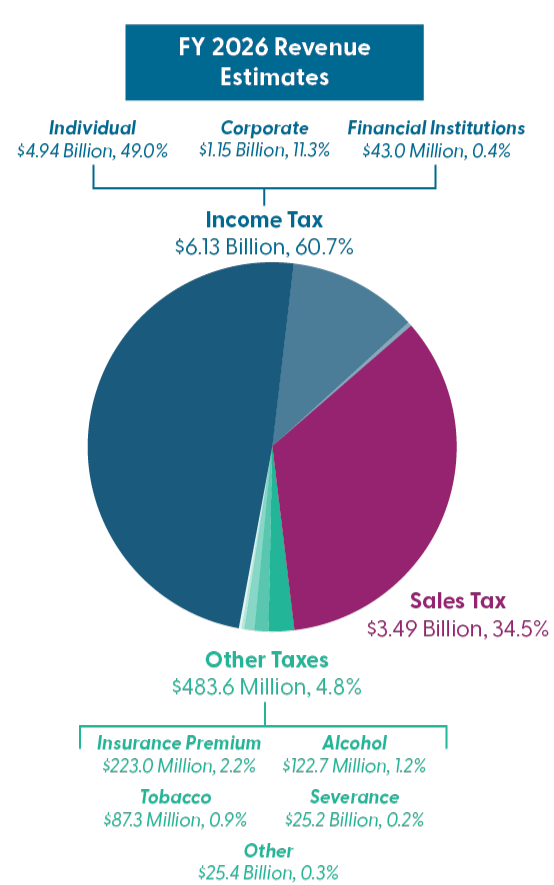
Income taxes are the cornerstone of Kansas’ revenue system, making up just under three-fifths of the State General Fund. Income taxes can be collected from individual households or businesses. Individual income taxes alone are nearly half the revenue received and are based on what an individual household earns, including wages, salaries, dividends, interest, and other income. Corporate income tax is based on business profits (net income).
Sales Taxes
Sales taxes are the second largest revenue source, representing more than one-third of annual collections. Sales taxes are levied for the purchase of goods or services, but they provide a less consistent source of yearly revenue as they are more affected by economic trends. Sales taxes tend to be regressive taxes, meaning low-income households pay a larger share of their incomes for these taxes than higher income households.
Property Taxes
Property taxes are another significant source of revenue for many governments. In Kansas, a local portion is levied by townships, cities, counties, and school districts to fund local services; a statewide portion levied by the state is used to fund public K-12 education.
This state property tax for school funding is a fixed rate that is applied to a percentage of a property’s value (known as the assessed value), resulting in a tax of $20 for every $1,000 of assessed value. Beginning in 2024, the first $75,000 of a residential property’s value was excluded from the tax calculation. There are also programs in place to reduce the cost burden of property taxes on lower-income Kansans who are seniors, blind or permanently disabled, or have dependent minors living with them.
Other Taxes
Several other smaller taxes contribute to the state’s revenue stream, including:
- Severance taxes for the extraction and production of coal, oil, or gas for profit or commercial use;
- Tobacco taxes imposed on all cigarettes sold;
- Alcohol taxes imposed on alcohol sold by retailers to Kansas consumers, or sold by distributors to clubs, drinking establishments, or caterers; and
- Privilege taxes assessed against the earnings of all financial institutions.
Where Does the State's Money Go in FY 2026?
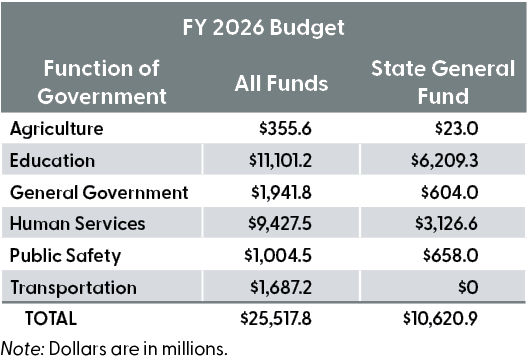 Kansas’ total FY 2026 budget is $25.6 billion, including $10.6 billion from the SGF.
The majority of the state budget’s all funds and SGF expenditures go toward education and human services. The education budget category includes agencies that provide state support of primary, secondary, and higher education.
The human services category includes agencies overseeing assistance programs, such as medical services, care and counseling for veterans, and programs to support the elderly, developmentally disabled, and mentally ill.
Budget Trends
As can be expected, the total Kansas budget has increased over time as the cost of providing services has increased due to inflation. However, the proportion of SGF to all other funds has remained relatively constant over the last 10 years.
The ratio of SGF to all other funds is impacted by several factors, including major state projects, changes in the availability of federal funds, and changes to tax policy.
Some examples include:
- Between FY 2020 to FY 2023, the state received billions of dollars in federal funding to offset the health, economic, and education disruptions caused by the COVID-19 pandemic. These federal dollars covered some expenditures that normally would have come from the SGF.
- Tax law changes, such as a decrease in income tax brackets and rates and ending the food sales tax, reduce SGF revenue. This leaves fewer funds available for the state budget.
Building a Better Budget
Budget decisions affect all Kansans because they influence the way people live.
Residents expect sufficient roadways that are adequately maintained to get to work or school. They expect safe communities and clean drinking water. They expect Kansas’ natural environment to be preserved and maintained. They expect public education that prepares young Kansans to become engaged, independent adults. Issues that may seem unrelated meet in the budget process, of which all Kansans can make an impact.
Because it directly affects everyone living in Kansas, the budget is the ultimate policy document. Building a state where all children and families have the resources they need to thrive requires constant and careful management of the budget.
There are opportunities to get involved in the budget process and stay informed about what’s happening.
-
Track bills, find contact information for members of the Senate and the House, and watch live streams of legislative sessions on the Kansas Legislature’s website.
-
Find information about the state budget, including the Governor’s proposed budget and monthly revenue reports on the Kansas Division of the Budget website.
-
Read in-depth budget analyses, forecasts, and summaries of legislation on the Kansas Legislative Research Department’s website.
-
Attend or watch meetings where assigned budget committees deliberate and decide on what to fund each year. Agendas, supporting documents, public testimony, and bills can be found at the respective web pages for the House Committee on Appropriations and the Senate Committee on Ways and Means.
-
Explore budget summaries and analyses to better understand how budget issues affect Kansas children and families on the Kansas Action for Children State Budget page.
Share

