


How Weightings Impact the Kansas School Finance Formula

Emily Barnes | November 18, 2025
After spending the spring months learning foundational information about Kansas’ finance formula, the Task Force members gained deeper insight into some weightings that influence school funding in their two-day June meeting.
After spending the spring months learning foundational information about Kansas’ finance formula, the Task Force members gained deeper insight into some weightings that influence school funding in their two-day June meeting. In this summary, we cover what they learned and how it may impact the new school finance formula that will need to be ready before July 2027.
In June, Task Force members considered the impact made by the Low and High Enrollment, Bilingual, and Transportation weightings.
The Bilingual weighting is based upon student characteristics, while Enrollment and Transportation weightings are based on characteristics of the entire district. At the beginning of the day-one meeting, legislative staff gave brief histories about weightings and example calculations, as well as spreadsheets with model runs of the large-scale budgeting impact changes to each weighting that could result.
You can listen to both days of the Task Force’s June meeting here and here.
Public Materials Provided during or about This Meeting
- June 3-4, 2025 Agenda
- High Enrollment Weighting
- Low Enrollment Weighting
- Elements of Transportation Funding
- Transportation Weighting Overview and History
- Overview of Models: Low Enrollment
- Overview of Models: High Enrollment
- Overview of the Impact of Weightings on State Foundation Aid
- English Speakers of Other Languages (ESOL)/Bilingual Education
- Legislative Post Audit Evaluating Bilingual Funding and Expenditures
- Bilingual Weighting Overview and History
- USD Transportation State Aid vs Transportation Cost 2023-2024
- Other supporting documents, including spreadsheets illustrating different weighting scenarios can be found here.
Let’s Do the Math: K-12 Funding Formula Breakdown
Before digging into the specifics of what the Task Force learned regarding a few of the weightings, it’s important to understand some specifics of how school funding is calculated in Kansas.
Since the enactment of the School District Finance and Quality Performance Act (SDFQPA) in 1992, State Foundation Aid for school districts has included a weighted school district enrollment for calculations. This was done to account for the complex variety of budgeting needs of districts across the state.
Years later, the Kansas School Equity and Enhancement Act (KSEEA) replaced the SDFQPA and established that State Foundation Aid is determined by subtracting a district’s Local Foundation Aid from its Total Foundation Aid. This means that to calculate how much state aid the district is entitled to, a few factors must first be determined: Weighted Full-Time Equivalent (FTE) Enrollment, Local Foundation Aid, and Total Foundation Aid.
First, to calculate Weighted FTE Enrollment using the weightings that are established in KSEEA, a district considers how many K-12 students attend full time. This is the district’s FTE enrollment of students.
Full-time attendance equals 1.0 FTE and is based upon the district’s enrollment on September 20 of each school year. A district can use the enrollment of the current school year or the school year immediately preceding it, whichever is greater. If a student attends part time, then the FTE is counted for the portion of the day they attend. For instance, a student enrolled as a Preschool-Aged At Risk student will count as 0.5 FTE.
Each weighting has its own factor that is added to the district’s FTE enrollment. Some of them apply to the entire district, while others only apply to certain demographics. For instance, the Low and High Enrollment Weightings and Transportation Weighting apply to the district. However, the Bilingual Weighting is specific to a student’s demographics and is calculated according to the formula in KSEEA.
The Total Weightings must first be calculated by multiplying the FTE Enrollment by the appropriate weighting factor, which is set in state law.
Weighting Factor x FTE Enrollment = Total Weightings
Now that the Total Weightings has been determined, the Weighted FTE Enrollment can next be calculated by adding the Total Weightings to the district’s FTE Enrollment.
Total Weightings + FTE Enrollment = Weighted FTE Enrollment
The Weighted FTE Enrollment is then multiplied by the Base Aid for Student Excellence (BASE), which is the guaranteed amount of funding per student the district receives for general education. This determines the Total Foundation Aid, or the total amount of funding a district needs to provide educational services to its students. A higher number of weightings or increases in student population will increase a district's Total Foundation Aid.
BASE x Weighted FTE Enrollment = Total Foundation Aid
However, the statutory requirements in KSEEA for local contributions mean that a district must also calculate its Local Foundation Aid. This form of aid comes from revenue sources like local taxes and levies, money that is distributed for non-resident students of the district (which can include students in foster care), and payments received by the school district for special education state aid or catastrophic special education state aid. These sources of revenue are added together to make up Local Foundation Aid.
Once all these calculations are completed, the district subtracts Local Foundation Aid from Total Foundation Aid to determine the State Foundation Aid amount, which is what the state must fund.
State Foundation Aid = Total Foundation Aid – Local Foundation Aid
As the finance formula developed and Kansas worked to fine tune the details, it became clear that the complex nature of Kansas’ population meant it needed to find ways to accommodate the unique needs of students across the state. Weightings allow the state to do just that.
June Meeting Summary
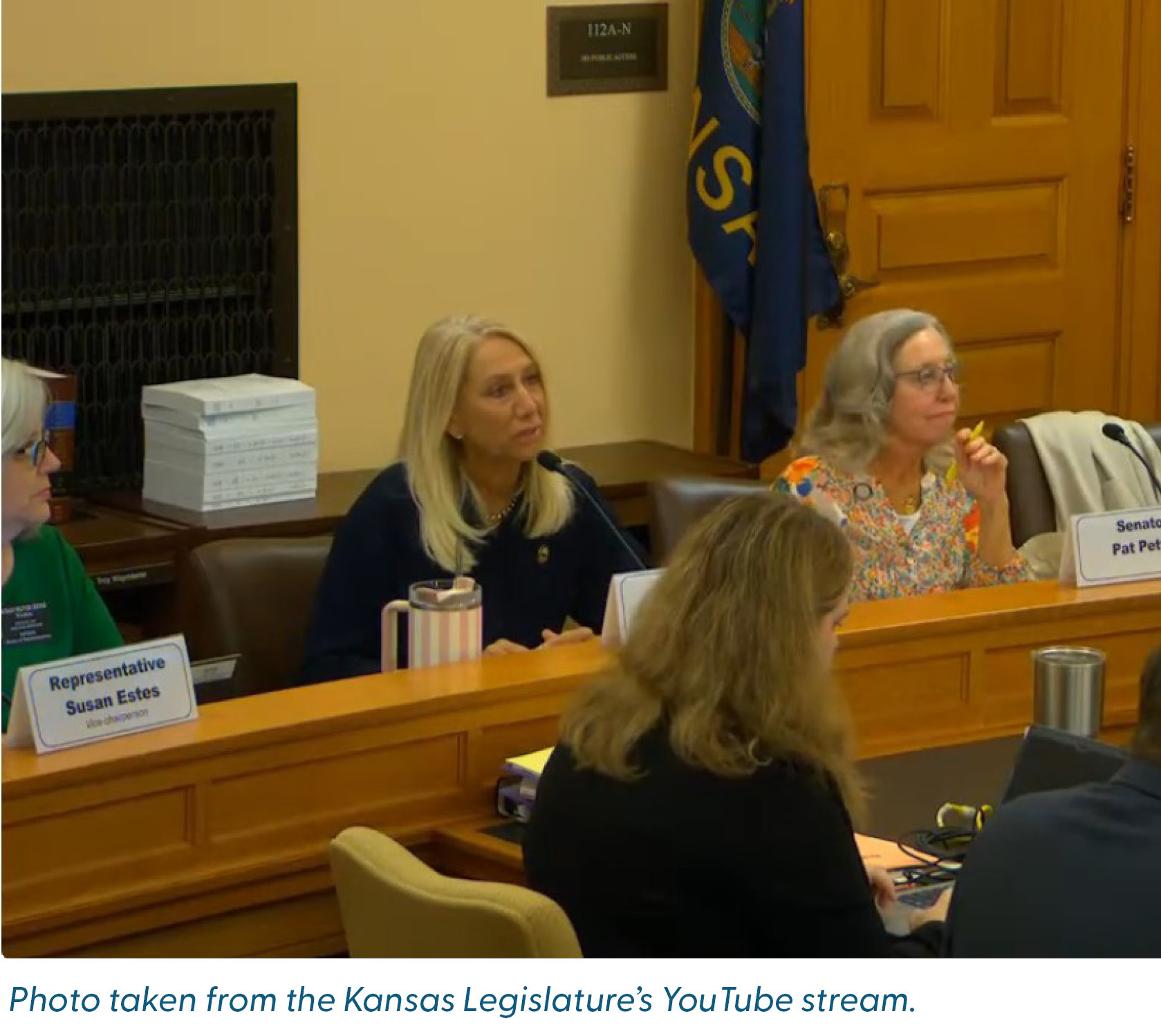
The majority of the Task Force’s two meeting days in June were spent learning about the history of specific weightings and considering the impacts of each through examples of what occurs when certain weightings are changed or removed.
Low and High Enrollment Weightings
Task Force members learned from legislative staff about the history of Enrollment Weightings. Each district is classified as either Low or High Enrollment, based on the number of students enrolled. Most school districts in Kansas receive a Low Enrollment Weighting.
The Low Enrollment Weighting was initially established in 1992 to address the unique financial needs of smaller districts. Districts with lower enrollment can face higher costs of educating students when considering economies of scale – the idea that average costs of production reduce as output volume increases. In response, the state developed a mathematical formula to offset this burden. They used median budgets in districts of various sizes to give reasonable expense amounts that created the projected formulas.
The Low Enrollment Weighting applies to districts that have fewer than 1,622 students enrolled and is broken into three tiers of Low Enrollment – fewer than 100 students, 100-299, and 300-1,621 students. Districts that have more than 1,622 students enrolled receive the High Enrollment Weighting.
The lowest tier of enrollment weightings uses a weighting factor of 1.014331, which gradually reduces as enrollment numbers increase, up to High Enrollment Weighting’s factor of 0.03504. Remember, when calculating the formula, these weighting factors are multiplied by the school district’s enrollment to determine that weighting’s value before being multiplied by BASE to determine the dollar amount.
The High Enrollment Weighting was created in response to the need for Low Enrollment Weighting. It was previously called the “correlation weighting,” but was renamed to High Enrollment Weighting in 2006. The threshold amounts have changed a few times and settled at 1,622 students.
The Task Force wondered whether the adjustments in thresholds changed due to reducing enrollment in the districts. Legislative staff explained that, according to historical record, school districts with higher enrollment had needed more local funds for education and the High Enrollment Threshold may have come about from a proposal to financially assist higher enrollment districts according to the SDFQPA. During discussion, though, it was noted that many of the changes in the High Enrollment Weighting happened around 2005, and there is not an exact record of why.
Before closing the explanation about these weightings, legislative staff explained that after the establishment in 1992 of the SDFQPA, the constitutionality of the Low Enrollment Weighting was challenged. Although initially considered unconstitutional by the district court, the Kansas Supreme Court maintained that there is a common-sense rational basis for extra funding in low enrollment situations, and Kansas has continued to use the Low Enrollment Weighting.
The Task Force members wondered if there is a way to make the Enrollment Weightings simpler and possibly remove the High Enrollment Weighting without hurting districts. Although it could be possible, they discussed the potential challenges in redistributing the funds effectively. They requested more historical context about decisions made and wondered about the current trends in enrollment, like among students who qualify as At Risk or Special Education.
Transportation Weighting
Kansas began providing transportation funding in 1965, and it continued mostly unchanged for more than 50 years. The current Transportation Weighting in KSEEA replaced that funding formula in 2018 and uses similar methodology.
State law requires that transportation is provided to students who live:
- 2.5 miles or more away from the school;
- Outside of corporate limits of a city and are 2.5 miles away from the school building; or
- In one city while attending a school building in another city and are 2.5 miles away from the building.
The current model allows districts to create the transportation density and per capita allowance schedule and adjusts for inflation. It uses a stepped approach to establish a minimum amount of funding for districts with the highest densities by using density ranges for determinations.
(Note: The Transportation Weighting does not include Special Education transportation reimbursement.)
Districts use the following steps to determine their Transportation Weighting:
-
Determine the District’s Transportation Density – Divide the total square mileage of the school district by the number of transported students.
- This number does not actually compute correctly, and the language was written into law incorrectly. The intent was to maintain transported students per square mile. Legislative staff noted there is an opportunity to correct this technical error.
- “Transported students” are the number of students in the preceding school year’s enrollment who resided within 2.5 miles of the school using the “usually traveled road.” Non-resident students do not count in this amount.
- This number does not actually compute correctly, and the language was written into law incorrectly. The intent was to maintain transported students per square mile. Legislative staff noted there is an opportunity to correct this technical error.
-
Determine the District’s Per Capita Allowance – Using the statutory schedule for the density figure, the district multiplies the number of transported students by the corresponding Per Capita Allowance amount to determine the transportation funding amount.
-
Adjust for Inflation – Multiply the transportation funding amount by an inflationary adjustment. This determines the amount of transportation funding provided by the Transportation Weighting. The inflationary adjustment is calculated by dividing the BASE amount for the current school year by the BASE amount for the 2018-2019 school year.
-
Determine the Transportation Weighting – Using the transportation funding amount determined in Step 3, divide by the BASE amount for the current school year.
- Apply Funding Cap (if necessary) – If a school district’s Transportation Weighting amount exceeds 110% of the district’s transportation expenditures for the preceding school year, the transportation weighting amount will be adjusted to meet the 110% threshold.
The Task Force heard about some of the elements of transportation funding, including distance, hazardous conditions, and population density. A few other states use shorter distances to determine who qualifies as a transported student while other states waive a distance requirement when hazardous conditions make it difficult or dangerous for a student to walk to school.
Members of the Task Force discussed the current distance requirement of 2.5 miles, and some worried it is too far. The Task Force also discussed consideration of population density, actual transportation costs, and factors like homelessness and transportation for summer programs and extracurriculars.
Bilingual Weighting
The last weighting the Task Force learned about during the June meeting was the Bilingual Weighting. This applies to students who are new to the country and/or need assistance learning to speak English when they receive English Language Learner (ELL) services.
When calculating this weighting, the district will use either the Contact Hour Determination (the amount of time students are enrolled for instruction with licensed teachers) or Headcount Determination (the number of qualifying students enrolled), whichever is greater. Districts experience needs for English Language Learner services in different ways based upon their populations.
Districts follow standards and criteria that were set by the Kansas State Board of Education for bilingual education services. This includes identification of students who need the services, evaluation of their performance, and the exit procedures from the education program based upon the student’s English proficiency. To count toward the weighting, students must qualify for the educational services and be taught by a teacher who is licensed to teach in the bilingual education program. Details about these requirements can be found in the Kansas State Department of Education’s enrollment handbook.
When originally established in 1992, the Bilingual Weighting was a component of the “program weighting” along with Career Technical Education (CTE) Weighting. Since 2005, the Bilingual Weighting has been calculated by multiplying the FTE enrollment by a weighting factor of 0.395. In 2017, the English Learner Headcount Enrollment option was established in KSEEA with a weighting factor of 0.185. These factors have remained the same since.
State law requires each district to maintain a bilingual education fund out of which all directly attributable expenses for its bilingual education program shall be paid. Remaining money in the fund is carried forward into the bilingual education fund for the following year. Starting in 2018, each district is required to transfer a portion of their supplemental general fund – otherwise called the Local Option Budget (LOB) – to the bilingual education fund. The amount transferred from LOB is used toward the district’s bilingual weighting.
After reviewing a Legislative Division of Post Audit report showing ELL students in Kansas take more time to become proficient in English than the national average, Task Force members were concerned about whether the program is implemented effectively and wondered about why funds may be used to pay classroom teachers rather than only the specifically credentialled English Language teacher. This led to discussion about the different ways school districts may encounter language needs in their student population. For instance, in a school with high student populations in ELL services, they may require all teachers in the building to be certified.
The group also discussed monitoring and support services offered to students as they transition out of programs to ensure continued student success.
Weighting Models and Examples
The Enrollment and Bilingual weightings presented to the Task Force included model runs to illustrate how changes or removing weightings altogether would impact each district’s funding. Legislative staff also provided examples of what could happen if the weighting was moved to the BASE rather than functioning as a weighting, as well as the impact of changes at different enrollment levels and/or different multiplier amounts.
Legislative staff did not show alternative models for Transportation Weighting, but the Task Force contemplated the need to consider safety hazards or the variety of transportation needs based on district qualities. They also discussed how transportation funding is pooled into general funds and the possible need to consider which vehicles are used, how services are contracted, and safety needs.
The Bilingual Weighting Models allowed Task Force members to review what happens both without a bilingual weighting and when it is rolled into the BASE. They also reviewed what happens when school districts are only offered contact hours or headcount amounts. Legislative staff also presented a tiered model with a higher weighting for a “newcomer” student who has lived in the country for less than a year.
These models helped illustrate the tradeoffs that happen when changes to the formula are made. During the presentation, legislative staff explained that “every facet of the formula is connected to something else,” and changes to single components could have larger impacts on another area of the formula.
Broader Discussion and Recommendations
The Task Force members voiced they would like to see models combining both Low and High Enrollment and to consider whether districts can control enrollment trends. They wondered about the ability to consider where low enrollment districts are and how to understand the dynamics for smaller districts that are near higher populated areas. They would like to understand density and possibly investigate the geographic factors that may lead to sparsity.
When discussing the Transportation Weighting, Task Force members stated they would like to consider how to clarify the formula. They wondered about considering factors like grade level of the student and different hazards they may face. They also hope to better understand how students use the services and whether routes and vehicle selection are most efficient. This could also mean adjusting the 110% cap for funding to help the weighting more accurately reflect the costs districts incur.
As the Task Force contemplated the Bilingual Weighting, they wondered about tiering this weighting to align with student needs. This idea opened discussion about creating a "newcomer” classification. The Task Force also wondered about how to better report expenditures and costs related to services to improve school district accountability.
The members of the Task Force reiterated their intent to align the finance formula to increase student outcomes. They discussed simplifying the formula while ensuring equity and balancing proposals with the need for local decision making and accountability. This could mean seeking input from stakeholders in the communities, such as from superintendents, educators, parents, and others.
Remaining Meetings
Before adjourning the June meeting, the Task Force identified some other priorities for their work, including investments in early childhood education and kindergarten through 3rd grade literacy proficiency. They discussed the need to consider outcomes based upon multiple data points and how to look for validated measures that accurately reflect how students are learning.
For the rest of 2025, the Task Force met two days each in July, August, and September. The discussion was robust and covered a wide range of topics. As the summer progressed, the Task Force discussed the At Risk and Special Education Weightings, which we’ll cover in the next blog in this series of summaries.
< Back to the news listShare

