


July 2026 Newsletter

Kansas Action for Children | July 30, 2026
Want to receive this weekly recap as soon as it's released? Sign up for our emails here.
There’s a Hunger Crisis in Kansas
Childhood hunger isn’t just an empty stomach. Kids can’t grow, learn, and thrive when they’re worried about where their next meal is coming from. When kids don’t get enough to eat, the effects can ripple throughout their entire lives – lower academic scores, worse health outcomes, and struggles with mental health.
Recent data is showing an alarming trend – kids getting kicked off of the SNAP program, food insecurity among Kansas kids rising, and cost shifts to the state budget that will set up the 2027 Legislature to choose between SNAP program stability or risking benefits for all SNAP enrollees.
It’s not a mystery to how we got here. Kansas kids aren’t going hungry because parents aren’t “doing their part.” Kids are becoming increasingly food insecure because the government’s policy choices aren’t proactively strengthening the programs that feed hungry kids.
Every time lawmakers put up a new barrier to accessing SNAP, make enrollment processes more burdensome, or decline to target tax relief for families struggling the most, they are creating a future where those families remain stretched thin and with few options to get on a better path to financial stability.
Year after year, federal and state decisionmakers weaken programs that ensure families have enough to eat for every meal. Kansas – and Congress – can choose differently to address this crisis and ensure every kid has the best opportunities to thrive.
Read on to see the concrete data that shows more Kansas kids going hungry.
Child Food Insecurity Rises in Kansas
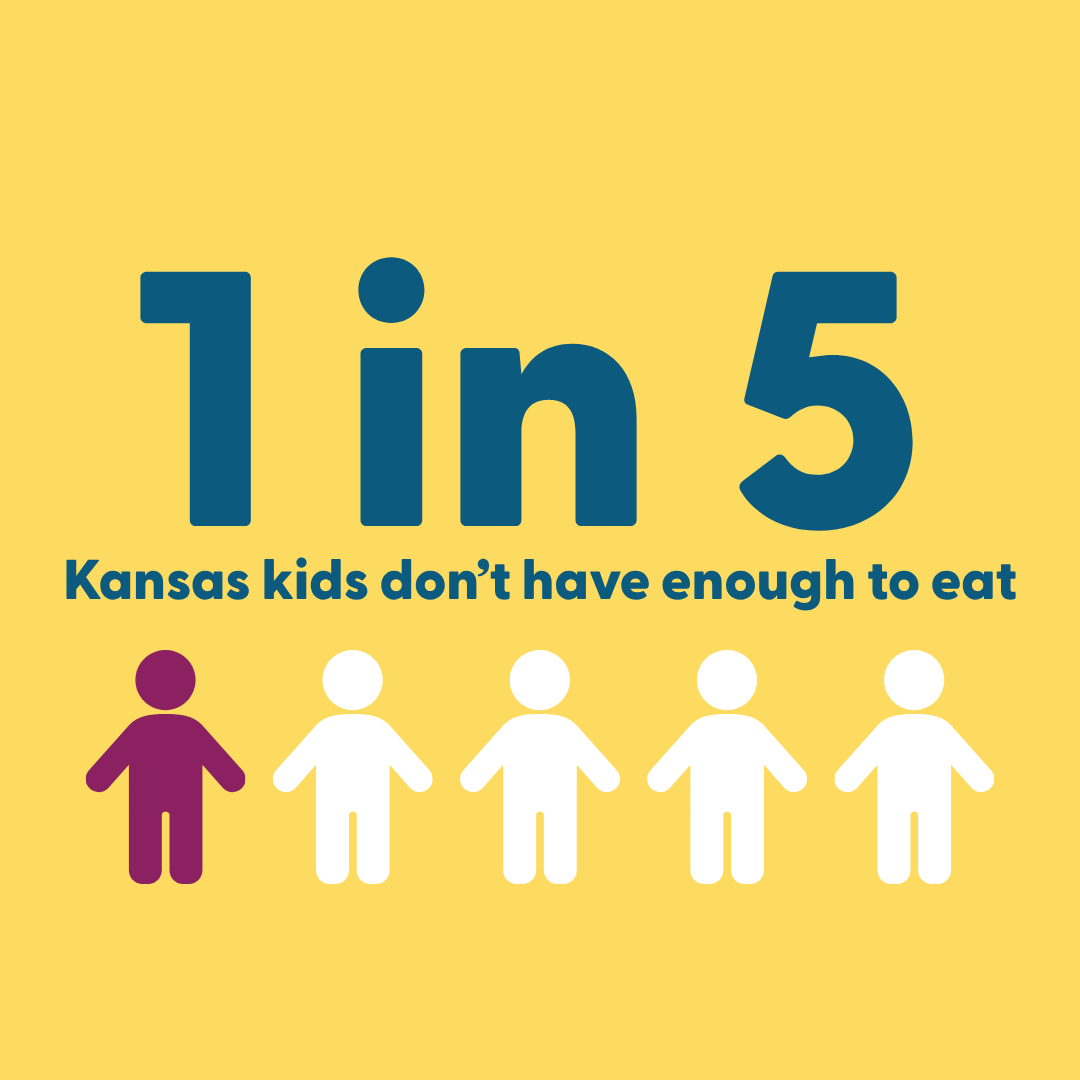 Feeding America has released its annual food insecurity data just this week. The “Map the Meal Gap” report shows that in Kansas, childhood food insecurity increased from 18.4% in 2023 to 20.9% in 2024 – roughly 17,200 more kids. And this data predates any of the SNAP participation losses that started showing up in 2025 as a result of H.R. 1, the federal bill passed by Congress last summer, and Kansas law changes in 2025 and 2026.
No kid should go hungry, especially in the “Breadbasket of the World.”
H.R. 1 Anniversary – In the News
A year into the implementation of H.R. 1, the “Big, Beautiful Bill,” thousands of Kansans are feeling its impact. Data from the Department for Children and Families shows a story of continually decreasing SNAP numbers, ending the fiscal year in June with just 163,000 SNAP enrollees compared to last July’s participation of 188,000.
Among the 25,000 Kansans who lost access to SNAP in the last year, around 11,000 are kids.
Here’s some of the media coverage we’ve collected detailing SNAP losses, incoming state penalties, and health impacts that advocates are tracking.
- Kansas food banks feel impact of Big Beautiful Bill on SNAP benefits (Topeka Capital-Journal)
- Missouri and Kansas error rates still too high to avoid paying more for SNAP (The Beacon)
- Kansas organizations detail impact of ‘One Big Beautiful Bill’ one year later (WIBW)
- Kansas grocery stores are facing losses as SNAP benefits shrink (Topeka Capital-Journal)
- Downstream effects of federal cuts seen in Kansas budget, access to healthcare, food assistance (Kansas Reflector)
- Food banks struggle as SNAP losses in Kansas surpass 25,000 people (KSNT)
- Do Kansas lawmakers plan to reverse SNAP cuts as thousands lose benefits? (KSNT)
- Harvesters warns Kansas, Missouri could face millions in new SNAP costs under ‘One Big Beautiful Bill’ (KCTV)
SNAP Error Rate Will Result Millions in Penalties to Kansas
Starting next fall, states will be required to pay part of the cost of SNAP benefits for the first time in the program’s history. This is due to new rules under H.R. 1 penalizing states who have a “SNAP payment error rate” higher than 6%.
Based on Kansas’ current SNAP payment error rate of 9.44% in FY 2025, that could leave Kansas on the hook for more than $40 million a year. Lawmakers will need to account for this in the next budget passed during the 2027 session. If they are unable (or unwilling to) fund the state’s portion, SNAP benefits could be at risk for the 163,000 Kansans who currently use the program.
Read our breakdown of how the payment error rates work, what is driving these errors, and what’s at stake for Kansas families.
Budget Process and the State’s Fiscal Health
With the state needing to account for millions in costs due to H.R. 1, we’re already analyzing how lawmakers might proceed with the state’s next funding plan, which is likely to be initially based on what they planned for FY 2027.
In our recent blog, we take a deeper dive into how the $10.75 billion spending plan for FY 2027 came to be – and how it might inform what tough choices lawmakers might have to make next session.
Don’t Forget to Vote!
Kansas primary election is next Tuesday! Don’t know who’s on your ballot or where your polling location is? Look up your voter information on the Secretary of State’s “Voter View” to see a sample ballot, your party affiliation, and where to cast your ballot on Election Day.
Polls close at 7 p.m. on August 4.
Share

