

Medicaid Spending: Where Does the Money Go?

Megan Leopold | August 26, 2026
The Kansas Medical Assistance Program, otherwise known as Medicaid, provides long-term health care to eligible low-income individuals. This includes dependent children, parents, pregnant women, people with disabilities, and older adults. The related Children’s Health Insurance Program (CHIP) provides similar coverage at a low cost to uninsured children living in low-income households.
In FY 2026, 352,753 Kansans were enrolled in Medicaid and 56,841 children were enrolled in CHIP.
As more state conversations focus on the state funding that goes toward the program, it’s important to understand how Medicaid (also known as KanCare) works in Kansas and how potential funding challenges could impact hundreds of thousands of Kansans’ access to health care.
Medicaid is administered by states, and program administration can vary widely. However, each state must meet minimum standards set by federal laws and regulations. For instance, these regulations include a prescribed list of services that each state must provide as part of their program and a provider network that offers adequate services in all areas of the state. The federal agency overseeing state compliance of Medicare, Medicaid, CHIP, and the ACA Marketplace programs is the Center for Medicare and Medicaid Services (CMS).
With actual FY 2025 expenditures totaling $6.27 billion from all funding sources, including $1.85 billion from the State General Fund (SGF), Medicaid is one of the largest items in the state budget. This large expenditure, however, is divided across a complex network of programs, services, and populations.
Before getting into how the $6.27 billion is divided across populations and services, there are a few key concepts that are important to understand.
Need to Know #1: How Medicaid Funding Needs Are Determined
Federal Medical Assistance Percentage (FMAP)
Medicaid is a partnership between the state and federal government, with both contributing to the overall cost. Each year, the federal government sets a Federal Medical Assistance Percentage (FMAP), which determines the state and federal shares of funding for Medicaid. The FMAP is based on the average per capita income for each state relative to the national average. The federal government pays a larger share of Medicaid costs in states with lower average personal incomes relative to the national average, so it is different for each state. Although it changes each year, the split generally hovers around 60% federal and 40% state, meaning that the federal government will pay roughly 60 cents for every dollar spent on Medicaid.
The FY 2026 FMAP for Kansas is 60.67, meaning that the federal government will pay 60.67% of the total Medicaid assistance costs. Over the last 20 years, the FMAP has fluctuated, with the lowest being 54.74 in 2018 and the highest being 69.68 in 2010. Although the shift is generally less than a percentage point or two each year, even a small shift can make a large difference in the amount of state funds needed for the program because of the large amount of money involved.
Managed Care Organization Rates
In January 2013, the Kansas Medicaid program was privatized and rebranded as “KanCare.” This represented a shift from the program being run entirely by the state to contracting with private companies — called managed care organizations (MCO) — to provide services to eligible individuals. Though the Kansas Department of Health and Environment (KDHE) still acts as the administrator of KanCare, most services are now coordinated through Kansas' three MCOs — Healthy Blue, Sunflower Health Plan, and UnitedHealthcare Community Plan of Kansas. The rates paid to these companies, often referred to as “capitation payments,” make up the largest expenditure in KanCare.
MCO rates are set by KDHE with the help of actuaries who review actual cost data and health trends to ensure rates reflect the actual cost of care as closely as possible. To determine the most accurate rate, each person enrolled fits into an “eligibility category,” and each category has a different monthly rate. The rate is based on the type of care a certain demographic is expected to need. For example, a child who qualifies for Medicaid due to their family's income usually needs less care than an elderly individual who is eligible because of a physical disability, so their rates are different. This system helps ensure the state pays MCOs an amount that matches the care individuals need and what it actually costs to treat them.
Though the state does not want to overpay the MCOs, rates must be high enough to allow MCOs to attract enough providers to meet federal requirements regarding provider access and adequacy. KDHE’s actuaries check the MCO rates on a regular basis and adjust them as needed (but typically twice a year) to ensure they remain in alignment with real costs.
Human Services Caseload Estimates
Medicaid is an entitlement program, which means that to receive federal matching funds, it must provide immediate eligibility to anyone who qualifies and may not have a waitlist. For this reason, state legislators must budget to provide a minimum level of services each fiscal year. In addition, Medicaid is a large expenditure that can change rapidly based on policy changes and the number of beneficiaries enrolled. To ensure their budget supports the mandatory aspects of Medicaid, the Legislature has developed a Human Services Consensus Estimating Group.
The Human Services Consensus Estimating Group consists of both legislative and executive branch staff and meets twice each year to estimate the required expenditures for Medicaid, foster care, and cash assistance (TANF). Using updated data, including population data and any adjustments to MCO rates, the group updates previously made estimates and creates new estimates for future years. These are reported to budget committees, giving lawmakers an opportunity to adjust the budgets of impacted agencies as needed.
Need to Know #2: The Flow of Funds
Medicaid funding flows down from the federal government through several layers that finally makes its way to actual payments to providers on behalf of enrolled Medicaid recipients.
The Legislature Funds State Agencies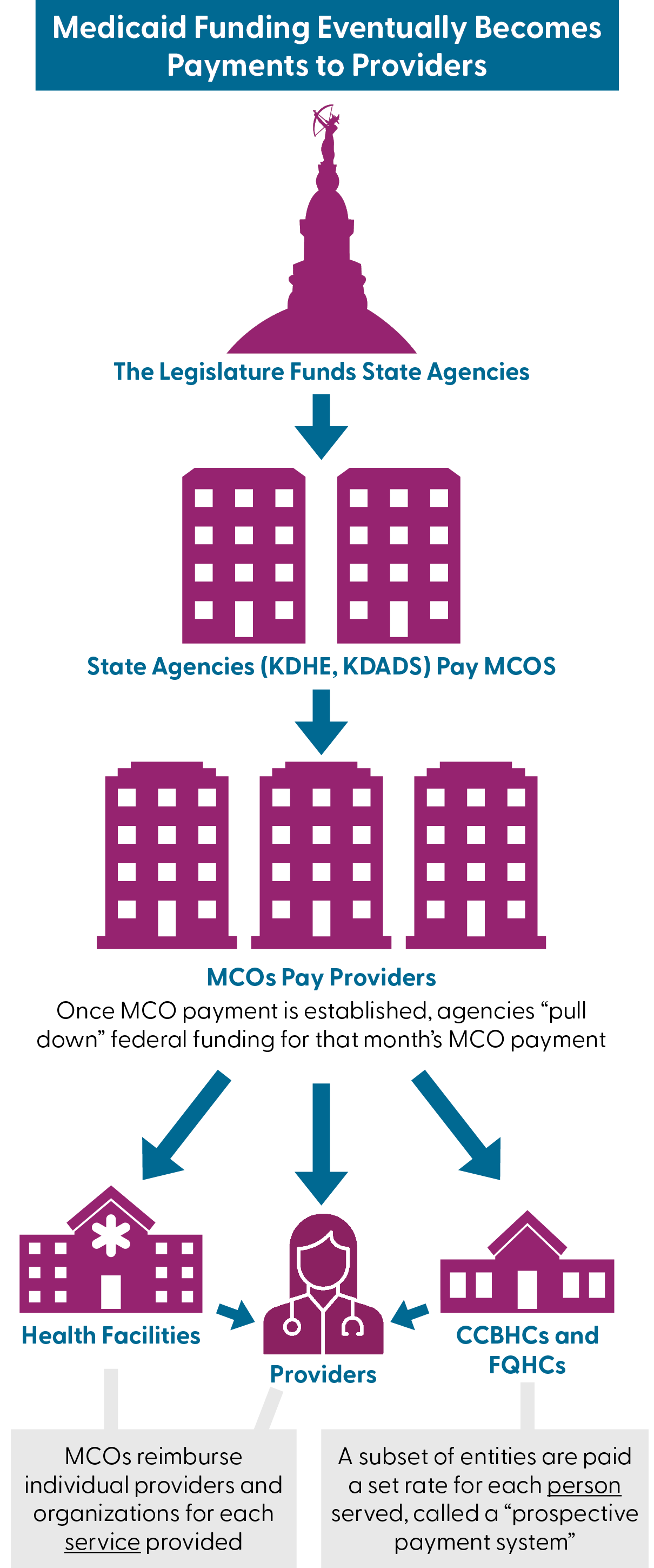
As part of the general budget process, the Legislature appropriates a specific amount of money for state agencies to run KanCare.
In Kansas, KanCare is funded through two state agencies: the Kansas Department of Health and Environment (KDHE) and the Kansas Department for Aging and Disability Services (KDADS). KDHE administers the program as a whole and is responsible for contract oversight, claims management, and ensuring compliance with federal law. KDADS administers the home and community-based services (HCBS) waivers, a system of community-based supports for individuals with disabilities or intensive medical needs.
State Agencies Pay the MCOs
Once the Legislature approves money in the state budget, KDHE must pay the MCOs for their services. MCOs are paid monthly using a rate based on the number of people enrolled in each eligibility category. This is known as the per-member per-month rate.
Once KDHE has established the total monthly payment for each MCO, they are able to draw down the federal portion of the total payment. Federal funds are available only as a match to state funds being spent and cannot be used to fund the program alone. The state and federal funds combine to create the full MCO payment.
MCOs Pay the Providers
While MCOs receive payment based on the number of members enrolled, providers are (in most cases) reimbursed by MCOs based on the services they provide to each beneficiary. For example, a doctor provides a child's well-visit, submits a claim for that service, and is reimbursed by the MCO with whom the patient contracts.
KDHE maintains a list of fee-for-service rates for all required Medicaid services. These rates represent the minimum amount MCOs are obligated to reimburse providers; current rates, called a “fee schedule” can be found on the KanCare website. While the state dictates the minimum allowable rate, MCOs have the ability to pay providers at a rate that exceeds the fee-for-service rates and also have the freedom to negotiate with providers. These negotiations — which do not involve the state — can result in varying reimbursement structures and rates among the three MCOs.
Though most services are reimbursed using the fee-for-service structure, certain facilities, such as federally qualified health centers and certified community-based health centers, use a prospective payment system (PPS), which is where those facilities are paid a consistent rate for each individual served, regardless of the services provided. This rate is based on the average cost per person at each specific health center, so will vary from one facility to the next. The state has authority to establish either a daily or a monthly pay rate and resets the rate on a yearly basis.
Where the Money Goes
Medicaid is not a one-size-fits-all program. It serves individuals ranging from young children with no known health concerns to adults with complex medical needs. It covers services ranging from annual exams and preventative care to the fitting of complex wheelchairs and assistive technology. In addition, it pays a variety of providers who range from small town family doctors to home health aides to specialists at hospitals.
This diversity in services, population, and providers presents a challenge to legislators who are working to make the program as efficient as possible while ensuring that the needs of eligible Kansans are met. One funding cut or policy change can have a very different impact across programs and populations.
Who Can Enroll in Medicaid in Kansas
All persons who receive KanCare must reside in Kansas, be a U.S. citizen,1 and meet several eligibility criteria to qualify. Medicaid eligibility falls into two broad categories: those eligible due to their income level and individuals eligible due to a disability. Within these categories, individuals have specific eligibility standards that must be met.
As a non-expansion state, adults in Kansas do not qualify for Medicaid unless they have a qualifying disability, are pregnant and meet the income threshold, or are the caretaker of a child and have a household income of less than 38% of the federal poverty level (FPL). For reference, 100% FPL in 2026 for a family of four is $33,000 a year, meaning 38% FPL for the same household size is just $12,540 a year.
The following populations are eligible for Medicaid in Kansas:
- Infants and children whose families earn less that 138% FPL and infants born to a mother on Medicaid
- Pregnant women up to 171% FPL
- Parents or caretakers whose income is less than 38% FPL
- Adults age 65 and older and/or individuals with disabilities who receive Supplemental Security Income
- Children in foster care
- Adopted children with special needs
- Adults younger than age 26 who have aged out of foster care
- Children living in long-term care institutions
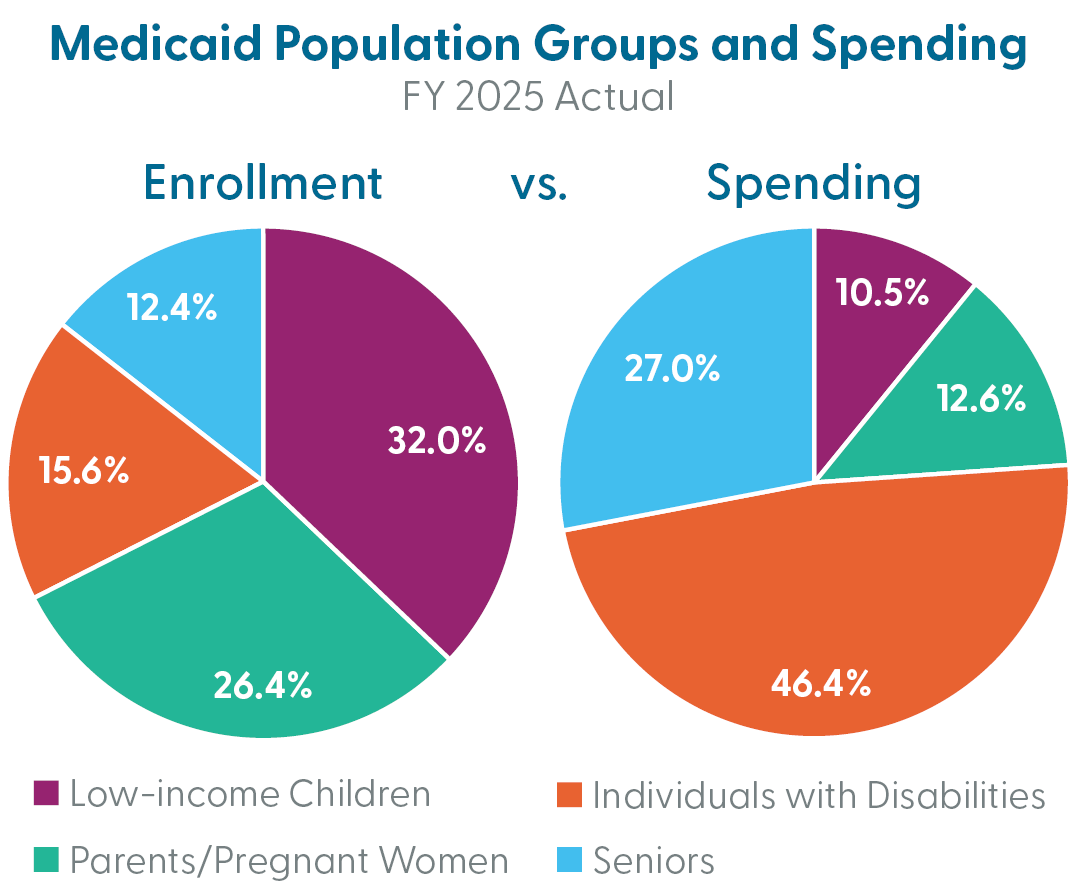
Because Medicaid serves such a wide range of individuals, the funding allocated for each varies greatly. While children and caregivers make up 58.4% of the population served by Medicaid, they make up only 23.1% of total Medicaid expenditures. In contrast, individuals with disabilities make up only 15.6% of the total population but are 46.4% of the total spend.2
What Medicaid Funds
Medicaid programs are divided into several large categories across agencies:
- KDHE KanCare | 40.1%: These are primarily the expenditures paid to MCOs to cover per-member per-month payments for enrolled beneficiaries
- KDADS KanCare | 32.2%: Payments to MCOs for mental health and long-term care expenditures within KDADS’ purview
- KDADS Non-KanCare | 3.5%: Services that are paid directly by the state and do not go through MCOs, such as evaluations for state hospitals, HCBS waivers, and programs for the elderly like the Program for All-inclusive Care for the Elderly (PACE)
- KDADS HCBS Waivers | 24.0%: Payments to the MCOs for HCBS waivers. These programs provide targeted medical and non-medical services to specific groups, such as older adults or individuals with physical, intellectual, or developmental disabilities
- Other expenditures (0.1%) are a very small part of the overall spending and include expenditures within the Department of Corrections to provide care for inmates and Intermediate care facilities for the Intellectual/Developmentally Disabled (I/DD) population
KanCare medical (non-waiver) expenditures within KDHE and KDADS are by far the largest within the Medicaid program, totaling around 72% of all Medicaid expenditures. In these two categories, the largest expenditures are the per-member per-month payments made to the MCOs for enrolled beneficiaries.
The KanCare MCOs coordinate both medical services, including mental health and substance use services, as well as all HCBS waiver services. For this reason, the vast majority of Medicaid spending goes directly to the MCOs. Although the state pays for some services directly, 92.6% of expenditures during FY 2026 fell into the category of managed care. This amounted to just over $5.4 billion.
HCBS Waivers
Home and Community-Based Services (HCBS) waivers are Medicaid programs designed to provide individuals with long-term care in their homes or communities rather than a nursing home or hospital. They are called “waivers” because they waive standard rules to allow Medicaid to pay for support services in everyday residential settings. Waivers must be approved by the federal government and, because they are not included in the minimum required service list provided by the federal government, they are able to have a waitlist.
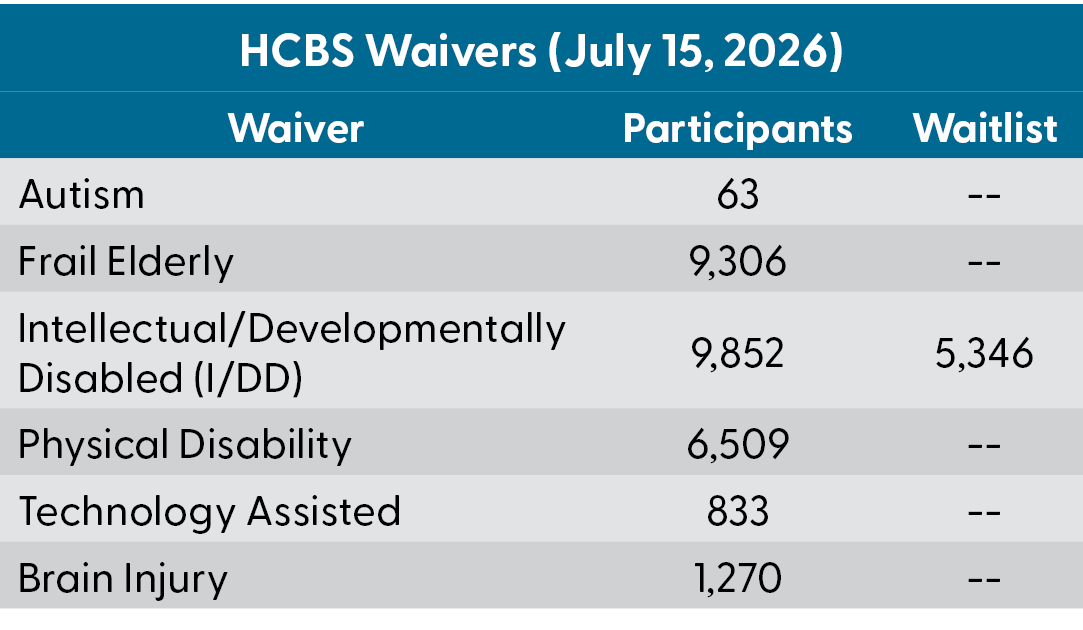
Kansas has six HCBS waivers, each serving a different population. The I/DD waiver requires the most funding, with the Brain Injury waiver requiring the least. The following lists each waiver with the number of eligible participants as of July 15, 2026:
Medicaid Funding Over Time

Kansas has seen a steady growth in Medicaid expenditures over the past 10 years. Prices for medical care typically grow more quickly than prices in other sectors. Using the Consumer Price Index, overall prices for medical care increased by 3.3% in June 2024 from the previous year. During that same time frame, overall prices (excluding medical care) grew by only 2.9%.
While this accounts for some of the increased Medicaid spending, the last five years have seen more substantial growth due to funding increases added by the Legislature. Challenges like low provider rates, a shortage of direct service providers, and nursing homes struggling to meet the needs of an aging population have caught the attention of legislators. Recent funding additions have helped support the program, but have not solved the underlying issues. KanCare still faces a slew of provider rates that haven't been increased in decades, growing demands in the areas of behavioral health, a growing aging population, and a continuing medical workforce shortage.
The need for continued investment in KanCare comes at a time when the Legislature is facing an unbalanced budget and a need to curb spending. This puts lawmakers in a tough position. To complicate matters, lawmakers will already be forced to deal with the ramifications of new federal regulations included in H.R. 1 that limit state-directed payments. This will likely mean a decrease in reimbursements to certain providers, which will put further stress on an already fragile system.
Ensuring Medicaid can continue providing care to 400,000 Kansans requires the Legislature to make a deliberate choice in the coming legislative session. They can choose to sustain the program that keeps kids healthy, elderly Kansans cared for, and people with disabilities supported. If the Kansas Medicaid program undergoes careless cuts, however, those short-term savings will be felt in emergency rooms, police stations, and jails as Kansans lose access to preventative care for their physical and mental health.
1 Provisions in H.R. 1, passed by Congress in July 2025, state that lawful permanent residents may be eligible after a five-year waiting period.
2 Kansas Action for Children analysis of the Kansas Medical Assistance Report, Fiscal Year 2026 as of July 21, 2026 as prepared by The Division of Health Care Finance, Kansas Department of Health and Environment. https://www.kancare.ks.gov/home/showpublisheddocument/6876/639215142805400000. (Note: Population and spending data does not include the following populations: MediKan, DCF, KJCC, SOBRA, Tuberculosis, Breast and Cervical Cancer, Inmate and the Aids Drug Assistance Program. These populations make up only 2.3% of the Medicaid population.)
Share

