


Recent Estimates Show Increased State Revenues — But the Outlook is Far from Certain
Nathan Kessler | December 9, 2025
The Consensus Revenue Estimating (CRE) group met in November to revise their forecast for state revenue in this fiscal year and in FY 2027. This group meets twice a year, in November and April, to reassess the outlook based on current receipts and economic conditions. The group is composed of legislative staff, the Director of the Budget, and economists from state agencies and major universities.
The forecasts that come out of this meeting are the assumptions that lawmakers use when working on the budget during the legislative session, making the November meeting one to pay attention to.
Last month, the CRE group revised its revenue projections upward based on higher individual income tax receipts than expected so far this year. However, corporate tax collections have been falling short, and the group doesn’t expect that to change in the coming months. Let’s dig into November’s estimates to see what the group expects for both state revenues and the broader economy.
Revenue Forecast
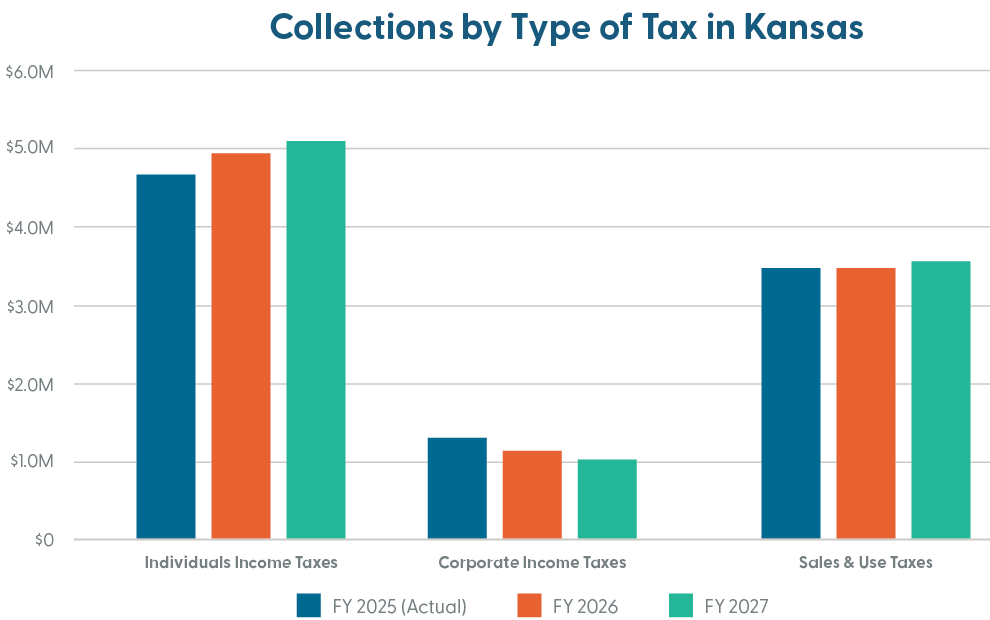
Previously, the CRE group had expected the state to collect about $9.95 billion in taxes in FY 2026, but in November, they raised that estimate to $10.1 billion. This increase is mostly based on higher expected personal income and sales tax collections, even as the state is expected to collect much less in corporate income taxes than before.
At this point in the fiscal year (July-October), individual income tax collections are $142.4 million higher than expected, while corporate income taxes have fallen short by $77.7 million. This led the group to raise their projected revenue from individual taxes by about $275 million, while lowering their corporate tax collections by $180 million. These estimates contain a fair bit of uncertainty.
While individual income tax collections have shown a lot of strength early this fiscal year, there is no guarantee that this trend will continue. In the long memo, the CRE group noted that this strong growth could be the result of inconsistent timing in employers implementing the new withholding tables resulting from the tax changes during the 2024 Special Session. If that is the cause for the higher revenues from individual income taxes, the state could be issuing a substantial amount of refunds come filing season.
As for the corporate piece, one possible reason for the shortfall in tax collections so far is that many corporations have resisted passing on the cost of tariffs to consumers in full. If corporations have been eating some of the cost of the tariffs, that would reduce their net income and the amount of taxes they pay. However, they’re unlikely to do this over the long term so we could see corporate receipts pick up if they begin to pass on more costs.
Looking further out, the CRE group expects modest growth in tax collections from FY 2026 to FY 2027, but this will be largely because of growth in individual income taxes. Corporate income tax growth is expected to be negative this year and next, while sales taxes are expected to grow by about 2% in FY 2027 after declining this year.
Economic Conditions
In addition to revenue, the group forecasts economic conditions for the current and next two calendar years. Overall, their forecasts point to a stable economy. The group expects productivity growth in Kansas to match the United States, as measured by gross domestic product, in each of the three years they project. They also anticipate that personal income will grow at the same rate as the rest of the United States in each calendar year.
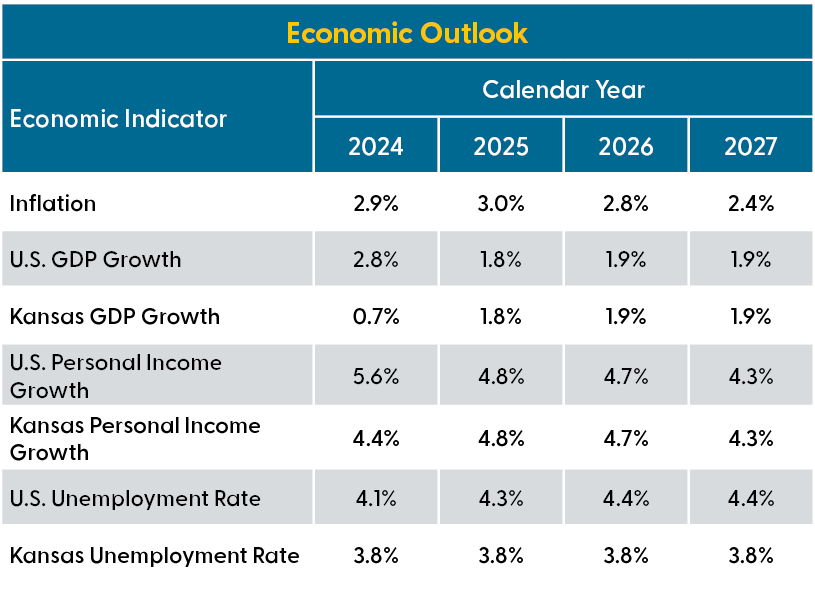
For context, national GDP growth outpaced state GDP growth in 16 years from 2000 to 2024 and was equal in just one. Over the same period, personal income growth was higher nationally in 17 years. This suggests that it would be highly abnormal for three consecutive years of equal growth in either of these indicators, let alone both.
On inflation, the group expects price growth to moderate over the next two years, falling from 3.0% this calendar year to 2.8% and 2.4% in 2026 and 2027, respectively. These forecasts are higher than the group’s previous estimates.
Important to note, the rate of inflation is a comparison to the previous year. So, while a moderation in price increases is expected, there is no expectation that prices will go down. Prices will remain elevated, and inflation could reaccelerate depending on fiscal, monetary, and trade policy.
Finally, they expect the Kansas unemployment rate to hover around 3.8% in each of the forecast years. This forecast reflects expectations for the annual average, so there could be some variation from month to month.
The Bottom Line
Heading into the legislative session, the assumptions made in November’s CRE meeting will be on the minds of lawmakers as they craft the budget and consider tax policy. Although estimates were revised for a more favorable outlook, it’s important to remember that these estimates come with a certain amount of uncertainty. Moreover, despite the upward revision in estimates, the state is still on the path to face budget shortfalls beginning in FY 2028. Lawmakers will need to raise revenue or make unpopular cuts to the programs and services many rely on.
While the CRE group anticipates a largely stable economy over the next two calendar years, there are plenty of risks to their forecasts. Tariffs, cracks in the labor market, aggressive investment in artificial intelligence, and debt and interest rate risks all pose challenges to economic stability, not to mention a rocky geopolitical climate.
If the group’s forecasts hold up, moderate growth in productivity and personal income – combined with slowing price increases – should provide a more favorable economic climate for Kansans in the years ahead.
< Back to the news listShare

