


State of the State Economy: Month of April 2026
Nathan Kessler | June 4, 2026
April’s economic data drop offers little comfort to those concerned about the direction of the economy and the impact on Kansas families. There were a couple of bright spots, but each one was undermined by other developments throughout the month.
State revenues came in above revised expectations, job growth was overshadowed by a decline in the labor force, and, despite average private-sector wages rising faster than inflation overall, the reality is that the cost of living is creating a real pinch on many families’ wallets.
State Revenues
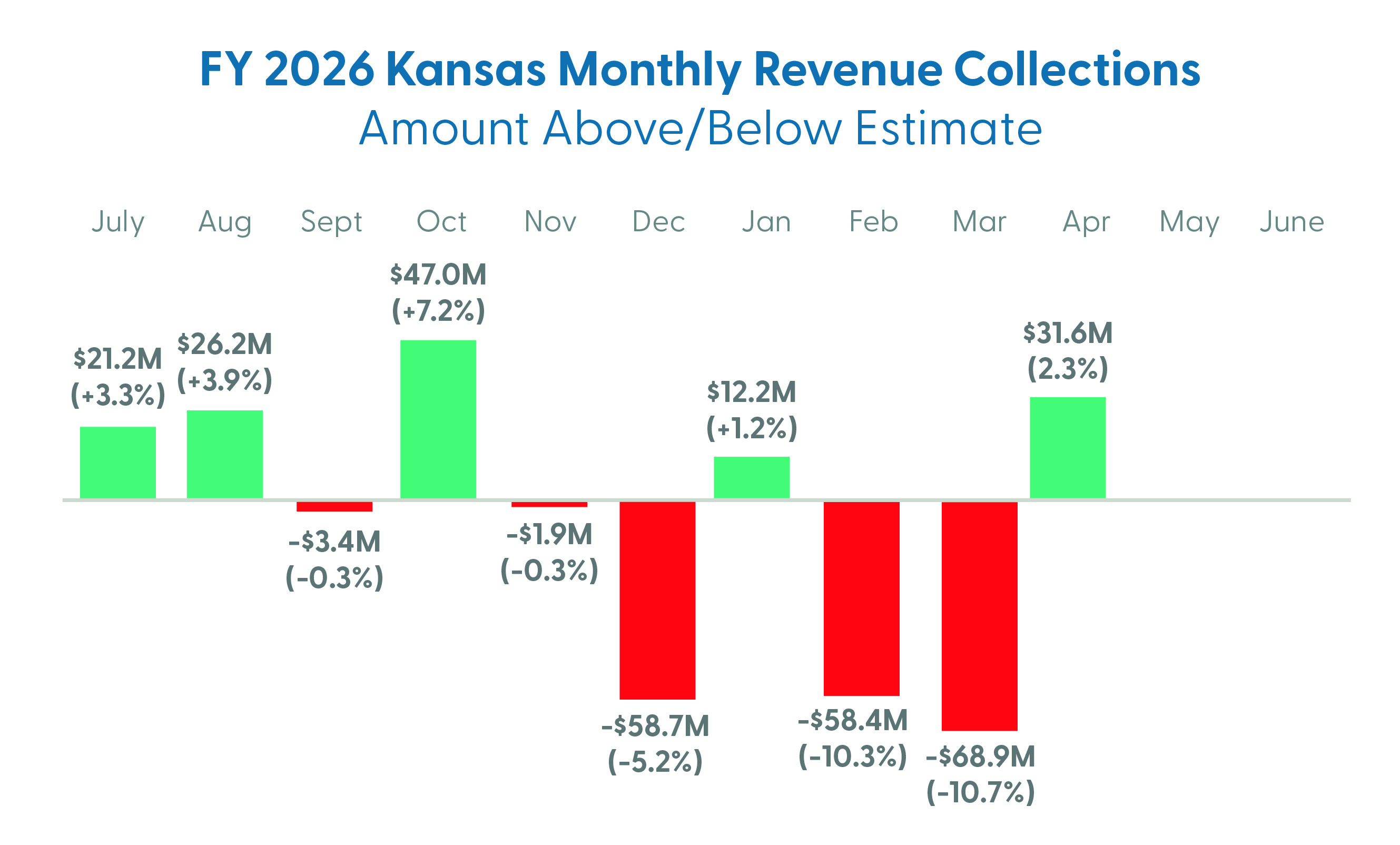
Kansas collected $1.39 billion in taxes in April, coming in $31.6 million, or 2.3%, above expectations. After two consecutive months of missing the mark by more than 10%, that is a positive development. However, there is important context to consider.
The Consensus Revenue Estimating (CRE) Group met on April 20 and revised its FY 2026 estimate for total tax collections downward by $153.0 million to $9.95 billion. With the lowered expectations, April's beat came against a lower bar than was set in November. That downward revision was driven by corporate income taxes, with estimated collections reduced by $145.0 million. You can read our full report on the CRE Group’s April meeting here.
Individual income taxes came in stronger than expected in April, largely fueling the month’s overall success in April as declines in retail sales taxes mostly offset overperformance in other tax categories. Compared to last year, individual income tax collections in April were higher by 17.3%, which likely reflects some combination of higher earnings and lower credit utilization.
On a cumulative basis, total tax collections through April stand at $8.28 billion, which is just 0.4% above the revised estimate, and essentially flat compared to where the state was at this point last fiscal year. With just two months left in FY 2026, there is very little cushion for collections in May and June if the state is to hit the revised estimate for total collections.
Jobs Report
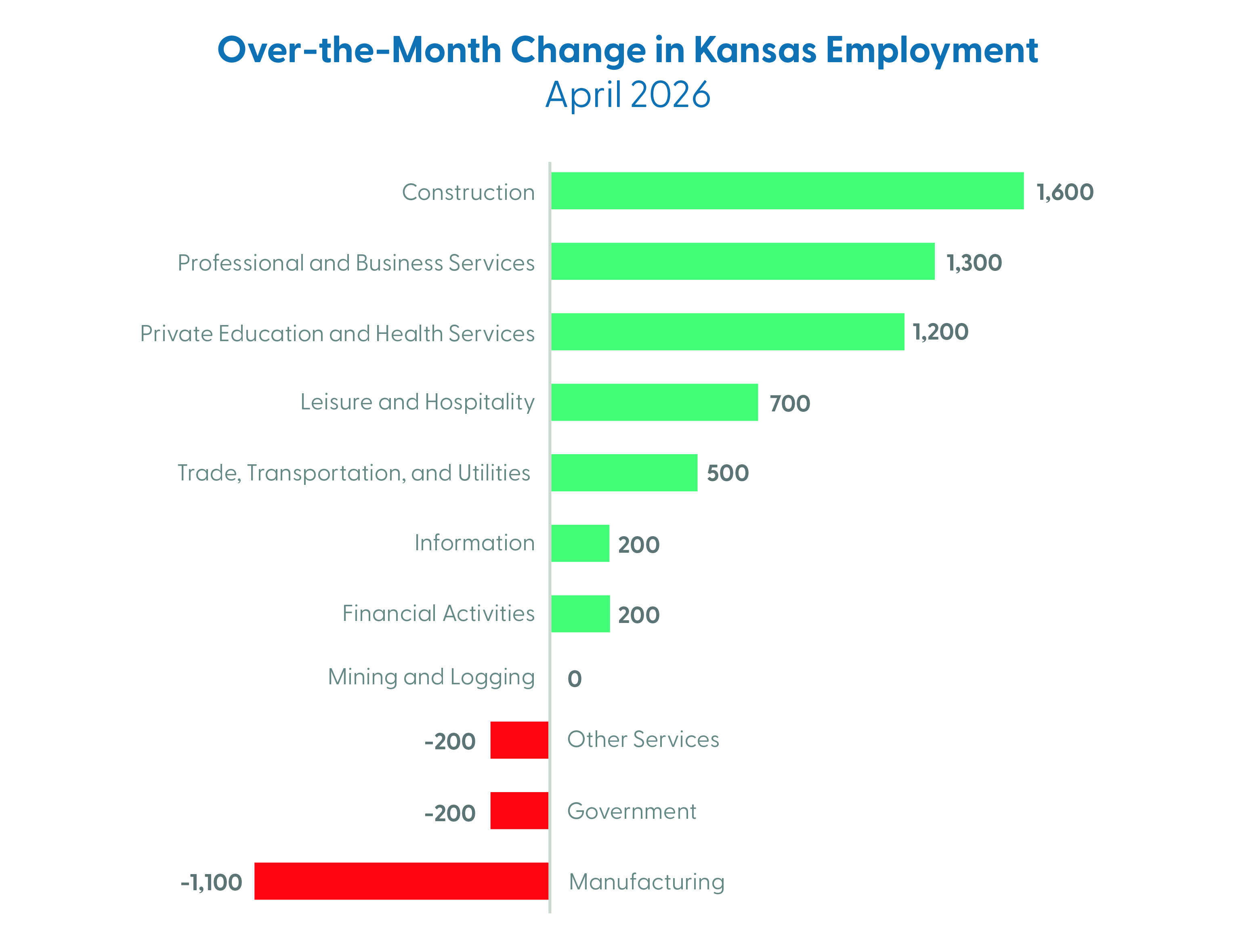
Kansas added 4,300 nonfarm jobs in April, a small increase of just 0.3% that offers some relief after back-to-back months of slight declines. However, the state is still at a decline of 3,300 nonfarm jobs since April 2025.
In April 2026, construction saw the largest gain with 1,600 new jobs, while manufacturing had the largest over-the-month decline, shedding 1,000 jobs.
The statewide unemployment rate held steady at 3.9% in April, unchanged from March and well below the national rate of 4.3%. However, over the past year, the Kansas labor force shrank by 13,640 workers – a decline of 0.9%.
When fewer people are actively looking for work, the unemployment rate can stay low even as the job market quietly contracts. Still, Kansas continues to have a much higher labor force participation rate (67.4%) than the nation overall (61.8%), demonstrating genuine durability in the Kansas jobs market.
Private sector wage growth was a bright spot in the April report with average nominal hourly earnings rising 4.6% over the year to $32.98. The increase was larger than the Midwest inflation rate of 4.1%, which led to a real hourly earnings gain of 0.4%.
It is good that wages are generally keeping pace with inflation. However, Kansans experience that inflation differently depending on income level, and for those needing to spend most of their paycheck on necessities, the data is not comforting.
Regional Inflation
The April inflation report shows that prices in the Midwest continue to trend notably higher than for the United States. Overall prices in the Midwest rose 4.1% over the year, with gasoline prices surging 24.1% – a significant acceleration from the 15.4% increase reported in March. Nationally, gas prices rose faster at 28.4% over the year, though the Midwest did see slightly larger price increases over the month.
Beyond gas prices, shelter costs in the Midwest rose 4.8% over the year in April, up from 3.9% in March and well above the national average of 3.3%. For the typical Kansas family, that means costs for the two biggest items in their budget — housing and transportation — are rising faster than for the nation overall.
Core inflation (stripping out food and energy) came in at 3.3% for the Midwest compared to 2.8% for the nation. This large gap in the less volatile, stickier inflation is due largely to the rapidly rising cost of housing in the Midwest.
Increases in the cost of shelter have been persistently higher in the Midwest. This is important because shelter makes up a significant portion of the Consumer Price Index – nearly one-third. In fact, when excluding shelter, Midwest inflation was lower than for the United States at 3.8% compared to 4.1%.
The real wages gain of 0.4% noted in the jobs report is genuinely a good indicator, but it does not reflect the reality for many Kansans. A household spending an above-average share of its budget on rent and gas, as many Kansas families do, is likely not feeling that gain at all.
The Big Picture
Despite a couple of bright spots, April's data leaves little room for enthusiasm. State revenues beat expectations, but those expectations had previously been revised down. The state saw a slight increase in jobs, but a much larger decrease in the size of the labor force. And there was really nothing to like in the inflation report, though solid wage growth in April likely helps some families weather the surging cost of living.
Admittedly, the economy has, to this point, largely defied the most bearish predictions at the outset of the war in Iran. But, as costs rise, global oil reserves diminish, and savings dwindle, the risks to the economy continue piling up. For many Kansas families, the crisis is already here.
Solid wage growth in April helped to offset some of the price increases across the economy, but that is little help to the likely majority of families that spend most of their income on housing and fuel – both of which are rising faster than overall inflation.
If the labor market holds up and the war comes to an end in the very near future, it’s possible that we can turn the corner and avoid some of the worst cases. However, even if the war ends tomorrow, it will be weeks to months before significant relief is felt at the pump. If the old saying “April showers bring May flowers” applies to the economy, perhaps we will be in for some good news in the next round of data.
< Back to the news listShare

