


State of the State Economy: Month of January 2026

Nathan Kessler | February 19, 2026
The first month of the calendar year brought a mixed bag of economic data. All of the major reports that we cover seemed to come with a caveat in January. The one exception to this is the Kansas Labor Report because there was no Kansas Labor Report.
However, that is just a function of how the Kansas Department of Labor reports the January results – it’s not carryover from the data delays the country experienced late last year. That means that next month, we will cover Kansas jobs for both January and February. For now, the U.S. jobs report gives us plenty to work with.
State Revenues
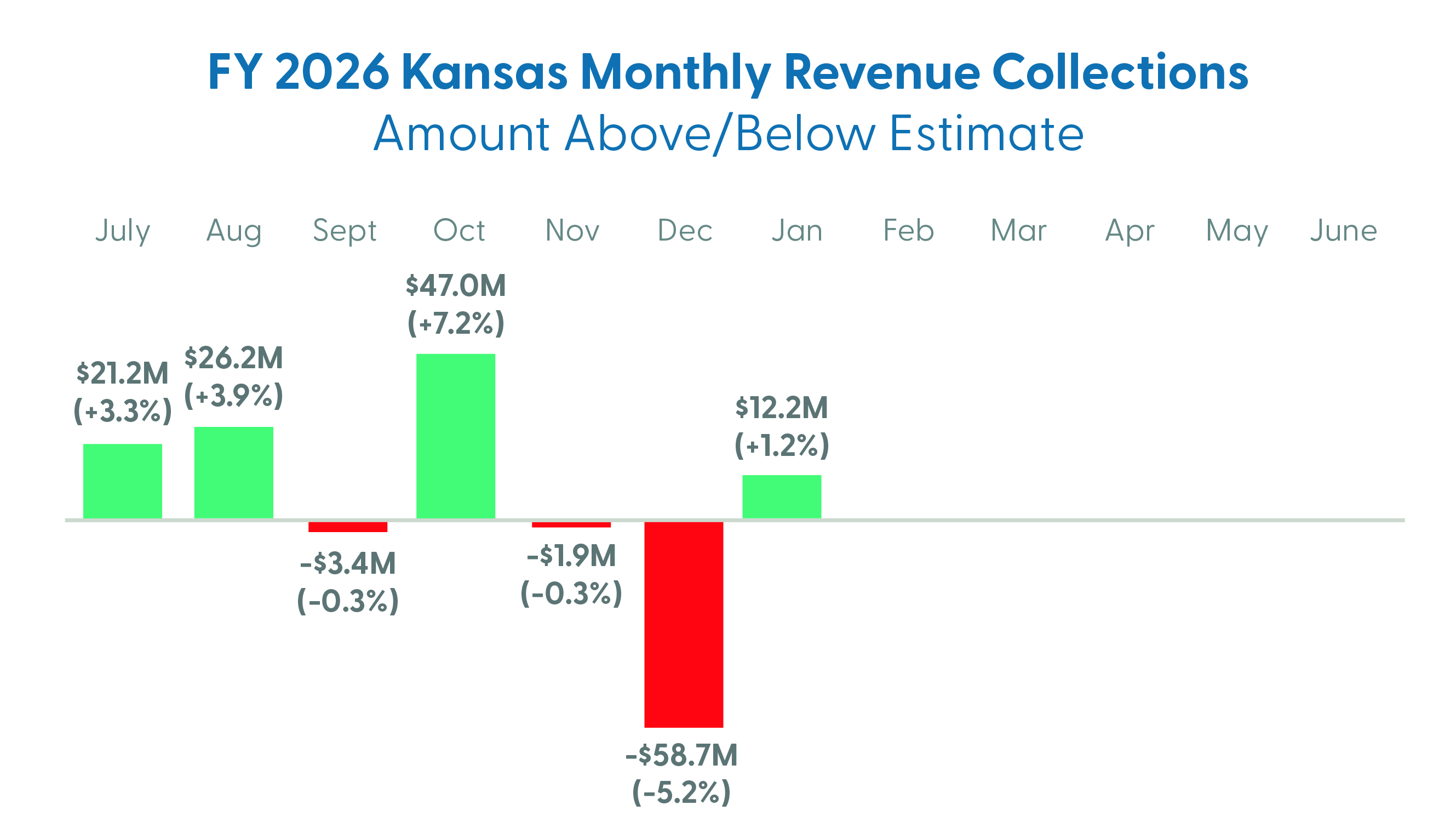
The state collected $988.2 million in tax revenue in January, exceeding expectations by $12.2 million. The state collected $45.4 million more in January 2026 than in the same month last year. On a cumulative basis, total collections are $47.7 million higher than by this time in FY 2025. Compared to last year, state receipts appear to be in good shape, but keep reading on.
When compared to expectations this year, cumulative tax revenue is falling short. We know that there is a bit of uncertainty baked into the FY 2026 estimates given the abnormal income tax collections in the first half of the year, so it’s difficult to say what comes next.
But currently, receipts are $48.4 million short of expectations, with individual and corporate income, retail sales, and compensating use tax revenues all below estimates at this point in the fiscal year. As filing season heats up, we will be watching closely to see what impact refunds have on state revenue.
Jobs Report
The national jobs report in January easily surpassed expectations, with the United States adding 130,000 jobs. The majority of these were in the health care industry, which added 82,000 jobs, primarily in ambulatory health care services. This is not surprising, as health care has been a significant driver of job growth over the past year.
Other areas of the economy that saw notable gains in January were social assistance and construction, adding 42,000 and 33,000 jobs, respectively. Declines occurred in federal government and financial activities employment, which declined by 34,000 and 22,000, in that order.
This report also included the benchmark revisions to the 2025 jobs numbers. Benchmarking is when the more timely data from the Current Employment Statistics (CES) program is brought into alignment with the more precise data collected through the Quarterly Census of Employment and Wages (QCEW). This routine process ensures that the most accurate information is reflected in every U.S. Bureau of Labor Statistics product.
These revisions show that job growth in 2025 was much more sluggish than previously reported. As revised, the U.S. economy added just 181,000 jobs last year – an average of about 15,000 jobs per month. The largest revisions were in the first four months of the year, with January 2025 revised down by 159,000 and February through April all revised down by at least 50,000. Job declines related to the government shutdown in October were actually revised up by 33,000.
Bringing this full circle, the revisions show how important health care has been to U.S. employment. While the economy overall added 15,000 jobs per month in 2025, the health care industry averaged more than twice that at 33,000 jobs per month.
Regional Inflation
Prices in the Midwest rose by 2.4% over the year in January, mirroring the increase in U.S. prices. This report showed slightly cooler inflation than was generally expected, but digging into the details reveals significant variation in the components that make up the Consumer Price Index (CPI).
The cost of food was a bright spot for the Midwest region in January’s inflation report, with food at home rising just 1% over the year compared to 2.1% for the nation overall. At the same time, the price of gas declined more in the Midwest than in the nation overall, falling by 11.2% over the year despite the rising price of oil in January. This dynamic could indicate a reduction in demand for gasoline, which may have been prompted by winter storms last month.
Shelter and household energy continue to be areas of concern in the Midwest CPI. Shelter costs were up 4.1% in January, while household energy rose by 9.6% over the year. This was substantially higher than in the U.S. overall, which saw increases of 3.0% and 6.6% in the respective categories. The large increase in the cost of shelter drove core consumer prices in the Midwest to rise by 2.7% compared to 2.5% for the United States, indicating so-called sticky inflation remains elevated in the region.
The Big Picture
Given January’s data, it’s difficult to say whether the economy is heating up or slowing down. A strong jobs report in January was clouded by steep downward revisions to employment in 2025. An economy that is adding just 15,000 jobs per month on average is far from firing on all cylinders. Given the size of the revision to January 2025, it’s hard to take last month’s gains at face value.
While inflation overall came in lower than expected, prices in the Midwest continue to increase at an uncomfortable rate. This sticky inflation is being driven by the cost of housing, with shelter and household energy price increases pressuring household budgets.
Next month will bring the benchmarked Kansas jobs data, which will offer more insight into how the state labor market fared amid sluggish job growth nationally last year. If the state had a strong 2025, that would alleviate some of the concerns that currently exist.
< Back to the news listShare

