


State of the State Economy: Month of November 2025
Nathan Kessler | December 17, 2025
This month’s economic update is going to be a bit different, as much of it takes us back in time a few months to September. As state and federal agencies strive to get their data release schedules back on track, November was a month of delayed reports.
As a result, our big story this month is the Kansas labor report for the month of September. As the data landscape continues to normalize, we will be sure to bring you all of the information as it becomes available. Next month’s economic update is likely to be a big one, as the Kansas Department of Labor plans to combine the October and November reports in a release on January 7, and we will receive multiple inflation reports before the next update.
Until then, this glimpse into the past will have to suffice. In this situation, there is a lesson about the importance of timely data as we navigate an uncertain present.
State Revenues
The state collected approximately $687.0 million in tax revenue in November 2025, just shy of the expected $688.8 million. This brings year-to-date (July to November) collections to $3.75 billion, which is about 37% of the $10.1 billion the Consensus Revenue Estimating (CRE) group expects the state will collect in FY 2026.
Previously, the CRE group had expected $9.95 billion in tax receipts this fiscal year, but raised their outlook at the November meeting based on strong individual income tax collections. Weak corporate tax receipts led them to downgrade their expectations in that category for the full fiscal year.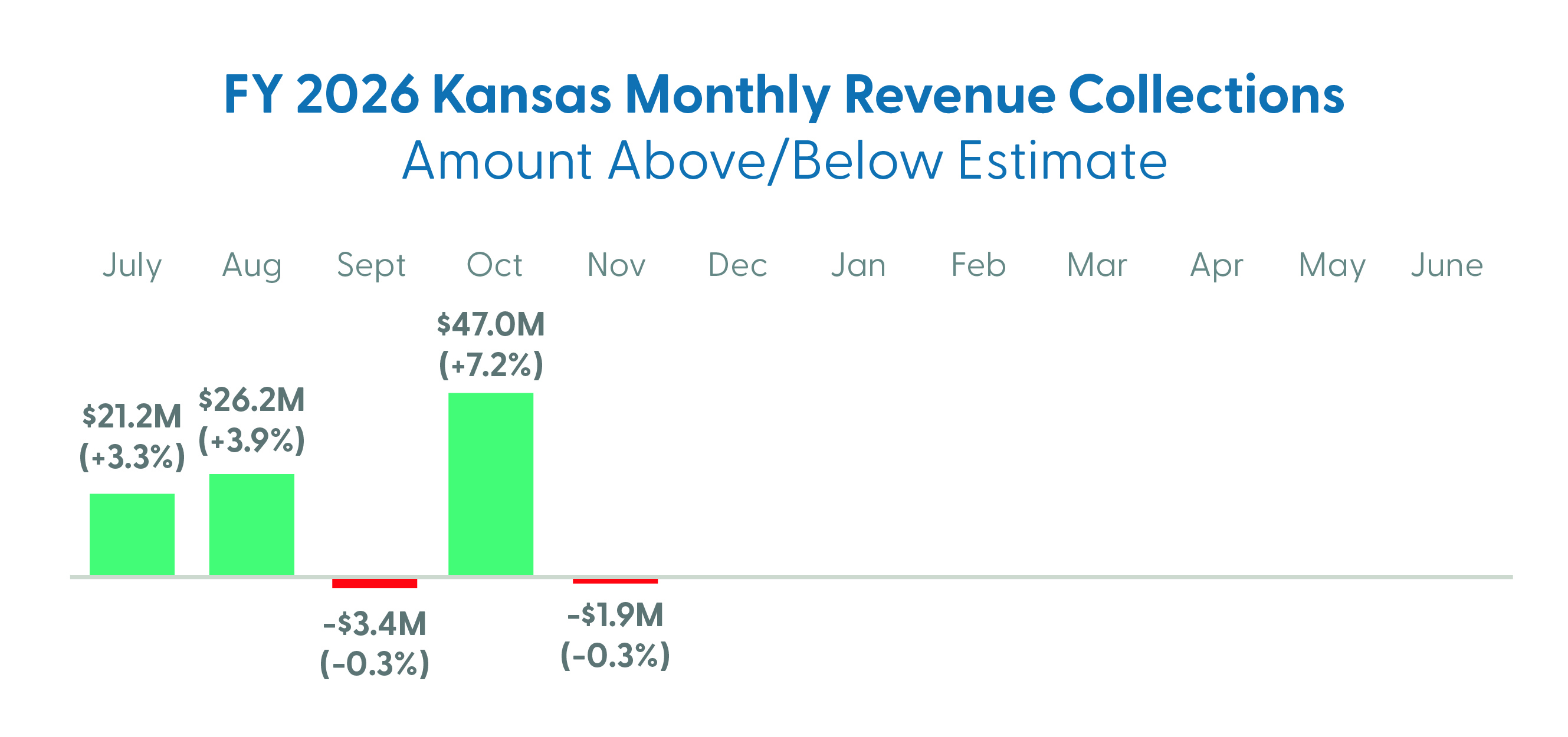
Despite a very small miss this month, collections so far are $56.2 million higher than at this point in FY 2025, and the CRE group believes Kansas is on track to collect more revenue than last year. However, there is some uncertainty in the forecasts as we wait to see how much the state ends up issuing in refunds as tax season begins in early 2026.
Delayed Labor Data Finally Arrives
The Kansas economy shed 300 jobs in September, as the private sector lost 2,000 jobs and government employment rose by 1,700. Job losses occurred in the professional and business services; manufacturing; and trade, transportation, and utilities sectors.
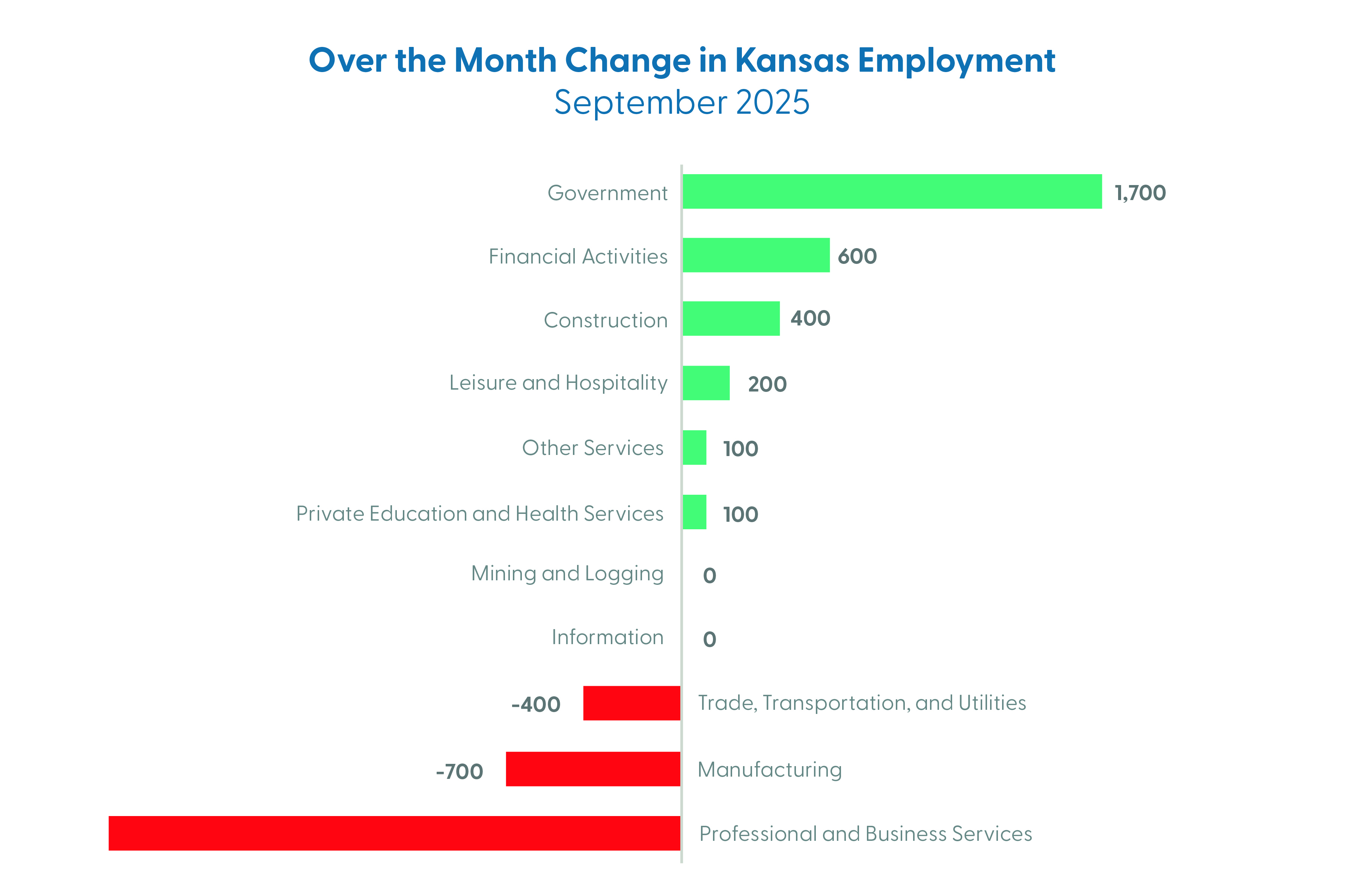
Despite losing an average of 1,700 jobs per month from July to September, the Kansas unemployment rate has remained steady at 3.8% since September 2024, even as the U.S. unemployment rate has been rising this year. Overall, this points to a largely stable labor market in the state, even though there has been some volatility in specific industries in recent months.
Regional Inflation
It’s official that we will not be getting inflation data for the month of October, and data for November wasn’t released in time to make it into this month’s economic update. However, the September labor report offers us a belated look at how inflation impacted Kansans throughout the early fall.
We previously reported the 3.1% increase in Midwest prices in our September economic update, but this labor report provides a more complete picture. While prices rose by 3.1%, average hourly earnings in the private sector grew by just 2.4%. In most cases, this would be solid monthly wage growth. But with the disproportionate increase in prices, real earnings in the Kansas private sector declined by 0.7%.
This decline in real wages, in combination with a slight decline in weekly hours worked, makes it clear that Kansas families are stretching their budgets increasingly thin. Wage growth had been outpacing inflation for much of the past year despite a downward trend. But with prices moving back up, it remains to be seen if this was a one-off or a turning point.
The Big Picture
The data we got this month points to an economy in a sort of holding pattern – at least in September. Given continued uncertainty, it makes sense that the state economy could take a number of paths. More data could give us the confirmation we need to understand where the economy stands.
Despite a very small miss in November, state revenues are ahead of expectations for the full fiscal year. There were some job losses in September, but the unemployment rate has been unchanged for a year, and it’s possible many of those losses were people leaving jobs rather than layoffs – though that data hasn’t yet been released for September.
The key point is that because of substantial data delays, we are left looking for answers on the economy’s long-term outlook. We just learned on December 11 what the state labor market looked like nearly three full months ago. The government shutdown may be over, but we continue to feel its effects in the void of timely data. We anticipate data release timing should go back to normal early next year – and we’ll be ready to analyze what the data tells us in 2026.
< Back to the news list
Share

