


State of the State Economy: Shutdown Edition, Month of September 2025
Nathan Kessler | October 27, 2025
With the government shutdown now entering its fifth week, access to some economic data is limited. The big piece missing from this month’s update is the jobs data because the Bureau of Labor Statistics (BLS) operations have been impacted by the shutdown, resulting in a delayed Kanas labor report.
State Revenues
September revenues slightly missed estimates for the first time this fiscal year. The $3.4 million shortcoming was driven by a $35.4 million shortfall in corporate income tax revenue compared to estimates for the month. Although individual income and sales tax collections exceeded expectations, they were unable to fully cover the deficit.
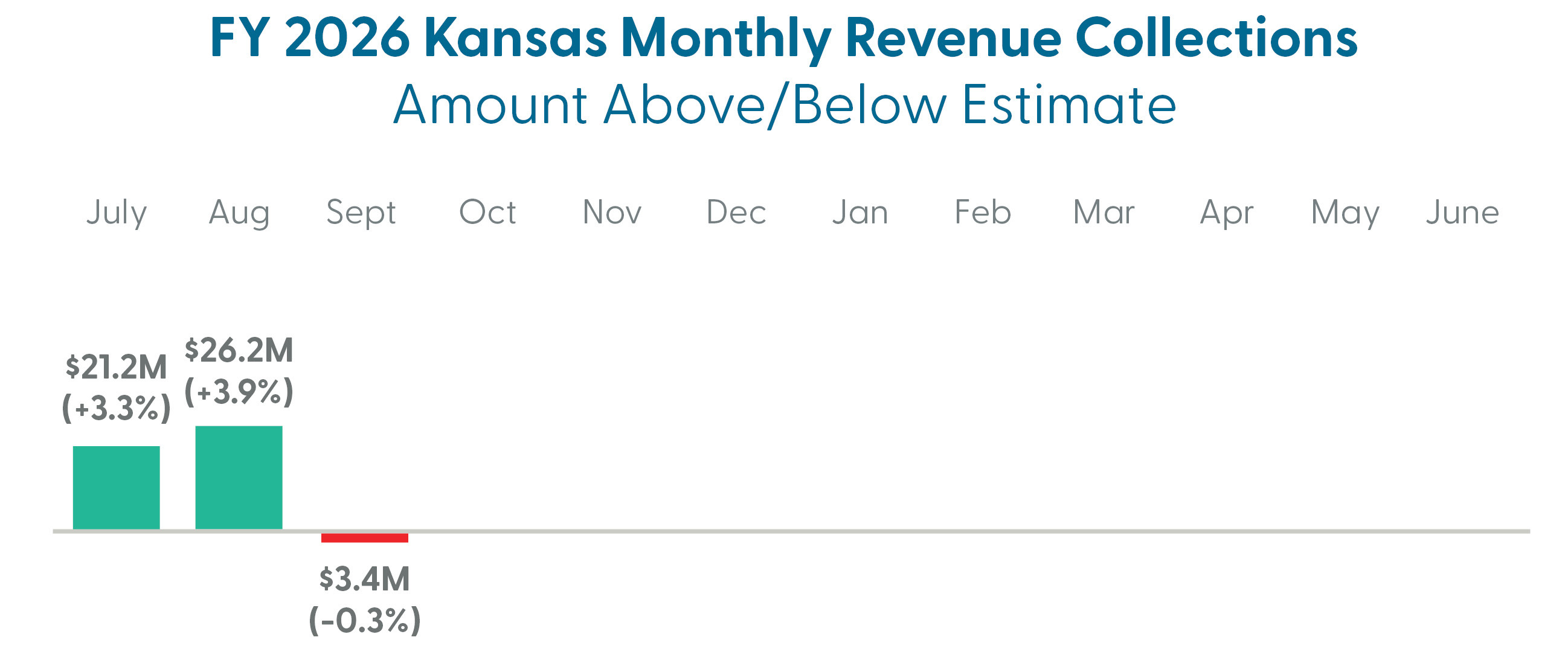
In total, Kansas collected approximately $1 billion in tax revenue in September 2025, which was 1.9% less than in September 2024. This brings the FY 2026 total receipts to $2.37 billion, which is about $17.3 million more than at this point last fiscal year. Strong receipts have so far been the result of higher-than-expected individual income tax collections.
At this time, the state has collected 23.8% of the $9.95 billion expected in FY 2026. However, the Consensus Revenue Estimating Group will be meeting again in November to discuss and revise this forecast. The CRE Group meets twice per year, in November and April, to give updates on the Kansas economy and consider the impact of legislation on expected revenues. Be on the lookout for our coverage of the upcoming meeting!
Regional Inflation
Because of the need to determine the cost-of-living adjustment for Social Security payments in the coming federal fiscal year, one report released by the Bureau of Labor Statistics this month is the Consumer Price Index (CPI).
Overall, inflation in the Midwest was higher than for the nation as a whole in September. Both headline and core (which excludes volatile food and energy prices) inflation rose 3.1% over the year in the Midwest compared to 3.0% for the United States. On a monthly basis, inflation in the Midwest for all items rose 0.3% compared to August and 0.4% when excluding food and energy.
One bright spot for Kansas consumers in this report is the price of gas, which declined on an annual and monthly basis in the Midwest. However, the cost of housing is rising much faster in the Midwest than in the United States overall.
Midwest housing was 4.5% higher over the year, compared to 3.9% for the nation. The difference is even more stark when looking specifically at the cost of rent, which was up 5.0% from September 2024 compared to a (still high) 3.4% for the United States.
Persistently high inflation continues to squeeze Kansans at home, at the grocery store, and pretty much everywhere else but the gas pump.
Kansas in Recession?
The Kansas economy has shed jobs in recent months, and that may be likely to continue if Mark Zandi, the Chief Economist at Moody’s Analytics, is right in his analysis that Kansas is one of 22 states currently experiencing a recession. Among these 22 states, Zandi notes a “common denominator... is that they have weak farm economies or faltering light manufacturing.”
In the context of the country’s ongoing trade war, it seems plausible that the Kansas economy would be on shaky ground. Farmers in the state have been unable to export crops like sorghum and soybeans to China, historically the largest market for these staples. That clearly puts Kansas farmers in a tough position, but it also has major implications for jobs further down the supply chain in food manufacturing, trade, and transportation.
Agriculture is a pillar of the Kansas economy, and current trade policy is likely to continue putting pressure on the industry with far-reaching consequences.
The Big Picture
While we weren’t able to get the full picture for September, the picture we did get isn’t exactly pretty. The one high point is that state revenues continue to be on track, even exceeding expectations three months into the fiscal year. Given the broader uncertainty in the economy, this strong start for state revenues is definitely welcome.
However, for the average Kansan, uncertainty is the bigger story. Prices for necessities like food, housing, and health care remain high, which are driven by tariffs, low supply, and recent policy changes. Kansas farmers are struggling to find markets for major crops, and employment in the state has been declining in recent months.
Where we go from here is difficult to say, especially as our view is clouded by limited data in the wake of the ongoing government shutdown. But at least one of the nation’s top economists is convinced Kansas is in, or nearly in, a recession. At the very least, we are experiencing some strong turbulence, and state lawmakers should proceed cautiously.
< Back to the news listShare

