


The Next Two Years of H.R. 1 Implementation

Heather Braum | August 27, 2026
Even a year after H.R. 1 became law, many provisions are still yet to go into effect. Kansas will soon face new pressure on the state budget, with lawmakers needing to backfill lost federal funding or new cost shares to operate Medicaid and SNAP. That leaves tough choices ahead for the Kansas Legislature.
As we continue tracking H.R. 1’s impact on Kansas families, here are the key implementation and expiration dates through 2028.
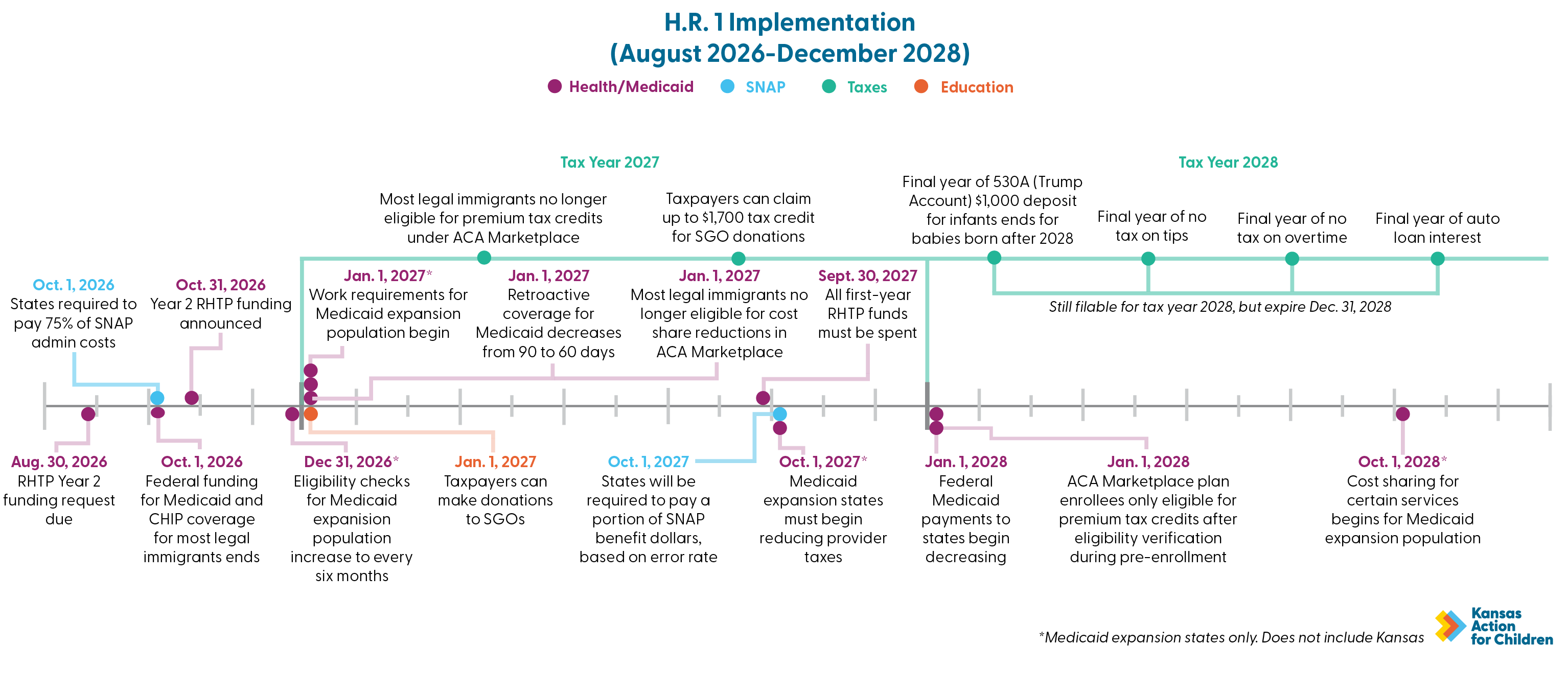
(Click here to enlarge or download)
SNAP
H.R. 1 cut the Supplemental Nutrition Assistance Program (SNAP) by around $178 billion over the first 10 years of implementation. A large portion of this will be paid by cost shifts to the states, which states must pay starting October 2027. If Kansas lawmakers can’t (or won’t) pay their new share — likely around $40 million — the state won’t be able to access federal funding to keep the SNAP program in Kansas operational.
-
October 1, 2026 – States are required to pay 75% of SNAP administrative costs. Previously, the state and federal government equally shared the costs associated with administering SNAP.
- The 2026 Kansas Legislature added $12.1 million to the FY 2027 budget to cover this cost increase for three quarters of the federal fiscal year.
- The 2027 Legislature will need to decide if it will fund this increase for all four quarters of FY 2028, an anticipated cost of $16.4 million.
-
October 1, 2027 – Kansas will be required to pay a portion of SNAP benefit dollars – a cost that has never been required of states in SNAP’s history. The cost shifted to states will be calculated based on each state’s “payment error rate” and could fall anywhere between $0 and $60.0 million.
- The Kansas payment error rate was at 9.44% in federal fiscal year (FFY) 2025, which would put Kansas on the hook for approximately $40.0 million. The 2027 Legislature will need to decide if they will fund this additional cost for FY 2028. Failure to do so would end the SNAP program in Kansas.
Health (Selected Medicaid, Marketplace, and Other Changes)
Changes to Medicaid, changes to the ACA Marketplace, and new program implementation will occur by the end of 2028. Most legal immigrants will soon lose access to Medicaid and to ACA Marketplace premium subsidies and cost-sharing reductions. While state budget impact details have yet to be released, any federal funding reductions will force lawmakers into tough choices on how to backfill those lost funds. State lawmakers’ tools are limited to reducing provider reimbursement rates, eliminating optional services from the Medicaid state plan, or reducing funding to HCBS waivers (which already face significant underfunding).
Meanwhile, the state continues to implement Rural Health Transformation Program initiatives. While this funding will not replace the expected federal funding cuts, opportunities abound for innovation and new collaborative partnerships to rethink rural health in our state.
Medicaid (All States)
-
October 1, 2026 – Federal funding for Medicaid and CHIP coverage restricted for most legal immigrants, including those with refugee or asylee status. Those no longer eligible for Medicaid will have their coverage discontinued by the state on September 30, 2026, including children and pregnant women. See this state document for more information.
- Emergency Medicaid for Non-Citizens (EMNC, formally SOBRA) will still be an available program to cover qualifying emergency services, including labor and delivery, for impacted individuals.
-
January 1, 2027 – Retroactive coverage for traditional Medicaid enrollees decreased from 90 days to 60 days. (Kansas codified this change into state law in the 2026 session.)
- Expansion enrollees’ retroactive coverage decreased from 90 days to 30 days.
-
January 1, 2028 – In non-expansion states, certain Medicaid state-directed payments (SDPs) will be reduced by 10 percentage points each year until they reach 110% of the Medicare rate. Expansion states must reduce to 100% of the Medicare rate.
- According to KFF analysis, Kansas is likely to see a fiscal impact, but official state estimates aren’t available.
- The 2027 Legislature will need to decide if they will cut rates of impacted providers or add state funding to supplement decreasing federal funds.
ACA Marketplace
- January 1, 2027 – Most legal immigrants will no longer be eligible for premium tax credits and cost-sharing reductions through ACA Marketplace plans. Non-citizens still eligible, however, include lawful permanent residents, Compact of Free Association (COFA) migrants, and Cuban and Haitian entrants.
- January 1, 2028 – ACA Marketplace plan enrollees only eligible for premium tax credits after their eligibility is verified during the pre-enrollment period.
Rural Health Transformation Program (RHTP)
- August 30, 2026 – Annual Report due for year one of RHTP, as well as the state funding request for year two of the program.
- October 31, 2026 – On or before this date, the second year of RHTP funding will be announced by the Centers for Medicare and Medicaid Services (CMS).
- September 30, 2027 – All first year RHTP funds must be spent.
Medicaid Expansion States (Kansas Has Not Expanded Medicaid)
- December 31, 2026 – Individuals in the Medicaid expansion population must undergo eligibility checks every six months. Previously, this was yearly.
- January 1, 2027 (or earlier) – Individuals in the Medicaid expansion population must provide proof they are working, volunteering, or pursuing work, documenting at least 80 hours per month. This is often known as work reporting requirements. Individuals subjected to this new rule include parents whose youngest child is older than 13.
- October 1, 2027 – Medicaid expansion states must begin reducing provider taxes by 0.5% each year until they reach 3.5% in FFY 2032.
- October 1, 2028 – Enrollees in the Medicaid expansion population must share costs (up to $35) for certain services, such as some specialist visits, certain prescriptions, and emergency room visits for non-emergency medical issues.
Education
Scholarship Tax Credit Program
The new Scholarship Tax Credit Program established by H.R. 1 provides dollar-for-dollar tax credits (up to $1,700 per taxpayer) to a Scholarship Granting Organization (SGO), which uses those funds to provide scholarships that can be used for tuition, tutoring services, supplies, and more for both public and private school students. States were required to opt into the program, which Kansas did during the 2026 session.
- January 1, 2027 – Taxpayers can make donations to SGOs
- Tax Year 2027 Onward – Taxpayers can claim up to $1,700 tax credit for donations made to SGOs.
Taxes
While H.R. 1 included several tax cuts or programs that are targeted at middle-class households, they are temporary and will expire after tax year 2028 unless Congress extends them in future legislation.
Comparatively, tax cuts for wealthier households, such as a $1 million increase in the estate tax exemption, are permanent.
- December 31, 2028 – 530A (Trump accounts) deposit of $1,000 for infants ends for any baby born after this date. Existing 530A accounts to remain open.
- December 31, 2028 – Ending of no taxes on tips (up to $25,000) (will still be able to file on this for tax year 2028).
- December 31, 2028 – Ending of no taxes on overtime (up to $12,500 for a single filer or $25,000 for joint filers) (will still be able to file on this for tax year 2028).
- December 31, 2028 – Auto loan interest deduction ends (will still be able to file for tax year 2028).
Planning for the Next Two Years
As experts and advocates predicted, data shows thousands of Kansans have already been impacted since we released our first year of implementation timeline last fall. With more provisions set to take effect or expire over the next two years, more impacts will continue to be felt within the state budget and Kansas families’ wallets. We’ll keep tracking them so advocates, lawmakers, and families can plan for what’s coming.
< Back to the news listShare

