


Consensus Revenue Estimating Group Projects Stable Economy while Acknowledging Risk Factors

Nathan Kessler | May 21, 2026
The Consensus Revenue Estimating (CRE) group convened in April for their second meeting in FY 2026. The purpose of the April meeting is to consider revisions to their November forecasts based on actual revenues collected since then in relation to current economic conditions.
The result of this meeting is the updated state revenue forecasts for FY 2026 and FY 2027, as well as for various economic indicators. In past years, these forecasts were valuable information for lawmakers as they wrapped up their final days of work each legislative session. However, with the two most recent sessions brought to a close before the estimates were available, lawmakers were forced to pass state spending plans and other policies impacting the state budget without being able to consider the most updated revenue forecast.
The group will meet again in June to further adjust the revenue forecasts based on relevant legislation passed during the 2026 session, but this is the final meeting in FY 2026 that will include economic projections.
Overall, the group expects state revenues to be lower than previously forecast by a combined $54.7 million in FY 2026 and FY 2027. Digging a little deeper shows why that is and what else they expect this year and next.
You can read the entirety of the CRE Group’s report here.
State Revenues Outlook
While the combined overall downward revision to state revenue was $54.7 million, most of that net reduction is expected to occur in FY 2026, with lower tax receipts being the sole reason for the decline. Expected tax collections for FY 2026 were revised down by $153.0 million, while other non-tax revenues are expected to be higher by $25.6 million. For FY 2027, these revenue sources were adjusted by a decrease of $34.5 million and an increase of $107.2 million, respectively. The driving force behind the higher “other” revenues, which make up a small fraction of the overall state budget, is higher interest returns on the balance of the Budget Stabilization Fund.
Looking at the bigger picture, total revenues for FY 2026 were adjusted downward by $127.4 million, while FY 2027 revenues are expected to be $72.7 higher than previously expected.
These revisions mean that total tax receipts for FY 2026 are expected to be $9.95 billion, down from the previously expected $10.10 billion and below the $10.00 billion collected in FY 2025. Collections are expected to recover slightly in FY 2027, with an estimated $10.20 billion in total receipts, largely because of higher-than-anticipated individual income tax revenue.
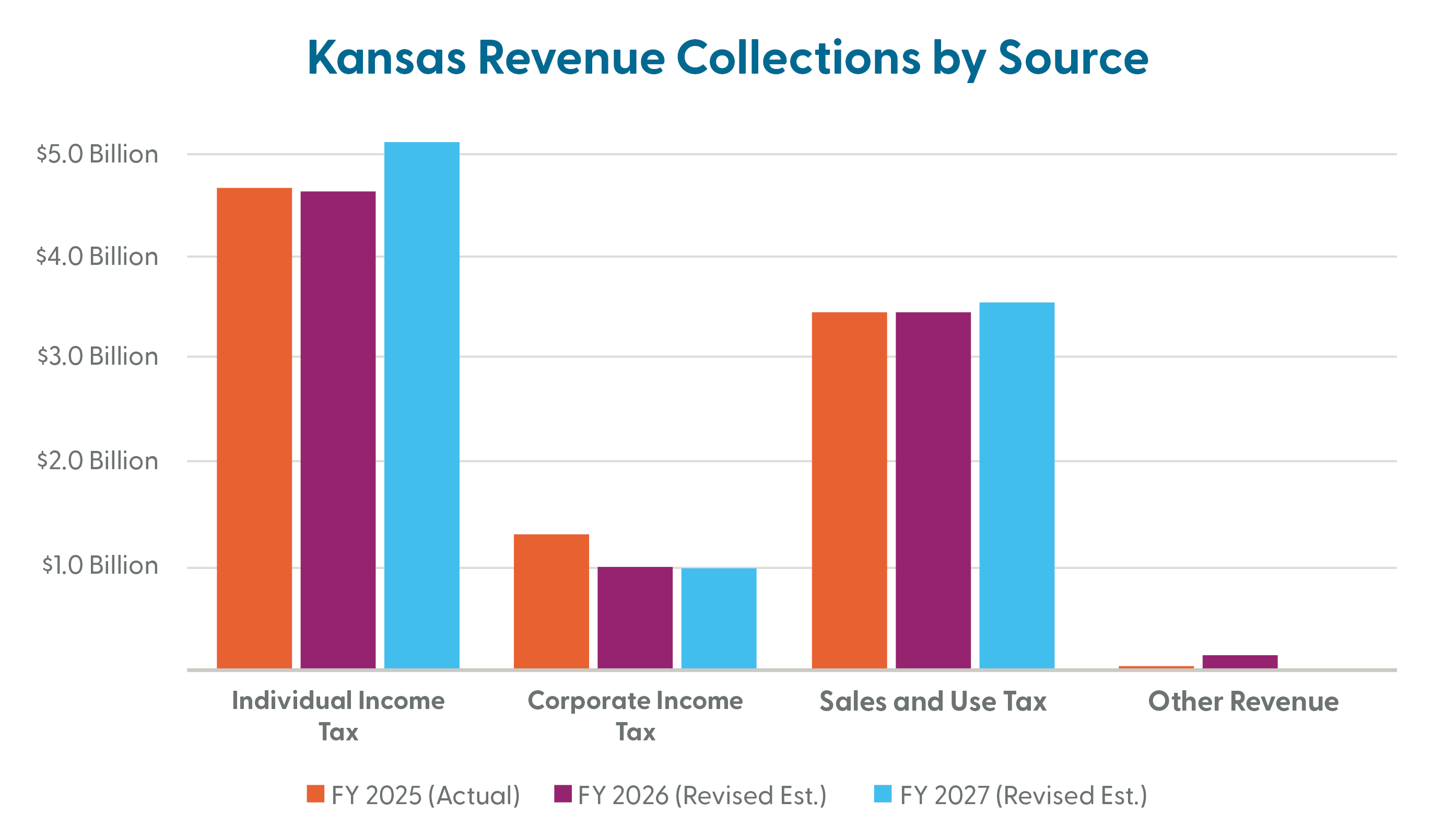
However, total income and privilege tax receipts in FY 2027 won’t be enough to trigger a tax rate reduction under SB 269, the flat tax legislation passed during the 2025 session. Under that bill, income and privilege tax receipts exceeding the FY 2024 baseline amount of $5.97 billion, adjusted for inflation, will be used to buy down the individual and then corporate income tax rate until a flat rate of 4% is reached.
Based on the latest Consumer Price Index data, the most recent threshold for triggering a rate reduction would be approximately $6.34 billion in income tax collections, which is about $180.0 million more than the expected $6.16 billion in FY 2027. This threshold will be much higher by the end of that fiscal year, however, so any notable rate reduction is likely still a few years away.
Economic Conditions
The CRE Long Memo begins by acknowledging multiple financial and geopolitical risk factors the economy is currently grappling with. Specifically, the group notes that “[s]ignificant concerns exist for the economy as a whole relative to the Iran war and its upward pressure on oil prices, elevated financial market volatility, inflation expectations that have remained above the Federal Reserve’s target, and uncertainty around the timing and realization of productivity gains that may or may not materialize from artificial intelligence.”
KAC has previously elevated many of these risks in our monthly State of the State Economy blog series, particularly around inflation and the war in Iran. Despite these concerns, the group anticipates continued moderation of inflation rates and stability in state and national real Gross Domestic Product (GDP) and personal income growth.
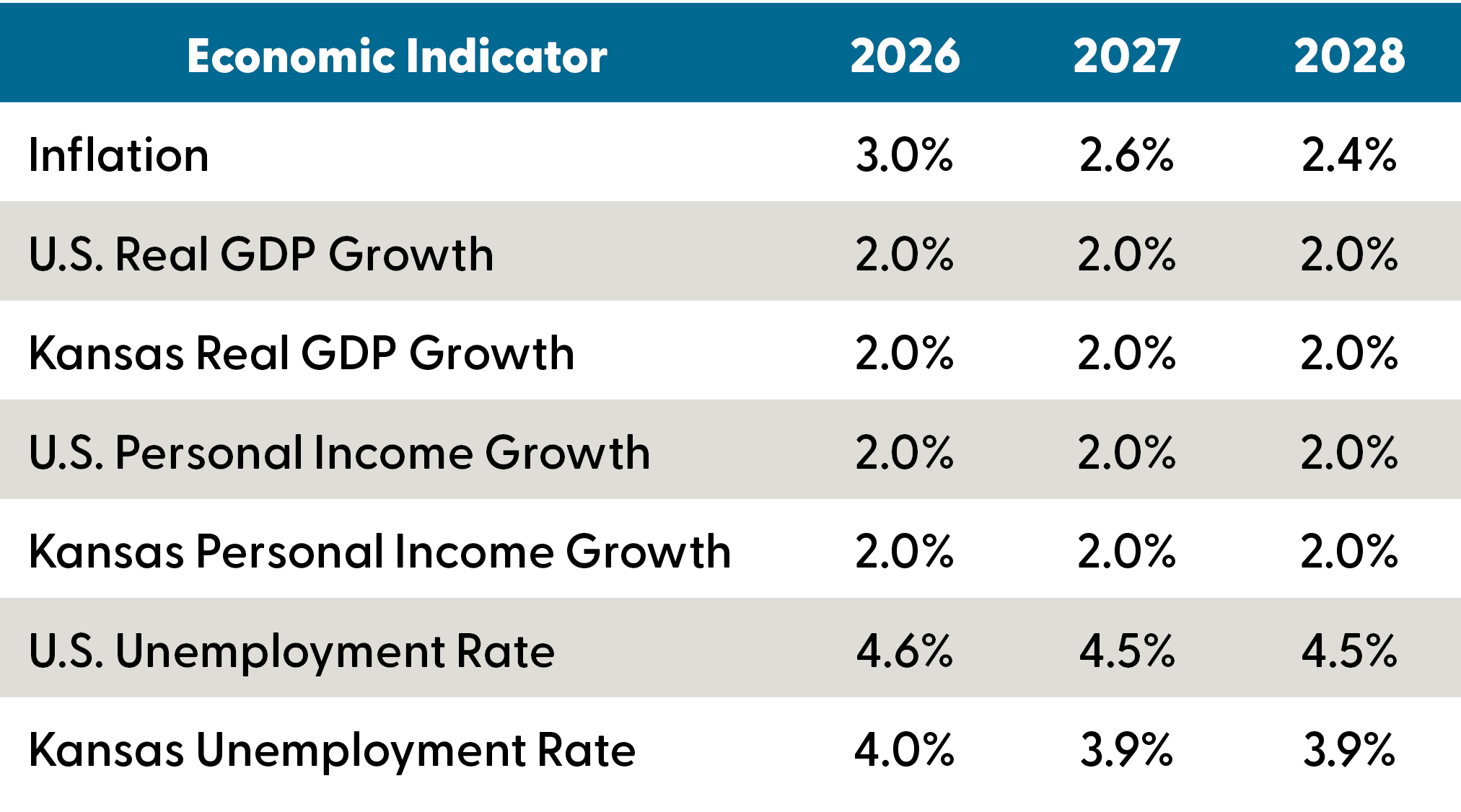 While the group has revised their expectations for state and national GDP growth in 2026 and 2027 up to 2.0% from 1.9% at their November meeting, forecasts for personal income growth are now markedly lower. This can likely be partially attributed to higher inflation and unemployment rate expectations compared to the November estimates.
In any case, the group still sees Kansas growth being on par with the broader nation. As was mentioned in our coverage of the CRE group’s November meeting, this would be an economic anomaly. Between 2000 and 2025, state and national real GDP growth were equal in just one year – 2015 – while there wasn’t a single year in which Kansas and U.S. personal income growth were the same.
The difference in state and national figures from 2000 to 2025 ranged significantly. For personal income growth, the average difference between Kansas and U.S. growth rates was 7.0% but varied widely with Kansas’ growth being 131.0% higher in 2008 and U.S. growth outpacing Kansas by 85.2% in 2016.
The contrast in real GDP was much more stark. On average, state and federal growth rates differ by 87.7%, driven largely by Kansas real GDP growth exceeding the U.S. rate by 2,500% in 2008. Excluding the 2008 outlier, national growth averages 8.8% higher than the state, with Kansas being 175.0% higher in 2007 and the nation exceeding Kansas growth by 103.8% in 2019.
Relative stability in these projections is surprising given the numerous risk factors mentioned at the top of the report. The fact is that the global economy remains in the midst of one of the worst oil supply shocks in history that shows no signs of relenting and will have multiple downstream effects, including higher prices on food, fuel, and other energy-dependent goods and services.
The Bottom Line
As of this writing, the price of a barrel of oil is more than $100, while the average price for a gallon of gas in Kansas is $4.10. The most recent Midwest Consumer Price Index (CPI) reading came in at 4.1%, driven by a 4.8% increase in the cost of shelter – the largest component of the CPI – compared to last April and a blistering 24.1% surge in the price of gas. These compounding costs have major financial implications for Kansas families that were already struggling to afford the basics before the ongoing oil price shock.
This cost-of-living crisis is likely the biggest threat to the CRE group’s forecasts for revenue growth in FY 2027 and a stable economy. The oil price shock alone is conceivably sufficient to put the economy in a recession if the shock is prolonged enough. In that case, the state would likely fall short of the CRE group’s revenue and economic targets. Even absent a recession, there is meaningful uncertainty in these projections.
Thus far, the economy has proven largely resilient amidst all the uncertainty over the past year, but cracks have been emerging. Consumers are increasingly spread thin, and the labor market and national GDP are buoyed by a select few industries. Despite this, the CRE group expects the economy to remain largely stable, albeit with markedly slower growth than was forecast in November.
< Back to the news listShare

