


Task Force Looks at Special Education Funding

By Emily Barnes | October 29, 2025
The Education Funding Task Force continued its work to evaluate the current school funding formula. The meetings between January and March 2025 set the foundation for the work the Task Force would set out to accomplish as they assess the current formula and create the next one.
In this first meeting after the legislative session ended, the group decided they would meet two consecutive days each month throughout the summer to learn about complex topics relating to Kansas’ school finance formula. May’s focus was on Special Education.
You can view the May 6 meeting here and the May 7 meeting here.
Public Materials Provided to Task Force Members for May Task Force Meetings
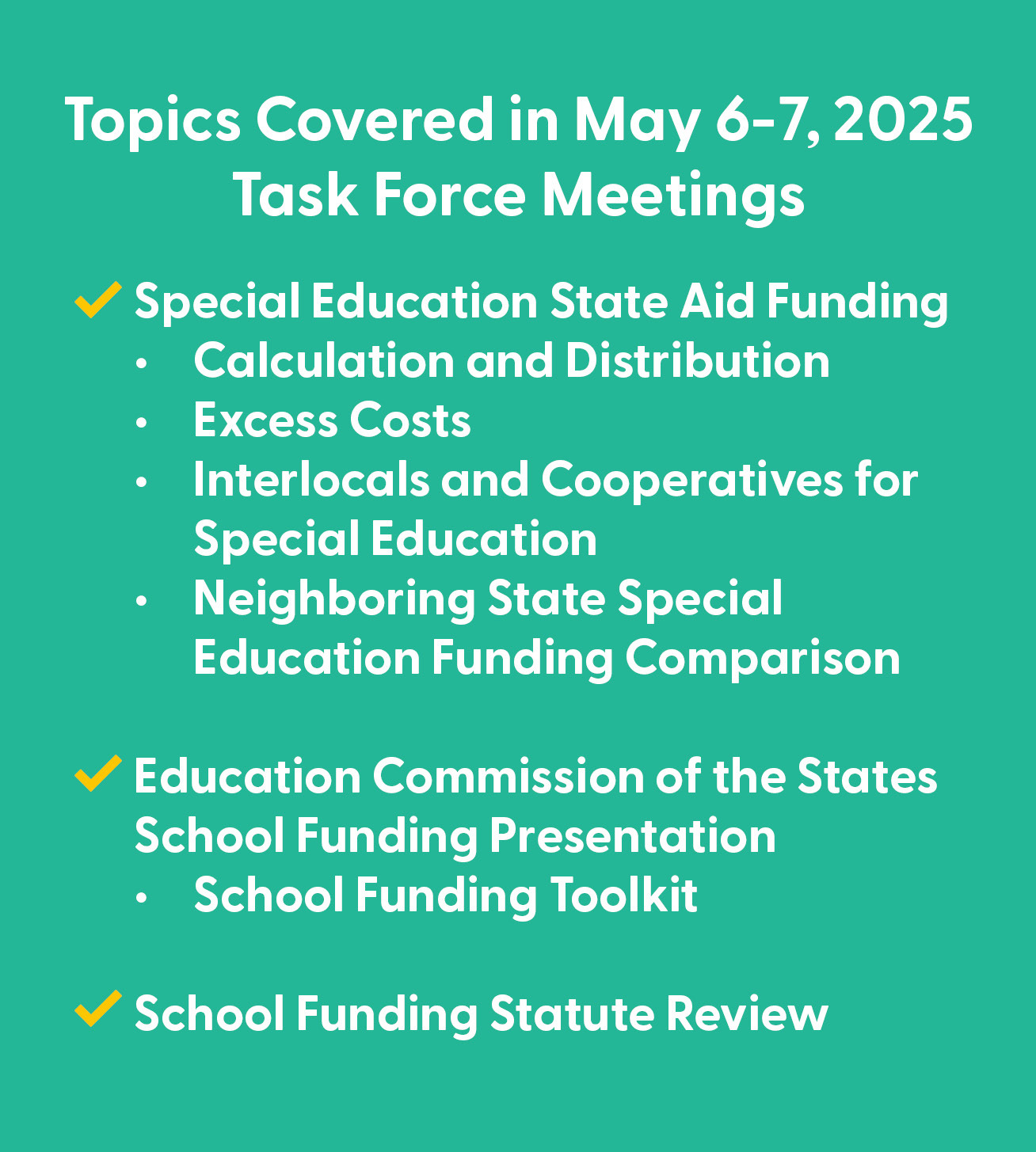
Summary of May Task Force Meeting
As the Task Force learned, Kansas’ special education services are based upon requirements in the federal Individuals with Disabilities Education Act (IDEA) and the state’s Special Education for Exceptional Children Act (SEECA). These laws offer guidance about how educational services will be delivered to students with disabilities, including how the state funds special education services.
In our recent blog post, we shared how weightings are used to calculate each school district’s funding total based on unique district and student characteristics. This is generally how K-12 education funding is determined.
However, the general education funding needed for special education students considers the weighted full time (FTE) enrollment without certain weightings like At Risk, Bilingual, Career Technology Education, and Special Education.
Calculation and Distribution
Discussion began with an explanation from legislative staff about Special Education State Aid.
There are two portions of aid – calculation and distribution – that often are referenced together but are found in separate sections of state law about Special Education State Aid.
Reimbursement rates for special education services are set at 92% of excess costs, meaning that the state is required to provide enough funding to reimburse 92% of the costs that are beyond general education services. The district is responsible for paying for the remaining costs.
Federal funding that is used to pay for special education services must be calculated. This includes IDEA funds, Medicaid reimbursement, and state hospital funding. Expenditures for special education and related services must then be estimated. The funding formula stipulates how to factor each of these together. A detailed breakdown of this formula can be found here. Once state aid has been calculated, the state must distribute the funding. The 2024 Legislature amended the law that governs how Special Education State Aid is distributed with the passage of House Sub. for SB 387.
Starting in FY 2025, the Legislature must appropriate at least $601 million for special education. Of that amount, $528 million must be distributed to reimburse four specific types of expenditures:
- Medicaid Replacement State Aid, which districts receive based upon the number of Medicaid-enrolled students who receive special education services in the district. This amount is capped and is divided evenly among all Medicaid-enrolled special education students. Also, this funding counts as federal funding and is subtracted from the amount the state needs to cover Medicaid claims.
- Catastrophic Aid, which is additional funding that the district may apply for when a student receives services that cost more than a set threshold. The reimbursement is applied to 75% of the costs above the threshold.
- Transportation Aid, which reimburses a district for 80% of the transportation costs for special education services.
- Special Education Teacher Aid, which is distributed to districts based on their total special education teacher and paraprofessional FTE staffing levels.
Special Education State Aid appropriations above $528 million are to be distributed using an equalization schedule that was created by the Kansas State Board of Education. This formula is based upon local efforts toward special education expenses and is often referred to as the Local Option Budget, or LOB.
State law requires that each school district transfer funds from its LOB for specific funds that include at-risk, bilingual, and special education and related services. The amount that is transferred varies by district but is proportional to the amount of the district’s Total Foundation Aid that is attributed to each weighting. Through this process, the state hopes to “equalize” the aid that districts receive to ensure students receive the education they need regardless of where they live.
District Collaboration
The rural nature of Kansas means that most districts across the state have lower student enrollment and varying amounts of local revenue, making it difficult to provide some special education services effectively. For a variety of reasons, many districts will work together as either an interlocal or a cooperative to provide the necessary services to their students. Although participation in either an interlocal or cooperative does not change the amount of funding a district may be eligible for, participating in shared services can improve the way they deliver the services to students and address regional barriers.
For reference, an interlocal is a separate entity that is created by a group of school districts. The interlocal has a director and is hired by a district to oversee the responsibilities of staffing, facilitating administration, and coordinating services.
A cooperative works slightly differently. One member district is the “host” district, which oversees the necessary responsibilities to provide special education services. The other districts transfer funding to the host district for the services rendered. This allows smaller districts to address logistical needs of providing special education services in a more cost-effective manner. The Task Force was given a color-coded map to show the school districts that operate independently and the different interlocals and cooperatives across the state.
State Comparison
In March 2025, the Task Force was offered comparison information about school funding formulas in neighboring states that included Arkansas, Colorado, Iowa, Missouri, Nebraska, and Oklahoma. In May’s meeting, the group was offered a comparison of how these states, plus Utah, distribute their special education funds. Some discussion included the use of a High-Cost Special Education Trust Fund in Colorado that is accessed through grant applications. This was a new concept for some lawmakers, and some wondered about the equitability of the process.
The members were also interested in understanding how some states use tiers for funding and, as in Oklahoma, structure their weightings to denote primary and secondary disabilities.
Goals for the Task Force’s Remaining Work
The second day of the Task Force meeting included topics ranging from academic performance of students, the use of funding and the inflationary mechanisms used in Kansas across the years, and the members’ thoughts on changing or removing some weightings. The Education Commission of States (ECS) presented to the Task Force about different funding models seen across the nation.
(Note: ECS is a non-political, nonpartisan, non-advocacy organization that was formed to help states understand different concepts around K-12 education. They do not direct state policies or decision making but focus on educating states about school funding options.)
The presentation focused on the various spending levels, as well as the funding models and mechanisms used across the nation. Much of the presentation reflected information the Task Force received in March. ECS also offered a tool kit while explaining the elements of funding formulas. When changing funding formulas, lawmakers should use these five principles to ensure their plans are:
- Transparent by allocating state aid using a simple, logical, clearly articulated proposal that is informed by students, families, teachers, and school leaders.
- Student-centered when allocating base funding on the learning needs of students, with a focus on improving outcomes.
- Adequate by providing sufficient resources for high-quality education to ensure all students have access to safe learning environments.
- Fair by prioritizing resources to schools serving students with complex learning needs and/or limited local resources.
- Sustainable by ensuring a dependable level of state resources that allow district leaders to plan for multiple years in advance.
After the presentation, the Task Force discussed the need for accountability and correlating funding to positive outcomes.
Legislative staff continued by explaining information about the educational programs that are established in Kansas statute but may not be specifically governed by the Kansas School Equity and Enhancement Act (KSEEA). This includes programs like school lunches, teacher stipends and professional development, student Career and Technical Education participation, and more.
Task Force members clarified that the two areas of the funding formula that will expire on June 30, 2027, are State Foundation Aid and Supplemental State Aid. The focus of their work must apply to these two areas; any other change can be considered but should not take priority.
Points of Discussion
Throughout the two-day meeting, Task Force members asked a variety of questions, from local budgets to relating educational outcomes to funding practices.
Task Force members expressed curiosity about how much the state receives from Local Option Budget (LOB) to be able to see the total amount of LOB that goes into each fund.
They also discussed the amount of cash carry-over or reserves districts have and how much of their budget was not used in a school year. Additionally, Task Force members highlighted the need for balancing local decision making with ensuring the state provides a formula resulting in equitable funding.
Pertaining to educational outcomes, a few members wondered about ways to avoid funding ineffective practices that result in low assessment scores. More discussion about state assessments clarified that, in 2015, there was a shift in how educational achievements were measured. Until that time, the state looked at proficiency pertaining to grade-level material, whereas now, K-12 achievement is viewed in relation to college preparation and performance.
Throughout both days’ discussions, members of the Task Force voiced the need to use funding in ways that lead to positive learning outcomes for students. Science-based reading curriculums and attention to educators’ professional development were suggested as solutions to improving Kansas students’ academic achievement.
The idea of transparency centered in many of the conversations, such as through the Task Force’s approach to decision making, data collection of expenditures, oversight of service delivery, and tracking student growth. They also highlighted the need to make information more accessible to the public.
As the Task Force discussed the needs of teachers and the increasing likelihood that educators will struggle to make ends meet, they brought up the topic of minimum teacher salaries. One possibility to address this issue was setting a higher entry salary in the pay schedule. It seemed unlikely to be a major focus as the work progresses, but incentives for improving student outcomes could be considered.
Some members wondered how changing or removing some weightings and adding that funding into BASE would impact the formula. The Task Force also is hoping to better understand transportation funding and what can be done to address barriers in that area.
Lastly, early education came up as a solution for long-term positive impacts. Some members of the Task Force elevated the connection of targeted efforts, such as smaller class sizes and specialized supports in the younger years, to increasing long-term student achievement.
Digging Deeper in Future Meetings
With the new format allowing multiple meeting days, the Task Force planned to dive deeper into specific weightings. For the Task Force’s remaining meetings in 2025, they reviewed low and high enrollment, bilingual, at-risk, and special education. We’ll continue to share how the Education Funding Task Force’s work unfolded in future blog entries.
< Back to the news listShare

