


October 2025 Newsletter

Shutdown Showdown
As the federal government shutdown continues, we’re learning more about how Kansas kids and families will be impacted.
You’ve likely heard a lot about the shutdown, everything from budget plans being rejected to what the main issue is that the two sides are disagreeing on. It can be overwhelming to sift through it all, so here’s our quick explanation of how we got to where we are today.
The shutdown began October 1 when the Congress failed to pass a budget bill that would continue funding the federal government. Whereas the House only needs a simple majority (50%+) to pass a budget bill, the Senate needs 60 out of the 100 votes in the chamber. With Republicans holding 53 of those seats, they need seven other Senators from the 45 Democrats or two Independents to vote with them.
Because the budget bill the House sent to the Senate hasn’t been able to reach the 60-vote threshold through several rounds of voting in October, the federal government has remained shut down.
At the crux of the disagreement is the inclusion of “Enhanced Premium Tax Credits” in the bill. These credits subsidize part of the cost of accessing health insurance through the ACA Marketplace. If Congress doesn’t extend them by the end of the year, Kansas premiums on the Marketplace for the same health insurance will go up an expected 77% (on average) for Kansas families, or about an additional $708 a month.
Now, nearly a month into the federal government shutdown, we’re beginning to learn how programs families rely on will be impacted.
First and foremost, Supplemental Nutrition Assistance Program (SNAP) benefit payments will be delayed starting November 1. That means around 188,000 Kansans, including 85,000 children, won’t be able to use SNAP to supplement their grocery budgets. With food banks supplying just one meal for every nine provided by SNAP, Kansas, as is the rest of the nation, is on the cusp of a hunger crisis.
Until the federal shutdown is resolved, hungry Kansans should locate their nearest food pantry and plan ahead for distribution dates and times. Kansas Food Bank covers most counties in the state, with the exception of the northeast quadrant. Harvesters serves most of northeast Kansas and 10 counties on the Missouri side, and Second Harvest covers Brown, Doniphan, and Atchison counties.
Kansans wishing to help should consider donating directly to their local food bank to help those organizations fulfill greater community need.
Beyond SNAP and Marketplace coverage, there are several other impacts that will begin hitting Kansas communities the longer this shutdown lingers. We’ve written up analysis on what we’re expecting, from SNAP, WIC, and Head Start to safety net clinics and the economy. You can read more here.
There are many who are characterizing the shutdown as a choice between affordable health care and funding SNAP. But that’s not true.
There are two options to continue funding SNAP benefits, even if the shutdown continues. First, the U.S. Department of Agriculture has the option to use a $6 billion contingency fund to go toward November benefits; it takes about $8 billion to fully fund SNAP benefits each month. So far, that federal agency has declined to release these contingency funds.
Second, Congress could quickly pass new bills proposed by Senator Hawley (Missouri) and Representative Mariannette Miller-Meeks (Iowa) that would solely fund SNAP while the shutdown continues.
When November 1 hits, we’ll be wading through uncharted territory where children, seniors, and people with disabilities will be cut off from life-saving grocery dollars. And any negotiation to end the shutdown that doesn’t include the extension of the enhanced premium tax credits is going to have devastating health and economic consequences for many Kansans.
Congress must get back to work and negotiate a bill that helps low- and moderate-income families access food and affordable health care. Anything less is unacceptable.
Federal Work Requirements for SNAP Start Saturday
Starting November 1, new federal work requirements to be eligible for SNAP take effect. These new rules were included in H.R. 1, the “Big, Beautiful Bill” passed by Congress in July.
New populations — some parents, older adults, veterans, youth aging out of foster care, and individuals experiencing homelessness — will be required to report 80 hours of work activity each month or will not be eligible to access food assistance. Around 5,500 Kansans fall into one of these categories and are in danger of losing their SNAP dollars due to noncompliance.
Many of the people who fall into these categories often have greater barriers to consistently working, either due to sick children, personal health issues, or not having supports that enable stable employment.
We cover more of who is impacted and what they need to do to keep benefits in our recent analysis.
These work requirements aren’t the only provisions from H.R. 1 going into effect. We have a new timeline through next October covering other changes relating to health/Medicaid, SNAP, taxes, and education. Review and download the timeline for future reference here.
'Big Bill, Big Problems' Tour Recap
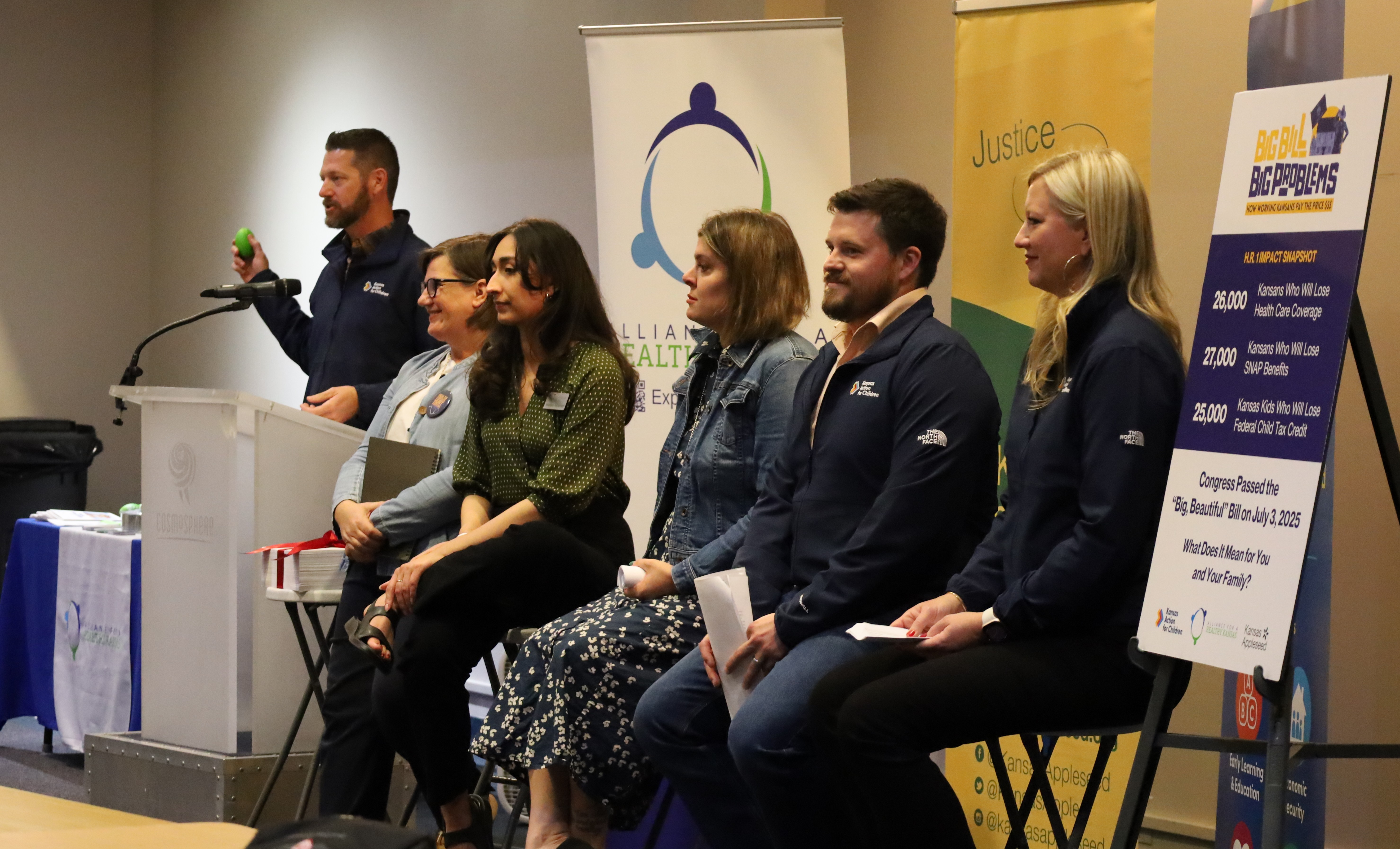
If you were able to join us in Garden City, Hutchinson, Iola, or Manhattan earlier this month to hear KAC, the Alliance for a Healthy Kansas, and Kansas Appleseed talk about H.R.1, thank you! Our groups walked away with heavy reminders of how public policy flows down to impacting individual lives.
Even with much of the bill set to be implemented over the next several months and years, we heard from Kansans who are already feeling the beginning shocks of Medicaid and SNAP cuts, as well as separate federal economic and immigration policies that are impacting everything from job losses to inflated grocery costs.
We shared more of our thoughts about the statewide tour with the Kansas Reflector in their recent podcast episode.
If you weren’t able to make it to one of the events, we have a recording of the Manhattan presentation here.
Other KAC Resources
Supplemental Poverty Measure. Last week, the Annie E. Casey Foundation released its “Supplemental Poverty Measure Data Snapshot” report, which highlights the role government programs play in reducing child poverty.
For instance, in 2021, with pandemic relief and an expanded Child Tax Credit, the Supplemental Poverty Measure (SPM) showed nationwide child poverty at 5% — the lowest rate on record. By 2024, it had nearly tripled to 13%, returning to pre-pandemic levels. Without key supports like tax credits, housing assistance and SNAP, child poverty would have reached 25%, adding 8.5 million more children in poverty. Read our analysis of Kansas SPM numbers here.
September Economic Data. Last month’s state revenues slightly missed the mark, bringing in $3.4 million less than previously expected. Additionally, with inflation for the Midwest region rising 3.1% over the year, the state economy could begin to see more concerning downward spending trends, spelling trouble for the state budget. According to one national economist, Kansas is currently experiencing a recession; however, it’ll be hard to tell how concrete that is until federal jobs data is released, which will be after the federal shutdown ends. Read more here.
Health Committee Recommendations. Three health-focused committees have met this interim to focus on several topics, from contract nursing to disability waiver waiting lists to AI chatbots being used by children for their mental health. We give a quick review of meeting topics and Committee recommendations here.
Task Force Looks at Special Education Funding. Continuing in our Education Funding Task Force blog series, we’ve reviewed the two-day May meeting, which focused on special education and how it’s funded differently from typical education expenses. If you’ve ever been curious about the school funding nuances to ensure all children receive a quality education, regardless of ability, this will be a foundational learning piece to read.
Share

